

substrate in tapping mode. In tapping-mode AFM, the tip is “tapped” on
the surface, placing it in contact with the surface only for a short amount
of time. This “tapping” is usually accomplished by oscillating the cantilever with constant driving force and ensuring that the cantilever is
positioned so that the tip touches the surface only at the bottom of the
oscillation. Typical frequencies of oscillation are on the order of a few
hundred kilohertz. By using tapping-mode AFM, surfaces that would
normally be destroyed are able to be imaged properly.
AFM can be used under water or on other liquids as well as in air, allowing
for imaging at solid–liquid interfaces. This ability is particularly important
for biological samples, which might be distorted at the surface-air boundary. One application of AFM in surface imaging is the detection of different functional groups on a surface, called chemical force microscopy
(CFM). In CFM, the AFM tip is chemically functionalized, often by coating
the tip with gold and then functionalizing it with a self-assembled
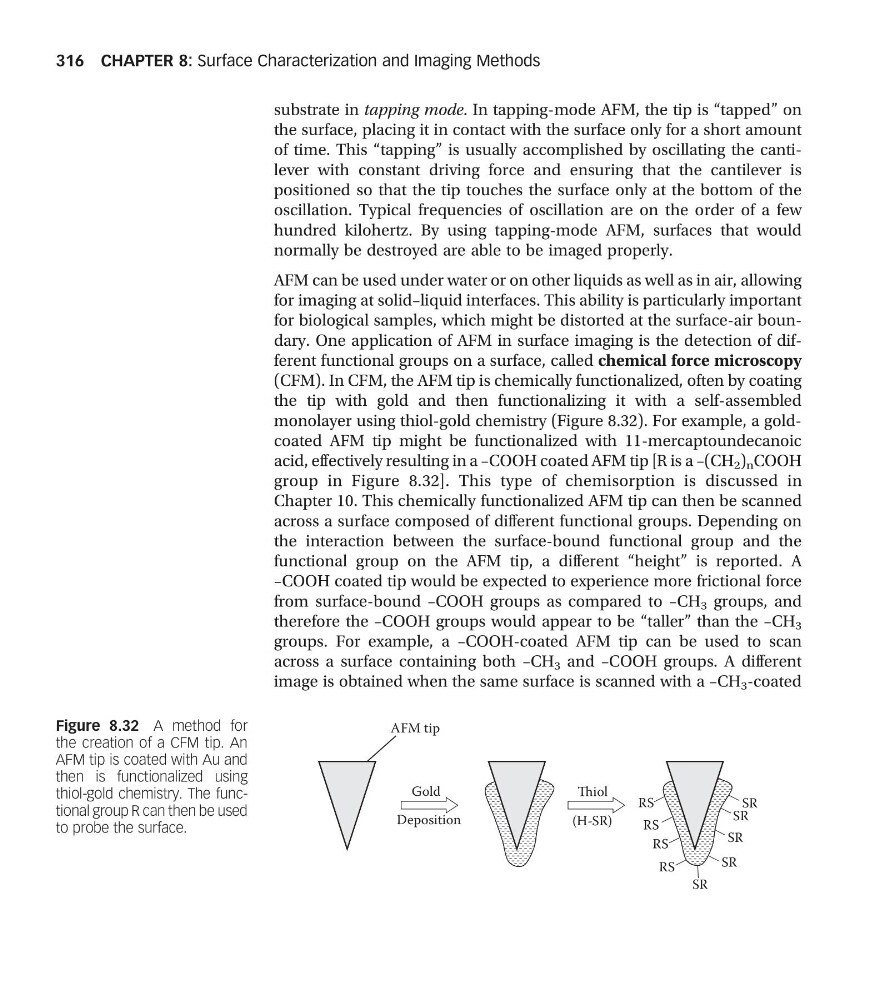
monolayer using thiol-gold chemistry (Figure 8.32). For example, a goldcoated AFM tip might be functionalized with 11-mercaptoundecanoic
acid, effectively resulting in a –COOH coated AFM tip [R is a –(CH 2 ) n COOH
group in Figure 8.32]. This type of chemisorption is discussed in
Chapter 10. This chemically functionalized AFM tip can then be scanned
across a surface composed of different functional groups. Depending on
the interaction between the surface-bound functional group and the
functional group on the AFM tip, a different “height” is reported. A
–COOH coated tip would be expected to experience more frictional force
from surface-bound –COOH groups as compared to –CH 3 groups, and
therefore the –COOH groups would appear to be “taller” than the –CH 3
groups. For example, a –COOH-coated AFM tip can be used to scan
across a surface containing both –CH 3 and –COOH groups. A different
image is obtained when the same surface is scanned with a –CH 3 -coated
AFM tip
RS
RS
SR
SR
Gold
Deposition
Thiol
RS
RS
SR
SR
SR
(H-SR)
Figure 8.32 A method for
the creation of a CFM tip. An
AFM tip is coated with Au and
then is functionalized using
thiol-gold chemistry. The functional group R can then be used
to probe the surface.
CHAPTER 8: Surface Characterization and Imaging Methods
316
the surface, placing it in contact with the surface only for a short amount
of time. This “tapping” is usually accomplished by oscillating the cantilever with constant driving force and ensuring that the cantilever is
positioned so that the tip touches the surface only at the bottom of the
oscillation. Typical frequencies of oscillation are on the order of a few
hundred kilohertz. By using tapping-mode AFM, surfaces that would
normally be destroyed are able to be imaged properly.
AFM can be used under water or on other liquids as well as in air, allowing
for imaging at solid–liquid interfaces. This ability is particularly important
for biological samples, which might be distorted at the surface-air boundary. One application of AFM in surface imaging is the detection of different functional groups on a surface, called chemical force microscopy
(CFM). In CFM, the AFM tip is chemically functionalized, often by coating
the tip with gold and then functionalizing it with a self-assembled
monolayer using thiol-gold chemistry (Figure 8.32). For example, a goldcoated AFM tip might be functionalized with 11-mercaptoundecanoic
acid, effectively resulting in a –COOH coated AFM tip [R is a –(CH 2 ) n COOH
group in Figure 8.32]. This type of chemisorption is discussed in
Chapter 10. This chemically functionalized AFM tip can then be scanned
across a surface composed of different functional groups. Depending on
the interaction between the surface-bound functional group and the
functional group on the AFM tip, a different “height” is reported. A
–COOH coated tip would be expected to experience more frictional force
from surface-bound –COOH groups as compared to –CH 3 groups, and
therefore the –COOH groups would appear to be “taller” than the –CH 3
groups. For example, a –COOH-coated AFM tip can be used to scan
across a surface containing both –CH 3 and –COOH groups. A different
image is obtained when the same surface is scanned with a –CH 3 -coated
AFM tip
RS
RS
SR
SR
Gold
Deposition
Thiol
RS
RS
SR
SR
SR
(H-SR)
Figure 8.32 A method for
the creation of a CFM tip. An
AFM tip is coated with Au and
then is functionalized using
thiol-gold chemistry. The functional group R can then be used
to probe the surface.
CHAPTER 8: Surface Characterization and Imaging Methods
316