

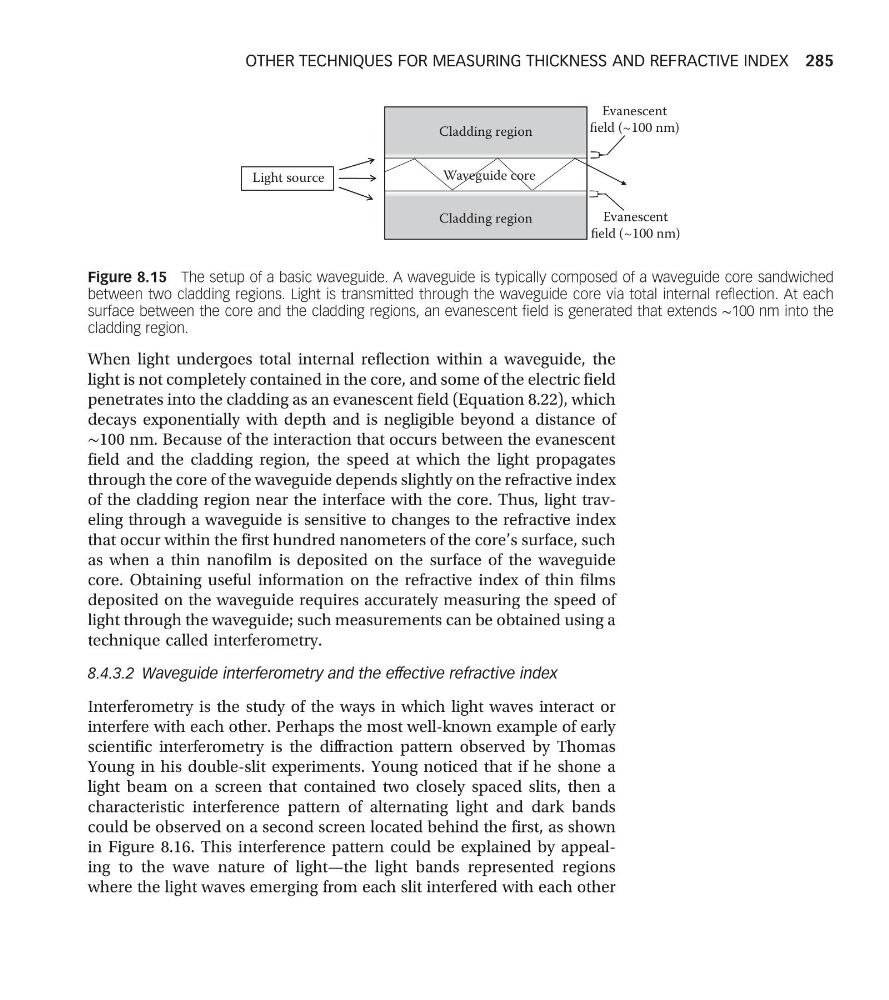
When light undergoes total internal reflection within a waveguide, the
light is not completely contained in the core, and some of the electric field
penetrates into the cladding as an evanescent field (Equation 8.22), which
decays exponentially with depth and is negligible beyond a distance of
∼100 nm. Because of the interaction that occurs between the evanescent
field and the cladding region, the speed at which the light propagates
through the core of the waveguide depends slightly on the refractive index
of the cladding region near the interface with the core. Thus, light traveling through a waveguide is sensitive to changes to the refractive index
that occur within the first hundred nanometers of the core’s surface, such
as when a thin nanofilm is deposited on the surface of the waveguide
core. Obtaining useful information on the refractive index of thin films
deposited on the waveguide requires accurately measuring the speed of
light through the waveguide; such measurements can be obtained using a
technique called interferometry.
8.4.3.2 Waveguide interferometry and the effective refractive index
Interferometry is the study of the ways in which light waves interact or
interfere with each other. Perhaps the most well-known example of early
scientific interferometry is the diffraction pattern observed by Thomas
Young in his double-slit experiments. Young noticed that if he shone a
light beam on a screen that contained two closely spaced slits, then a
characteristic interference pattern of alternating light and dark bands
could be observed on a second screen located behind the first, as shown
in Figure 8.16. This interference pattern could be explained by appealing to the wave nature of light—the light bands represented regions
where the light waves emerging from each slit interfered with each other
Evanescent
field (~100 nm)
Cladding region
Light source
Evanescent
field (~100 nm)
Cladding region
Waveguide core
Figure 8.15 The setup of a basic waveguide. A waveguide is typically composed of a waveguide core sandwiched
between two cladding regions. Light is transmitted through the waveguide core via total internal reflection. At each
surface between the core and the cladding regions, an evanescent field is generated that extends ∼100 nm into the
cladding region.
OTHER TECHNIQUES FOR MEASURING THICKNESS AND REFRACTIVE INDEX 285
light is not completely contained in the core, and some of the electric field
penetrates into the cladding as an evanescent field (Equation 8.22), which
decays exponentially with depth and is negligible beyond a distance of
∼100 nm. Because of the interaction that occurs between the evanescent
field and the cladding region, the speed at which the light propagates
through the core of the waveguide depends slightly on the refractive index
of the cladding region near the interface with the core. Thus, light traveling through a waveguide is sensitive to changes to the refractive index
that occur within the first hundred nanometers of the core’s surface, such
as when a thin nanofilm is deposited on the surface of the waveguide
core. Obtaining useful information on the refractive index of thin films
deposited on the waveguide requires accurately measuring the speed of
light through the waveguide; such measurements can be obtained using a
technique called interferometry.
8.4.3.2 Waveguide interferometry and the effective refractive index
Interferometry is the study of the ways in which light waves interact or
interfere with each other. Perhaps the most well-known example of early
scientific interferometry is the diffraction pattern observed by Thomas
Young in his double-slit experiments. Young noticed that if he shone a
light beam on a screen that contained two closely spaced slits, then a
characteristic interference pattern of alternating light and dark bands
could be observed on a second screen located behind the first, as shown
in Figure 8.16. This interference pattern could be explained by appealing to the wave nature of light—the light bands represented regions
where the light waves emerging from each slit interfered with each other
Evanescent
field (~100 nm)
Cladding region
Light source
Evanescent
field (~100 nm)
Cladding region
Waveguide core
Figure 8.15 The setup of a basic waveguide. A waveguide is typically composed of a waveguide core sandwiched
between two cladding regions. Light is transmitted through the waveguide core via total internal reflection. At each
surface between the core and the cladding regions, an evanescent field is generated that extends ∼100 nm into the
cladding region.
OTHER TECHNIQUES FOR MEASURING THICKNESS AND REFRACTIVE INDEX 285