

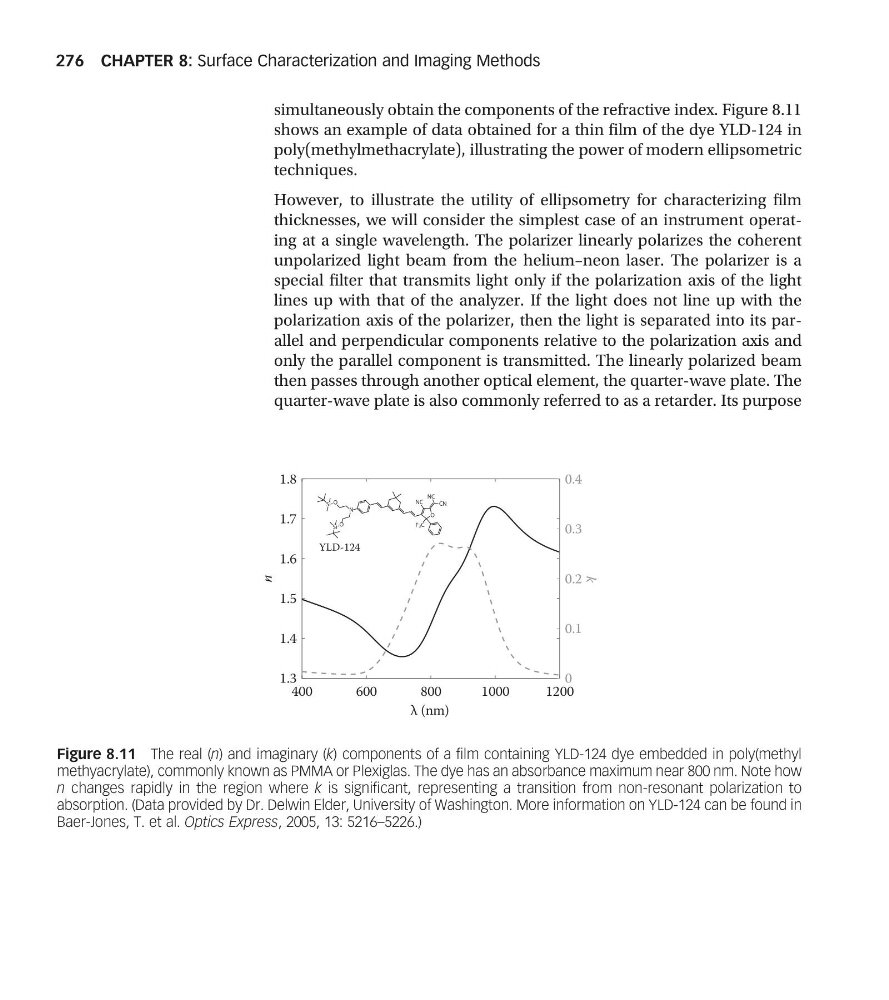
simultaneously obtain the components of the refractive index. Figure 8.11
shows an example of data obtained for a thin film of the dye YLD-124 in
poly(methylmethacrylate), illustrating the power of modern ellipsometric
techniques.
However, to illustrate the utility of ellipsometry for characterizing film
thicknesses, we will consider the simplest case of an instrument operating at a single wavelength. The polarizer linearly polarizes the coherent
unpolarized light beam from the helium–neon laser. The polarizer is a
special filter that transmits light only if the polarization axis of the light
lines up with that of the analyzer. If the light does not line up with the
polarization axis of the polarizer, then the light is separated into its parallel and perpendicular components relative to the polarization axis and
only the parallel component is transmitted. The linearly polarized beam
then passes through another optical element, the quarter-wave plate. The
quarter-wave plate is also commonly referred to as a retarder. Its purpose
400
600
800
1000
1200
λ (nm)
1.3
1.4
1.5
1.6
1.7
1.8
n
0
0.1
0.2
0.3
0.4
k
YLD-124
Si
Si
O
O
NC
NC
CN
O
F3C
N
Figure 8.11 The real (n) and imaginary (k) components of a film containing YLD-124 dye embedded in poly(methyl
methyacrylate), commonly known as PMMA or Plexiglas. The dye has an absorbance maximum near 800 nm. Note how
n changes rapidly in the region where k is significant, representing a transition from non-resonant polarization to
absorption. (Data provided by Dr. Delwin Elder, University of Washington. More information on YLD-124 can be found in
Baer-Jones, T. et al. Optics Express, 2005, 13: 5216–5226.)
CHAPTER 8: Surface Characterization and Imaging Methods
276
shows an example of data obtained for a thin film of the dye YLD-124 in
poly(methylmethacrylate), illustrating the power of modern ellipsometric
techniques.
However, to illustrate the utility of ellipsometry for characterizing film
thicknesses, we will consider the simplest case of an instrument operating at a single wavelength. The polarizer linearly polarizes the coherent
unpolarized light beam from the helium–neon laser. The polarizer is a
special filter that transmits light only if the polarization axis of the light
lines up with that of the analyzer. If the light does not line up with the
polarization axis of the polarizer, then the light is separated into its parallel and perpendicular components relative to the polarization axis and
only the parallel component is transmitted. The linearly polarized beam
then passes through another optical element, the quarter-wave plate. The
quarter-wave plate is also commonly referred to as a retarder. Its purpose
400
600
800
1000
1200
λ (nm)
1.3
1.4
1.5
1.6
1.7
1.8
n
0
0.1
0.2
0.3
0.4
k
YLD-124
Si
Si
O
O
NC
NC
CN
O
F3C
N
Figure 8.11 The real (n) and imaginary (k) components of a film containing YLD-124 dye embedded in poly(methyl
methyacrylate), commonly known as PMMA or Plexiglas. The dye has an absorbance maximum near 800 nm. Note how
n changes rapidly in the region where k is significant, representing a transition from non-resonant polarization to
absorption. (Data provided by Dr. Delwin Elder, University of Washington. More information on YLD-124 can be found in
Baer-Jones, T. et al. Optics Express, 2005, 13: 5216–5226.)
CHAPTER 8: Surface Characterization and Imaging Methods
276