

for adsorption per unit mass of adsorbent. Usually the amount of solute
adsorbed from solution per unit mass of adsorbent depends on the solute
bulk concentration up to its saturation point. As well, the amount
adsorbed per unit mass of adsorbent for a given solute bulk concentration
decreases with increasing temperature. If the adsorption is physical, it is
reversible and the solute leaves the surface of the adsorbent to reestablish
equilibrium when the adsorbent is removed from a solution in equilibrium and placed in a solution of lower concentration. Such reversibility
may not be shown if the process is chemisorption. The following section
describes how adsorption capacity can be measured and how information, such as monolayer coverage and substrate surface area, can be
extracted by measuring the adsorption capacity.
7.2.1 Simple adsorption isotherms
An adsorption isotherm is a mathematical relationship between surface
coverage (i.e., the fraction of the adsorbent surface covered by the
adsorbate) versus the bulk concentration of the adsorbate. The “isotherm” term means that these measurements are carried out at constant
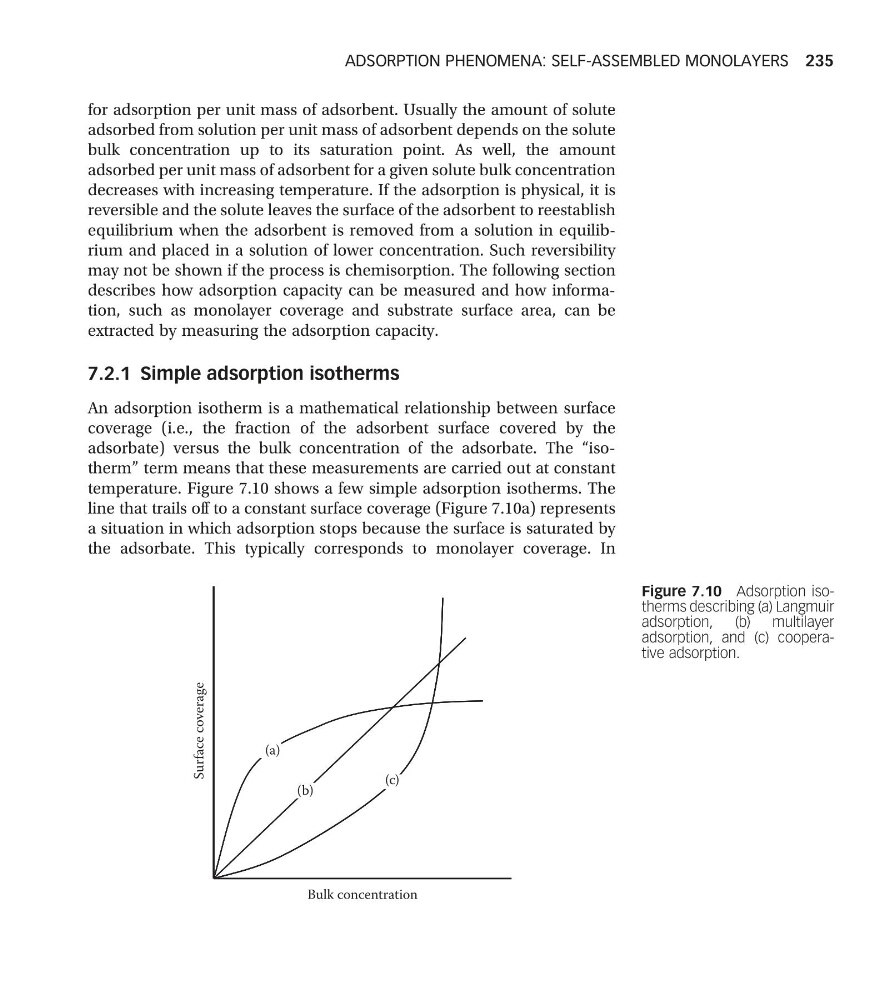
temperature. Figure 7.10 shows a few simple adsorption isotherms. The
line that trails off to a constant surface coverage (Figure 7.10a) represents
a situation in which adsorption stops because the surface is saturated by
the adsorbate. This typically corresponds to monolayer coverage. In
Surface coverage
(a)
(b)
(c)
Bulk concentration
Figure 7.10 Adsorption isotherms describing (a) Langmuir
adsorption,
(b) multilayer
adsorption, and (c) cooperative adsorption.
ADSORPTION PHENOMENA: SELF-ASSEMBLED MONOLAYERS 235
adsorbed from solution per unit mass of adsorbent depends on the solute
bulk concentration up to its saturation point. As well, the amount
adsorbed per unit mass of adsorbent for a given solute bulk concentration
decreases with increasing temperature. If the adsorption is physical, it is
reversible and the solute leaves the surface of the adsorbent to reestablish
equilibrium when the adsorbent is removed from a solution in equilibrium and placed in a solution of lower concentration. Such reversibility
may not be shown if the process is chemisorption. The following section
describes how adsorption capacity can be measured and how information, such as monolayer coverage and substrate surface area, can be
extracted by measuring the adsorption capacity.
7.2.1 Simple adsorption isotherms
An adsorption isotherm is a mathematical relationship between surface
coverage (i.e., the fraction of the adsorbent surface covered by the
adsorbate) versus the bulk concentration of the adsorbate. The “isotherm” term means that these measurements are carried out at constant
temperature. Figure 7.10 shows a few simple adsorption isotherms. The
line that trails off to a constant surface coverage (Figure 7.10a) represents
a situation in which adsorption stops because the surface is saturated by
the adsorbate. This typically corresponds to monolayer coverage. In
Surface coverage
(a)
(b)
(c)
Bulk concentration
Figure 7.10 Adsorption isotherms describing (a) Langmuir
adsorption,
(b) multilayer
adsorption, and (c) cooperative adsorption.
ADSORPTION PHENOMENA: SELF-ASSEMBLED MONOLAYERS 235