

θ
dsinθ
d
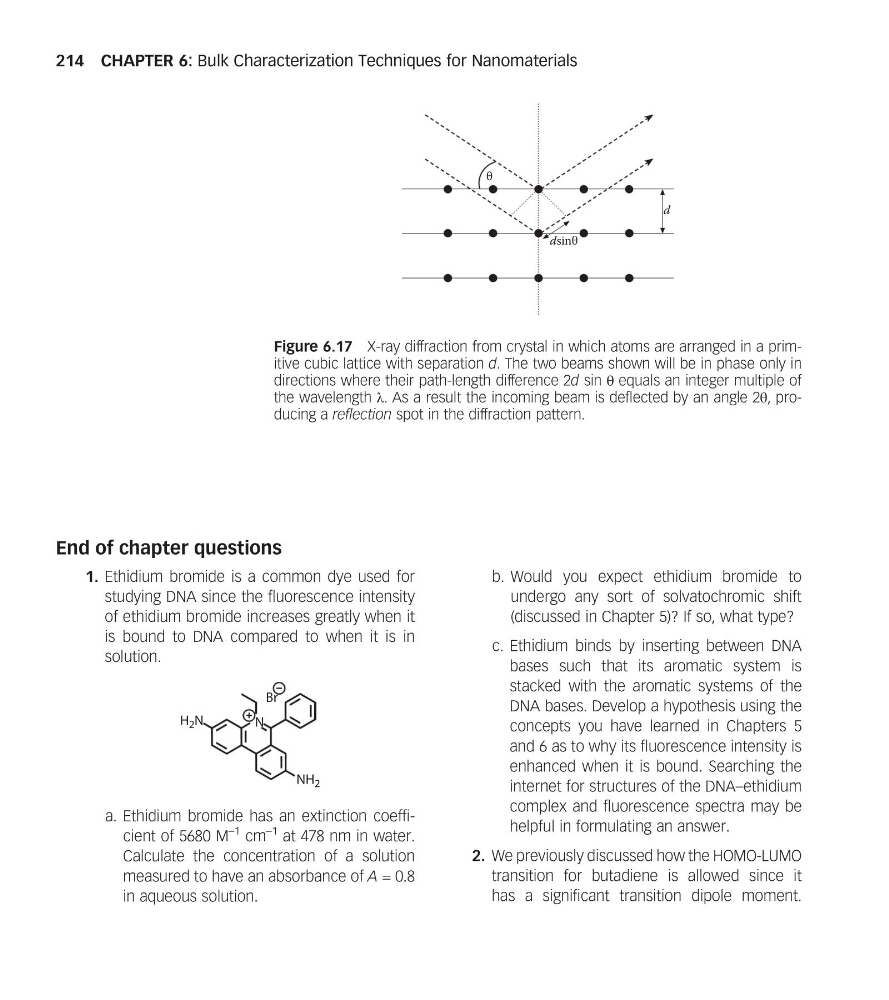
Figure 6.17 X-ray diffraction from crystal in which atoms are arranged in a primitive cubic lattice with separation d. The two beams shown will be in phase only in
directions where their path-length difference 2d sin θ equals an integer multiple of
the wavelength λ. As a result the incoming beam is deflected by an angle 2θ, producing a reflection spot in the diffraction pattern.
End of chapter questions
1. Ethidium bromide is a common dye used for
studying DNA since the fluorescence intensity
of ethidium bromide increases greatly when it
is bound to DNA compared to when it is in
solution.
Br
H 2 N
NH 2
N
a. Ethidium bromide has an extinction coefficient of 5680 M
–1 cm
–1 at 478 nm in water.
Calculate the concentration of a solution
measured to have an absorbance of A = 0.8
in aqueous solution.
b. Would you expect ethidium bromide to
undergo any sort of solvatochromic shift
(discussed in Chapter 5)? If so, what type?
c. Ethidium binds by inserting between DNA
bases such that its aromatic system is
stacked with the aromatic systems of the
DNA bases. Develop a hypothesis using the
concepts you have learned in Chapters 5
and 6 as to why its fluorescence intensity is
enhanced when it is bound. Searching the
internet for structures of the DNA–ethidium
complex and fluorescence spectra may be
helpful in formulating an answer.
2. We previously discussed how the HOMO-LUMO
transition for butadiene is allowed since it
has a significant transition dipole moment.
CHAPTER 6: Bulk Characterization Techniques for Nanomaterials
214
dsinθ
d
Figure 6.17 X-ray diffraction from crystal in which atoms are arranged in a primitive cubic lattice with separation d. The two beams shown will be in phase only in
directions where their path-length difference 2d sin θ equals an integer multiple of
the wavelength λ. As a result the incoming beam is deflected by an angle 2θ, producing a reflection spot in the diffraction pattern.
End of chapter questions
1. Ethidium bromide is a common dye used for
studying DNA since the fluorescence intensity
of ethidium bromide increases greatly when it
is bound to DNA compared to when it is in
solution.
Br
H 2 N
NH 2
N
a. Ethidium bromide has an extinction coefficient of 5680 M
–1 cm
–1 at 478 nm in water.
Calculate the concentration of a solution
measured to have an absorbance of A = 0.8
in aqueous solution.
b. Would you expect ethidium bromide to
undergo any sort of solvatochromic shift
(discussed in Chapter 5)? If so, what type?
c. Ethidium binds by inserting between DNA
bases such that its aromatic system is
stacked with the aromatic systems of the
DNA bases. Develop a hypothesis using the
concepts you have learned in Chapters 5
and 6 as to why its fluorescence intensity is
enhanced when it is bound. Searching the
internet for structures of the DNA–ethidium
complex and fluorescence spectra may be
helpful in formulating an answer.
2. We previously discussed how the HOMO-LUMO
transition for butadiene is allowed since it
has a significant transition dipole moment.
CHAPTER 6: Bulk Characterization Techniques for Nanomaterials
214