

derivative of poly(phenylene vinylene) (PPV), and such materials are
being developed for applications in nanophotovoltaics.
As discussed previously (Section 6.1.1), there are several alternative
relaxation processes that may occur in lieu of fluorescence, such as nonradiative relaxation and intersystem crossing. Furthermore, reabsorption
of the fluorescent photon by a neighboring fluorophore may occur,
especially at higher concentrations of fluorophore. Therefore, it is convenient to define a parameter that represents how often a given fluorophore
successfully emits a fluorescent photon. Fluorescence quantum yield (F f )
is the usual measure of such a parameter and is defined as the ratio of
photons absorbed to photons emitted for a given fluorescing species. The
correct determination of F f is especially important in the characterization
of certain emissive nanomaterials such as those designed for photoluminescent devices.
Determination of F f for a given material A can normally be accomplished
in a rather straightforward manner by comparison with a standard
material of known quantum yield F std according to
F fa = F std
g a n
2
a
g std n
2
std
(6.12)
120
0.18
0.20
(a)
(b)
80
100
0.14
0.16
40
60
0.06
0.08
0.10
0.12
Absorbance
0
20
0.00
0.02
0.04
Fluorescence intensity
350
450
550
650
750
Wavelength (nm)
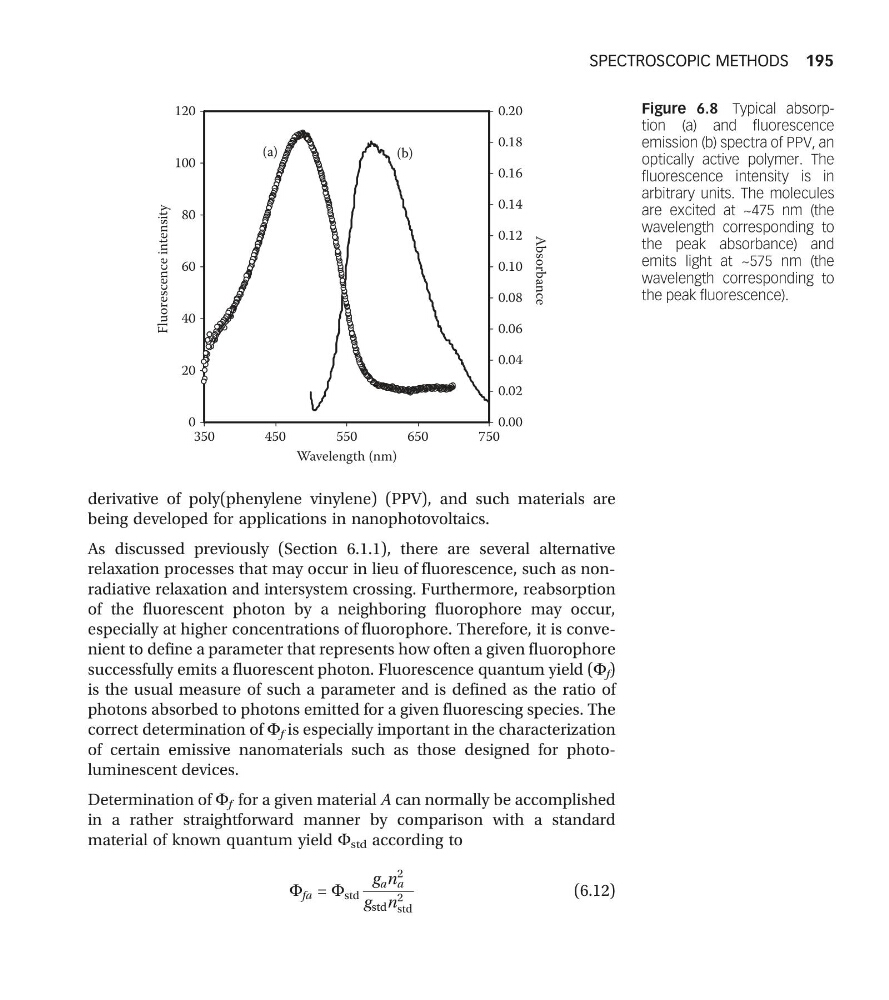
Figure 6.8 Typical absorption (a) and fluorescence
emission (b) spectra of PPV, an
optically active polymer. The
fluorescence intensity is in
arbitrary units. The molecules
are excited at ~475 nm (the
wavelength corresponding to
the peak absorbance) and
emits light at ~575 nm (the
wavelength corresponding to
the peak fluorescence).
SPECTROSCOPIC METHODS 195
being developed for applications in nanophotovoltaics.
As discussed previously (Section 6.1.1), there are several alternative
relaxation processes that may occur in lieu of fluorescence, such as nonradiative relaxation and intersystem crossing. Furthermore, reabsorption
of the fluorescent photon by a neighboring fluorophore may occur,
especially at higher concentrations of fluorophore. Therefore, it is convenient to define a parameter that represents how often a given fluorophore
successfully emits a fluorescent photon. Fluorescence quantum yield (F f )
is the usual measure of such a parameter and is defined as the ratio of
photons absorbed to photons emitted for a given fluorescing species. The
correct determination of F f is especially important in the characterization
of certain emissive nanomaterials such as those designed for photoluminescent devices.
Determination of F f for a given material A can normally be accomplished
in a rather straightforward manner by comparison with a standard
material of known quantum yield F std according to
F fa = F std
g a n
2
a
g std n
2
std
(6.12)
120
0.18
0.20
(a)
(b)
80
100
0.14
0.16
40
60
0.06
0.08
0.10
0.12
Absorbance
0
20
0.00
0.02
0.04
Fluorescence intensity
350
450
550
650
750
Wavelength (nm)
Figure 6.8 Typical absorption (a) and fluorescence
emission (b) spectra of PPV, an
optically active polymer. The
fluorescence intensity is in
arbitrary units. The molecules
are excited at ~475 nm (the
wavelength corresponding to
the peak absorbance) and
emits light at ~575 nm (the
wavelength corresponding to
the peak fluorescence).
SPECTROSCOPIC METHODS 195