

the methods used to fabricate the multilayers in Chapter 9. About 1-nmthick layers of PEI and PAZO can be constructed on a glass substrate in a
layer-by-layer fashion. These layers are held together by strong electrostatic interactions between the positively charged PEI and the negatively
charged PAZO. Each PEI and PAZO pair in the film can be described as a
“bilayer.” Figure 6.6b shows a UV–vis spectrum of a PEI and PAZO
multilayer film as a function of the bilayer number. Only the absorbance
value at ~360 nm is shown. In this range, only the chromophores associated with PAZO are able to absorb light (centered at a wavelength of
360 nm). The PEI is essentially transparent at visible and longer UV
wavelengths, and therefore the increase in the absorbance in Figure 6.6b
reflects the increase in the amount of total PAZO in the film after each
bilayer.
Example 6.1 Determining Absorbance Values
Estimate the slope of the line in the graph shown in Figure 6.6 and
use it to predict an absorbance value of a film composed of 15
bilayers. How would you determine the concentration of PAZO in
the film from the PAZO’s molar absorptivity? What other technique
would be useful in this determination?
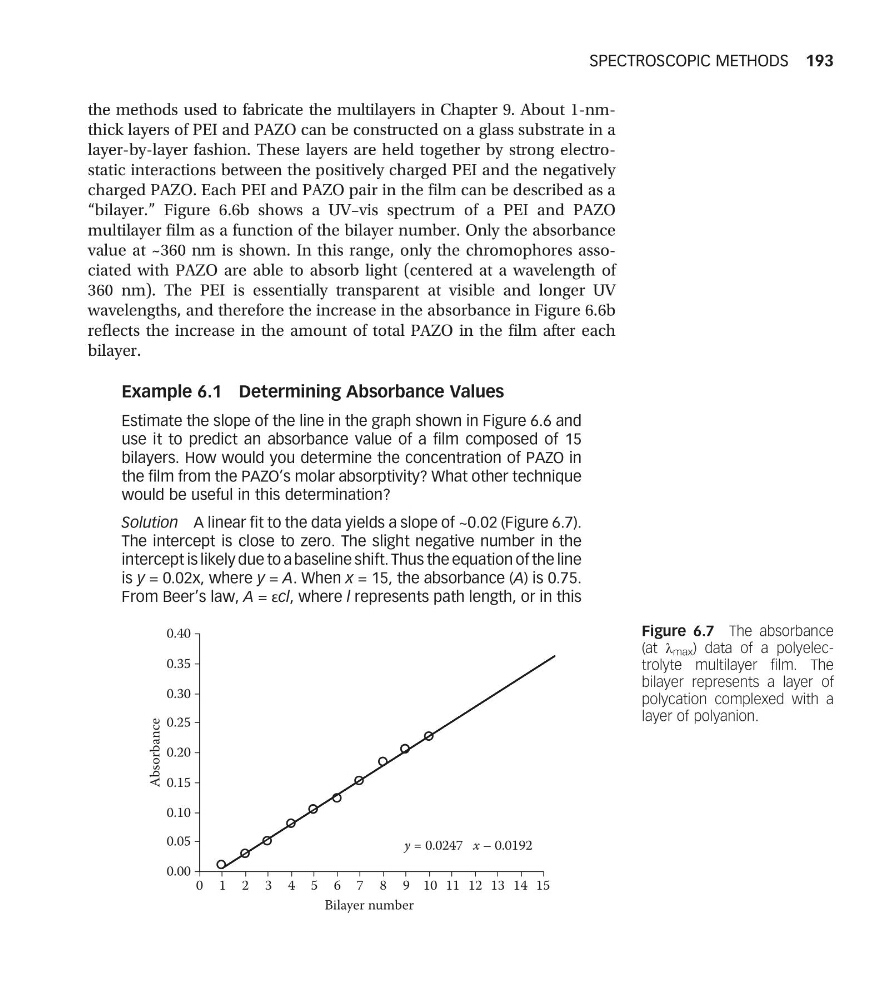
Solution A linear fit to the data yields a slope of ~0.02 (Figure 6.7).
The intercept is close to zero. The slight negative number in the
intercept is likely due to a baseline shift. Thus the equation of the line
is y = 0.02x, where y = A. When x = 15, the absorbance (A) is 0.75.
From Beer’s law, A = εcl, where l represents path length, or in this
0.35
0.40
0.25
0.30
0.15
0.20
Absorbance
y = 0.0247 x – 0.0192
0.00
0.05
0.10
0 1 2 3 4 5 6 7 8 9 10 11 12 13 14 15
Bilayer number
Figure 6.7 The absorbance
(at λ max ) data of a polyelectrolyte multilayer film. The
bilayer represents a layer of
polycation complexed with a
layer of polyanion.
SPECTROSCOPIC METHODS 193
layer-by-layer fashion. These layers are held together by strong electrostatic interactions between the positively charged PEI and the negatively
charged PAZO. Each PEI and PAZO pair in the film can be described as a
“bilayer.” Figure 6.6b shows a UV–vis spectrum of a PEI and PAZO
multilayer film as a function of the bilayer number. Only the absorbance
value at ~360 nm is shown. In this range, only the chromophores associated with PAZO are able to absorb light (centered at a wavelength of
360 nm). The PEI is essentially transparent at visible and longer UV
wavelengths, and therefore the increase in the absorbance in Figure 6.6b
reflects the increase in the amount of total PAZO in the film after each
bilayer.
Example 6.1 Determining Absorbance Values
Estimate the slope of the line in the graph shown in Figure 6.6 and
use it to predict an absorbance value of a film composed of 15
bilayers. How would you determine the concentration of PAZO in
the film from the PAZO’s molar absorptivity? What other technique
would be useful in this determination?
Solution A linear fit to the data yields a slope of ~0.02 (Figure 6.7).
The intercept is close to zero. The slight negative number in the
intercept is likely due to a baseline shift. Thus the equation of the line
is y = 0.02x, where y = A. When x = 15, the absorbance (A) is 0.75.
From Beer’s law, A = εcl, where l represents path length, or in this
0.35
0.40
0.25
0.30
0.15
0.20
Absorbance
y = 0.0247 x – 0.0192
0.00
0.05
0.10
0 1 2 3 4 5 6 7 8 9 10 11 12 13 14 15
Bilayer number
Figure 6.7 The absorbance
(at λ max ) data of a polyelectrolyte multilayer film. The
bilayer represents a layer of
polycation complexed with a
layer of polyanion.
SPECTROSCOPIC METHODS 193