

Here, the real component, n, is the refractive index that we’ve previously introduced (and typically called the refractive index). The imaginary component, k, is known as the extinction index and represents
absorption.
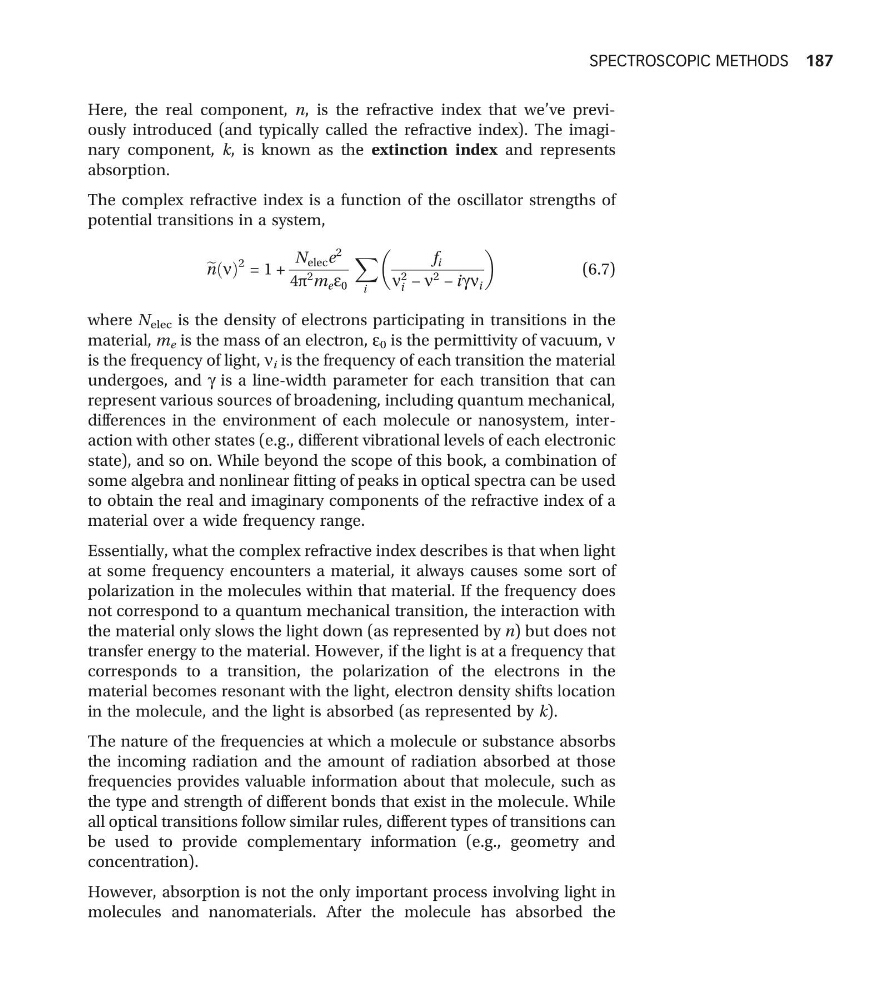
The complex refractive index is a function of the oscillator strengths of
potential transitions in a system,
e
n n
ð Þ
2 = 1 +
N elec e
2
4π 2 m e e 0
X
i
f i
n 2
i − n 2 − ign i
(6.7)
where N elec is the density of electrons participating in transitions in the
material, m e is the mass of an electron, e 0 is the permittivity of vacuum, n
is the frequency of light, n i is the frequency of each transition the material
undergoes, and g is a line-width parameter for each transition that can
represent various sources of broadening, including quantum mechanical,
differences in the environment of each molecule or nanosystem, interaction with other states (e.g., different vibrational levels of each electronic
state), and so on. While beyond the scope of this book, a combination of
some algebra and nonlinear fitting of peaks in optical spectra can be used
to obtain the real and imaginary components of the refractive index of a
material over a wide frequency range.
Essentially, what the complex refractive index describes is that when light
at some frequency encounters a material, it always causes some sort of
polarization in the molecules within that material. If the frequency does
not correspond to a quantum mechanical transition, the interaction with
the material only slows the light down (as represented by n) but does not
transfer energy to the material. However, if the light is at a frequency that
corresponds to a transition, the polarization of the electrons in the
material becomes resonant with the light, electron density shifts location
in the molecule, and the light is absorbed (as represented by k).
The nature of the frequencies at which a molecule or substance absorbs
the incoming radiation and the amount of radiation absorbed at those
frequencies provides valuable information about that molecule, such as
the type and strength of different bonds that exist in the molecule. While
all optical transitions follow similar rules, different types of transitions can
be used to provide complementary information (e.g., geometry and
concentration).
However, absorption is not the only important process involving light in
molecules and nanomaterials. After the molecule has absorbed the
SPECTROSCOPIC METHODS 187
absorption.
The complex refractive index is a function of the oscillator strengths of
potential transitions in a system,
e
n n
ð Þ
2 = 1 +
N elec e
2
4π 2 m e e 0
X
i
f i
n 2
i − n 2 − ign i
(6.7)
where N elec is the density of electrons participating in transitions in the
material, m e is the mass of an electron, e 0 is the permittivity of vacuum, n
is the frequency of light, n i is the frequency of each transition the material
undergoes, and g is a line-width parameter for each transition that can
represent various sources of broadening, including quantum mechanical,
differences in the environment of each molecule or nanosystem, interaction with other states (e.g., different vibrational levels of each electronic
state), and so on. While beyond the scope of this book, a combination of
some algebra and nonlinear fitting of peaks in optical spectra can be used
to obtain the real and imaginary components of the refractive index of a
material over a wide frequency range.
Essentially, what the complex refractive index describes is that when light
at some frequency encounters a material, it always causes some sort of
polarization in the molecules within that material. If the frequency does
not correspond to a quantum mechanical transition, the interaction with
the material only slows the light down (as represented by n) but does not
transfer energy to the material. However, if the light is at a frequency that
corresponds to a transition, the polarization of the electrons in the
material becomes resonant with the light, electron density shifts location
in the molecule, and the light is absorbed (as represented by k).
The nature of the frequencies at which a molecule or substance absorbs
the incoming radiation and the amount of radiation absorbed at those
frequencies provides valuable information about that molecule, such as
the type and strength of different bonds that exist in the molecule. While
all optical transitions follow similar rules, different types of transitions can
be used to provide complementary information (e.g., geometry and
concentration).
However, absorption is not the only important process involving light in
molecules and nanomaterials. After the molecule has absorbed the
SPECTROSCOPIC METHODS 187