

will experience with other identical molecules
based on its structure, and (b) briefly explain
how these interactions and/or molecular shape
could lead to the Onsager model producing a
good or poor estimate of the dielectric constant.
8. Use the particle-in-a-box model to predict the
values of ΔE and the corresponding values of
λ max for the conjugated linear hydrocarbons
shown in Figure 5.21. Assume the C–C bond
length is 154 pm and the C=C bond length is
134 pm.
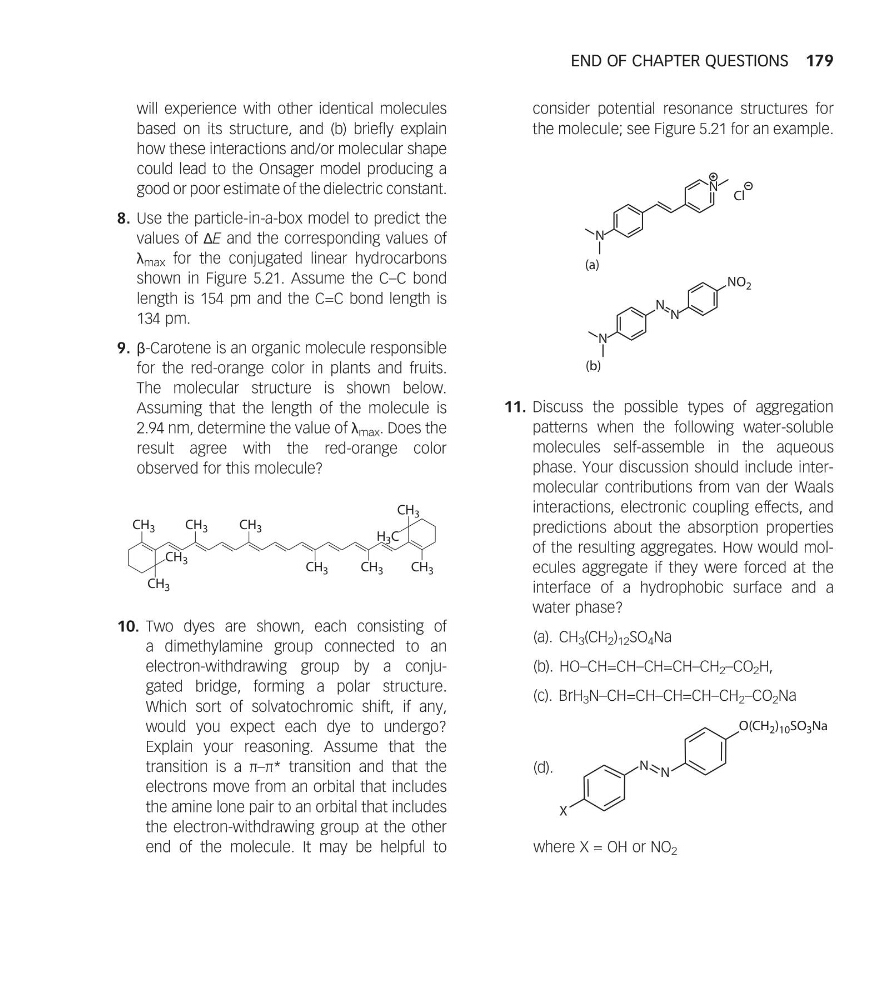
9. β-Carotene is an organic molecule responsible
for the red-orange color in plants and fruits.
The molecular structure is shown below.
Assuming that the length of the molecule is
2.94 nm, determine the value of λ max . Does the
result agree with the red-orange color
observed for this molecule?
CH 3
CH 3
CH 3
CH 3
CH 3
CH 3
CH 3
CH 3
CH 3
H 3 C
10. Two dyes are shown, each consisting of
a dimethylamine group connected to an
electron-withdrawing group by a conjugated bridge, forming a polar structure.
Which sort of solvatochromic shift, if any,
would you expect each dye to undergo?
Explain your reasoning. Assume that the
transition is a π–π* transition and that the
electrons move from an orbital that includes
the amine lone pair to an orbital that includes
the electron-withdrawing group at the other
end of the molecule. It may be helpful to
consider potential resonance structures for
the molecule; see Figure 5.21 for an example.
N
N
NO 2
N N
N Cl
(a)
(b)
11. Discuss the possible types of aggregation
patterns when the following water-soluble
molecules self-assemble in the aqueous
phase. Your discussion should include intermolecular contributions from van der Waals
interactions, electronic coupling effects, and
predictions about the absorption properties
of the resulting aggregates. How would molecules aggregate if they were forced at the
interface of a hydrophobic surface and a
water phase?
(a). CH 3 (CH 2 ) 12 SO 4 Na
(b). HO–CH=CH–CH=CH–CH 2 –CO 2 H,
(c). BrH 3 N–CH=CH–CH=CH–CH 2 –CO 2 Na
(d).
N N
X
O(CH 2 ) 10 SO 3 Na
where X = OH or NO 2
END OF CHAPTER QUESTIONS 179
based on its structure, and (b) briefly explain
how these interactions and/or molecular shape
could lead to the Onsager model producing a
good or poor estimate of the dielectric constant.
8. Use the particle-in-a-box model to predict the
values of ΔE and the corresponding values of
λ max for the conjugated linear hydrocarbons
shown in Figure 5.21. Assume the C–C bond
length is 154 pm and the C=C bond length is
134 pm.
9. β-Carotene is an organic molecule responsible
for the red-orange color in plants and fruits.
The molecular structure is shown below.
Assuming that the length of the molecule is
2.94 nm, determine the value of λ max . Does the
result agree with the red-orange color
observed for this molecule?
CH 3
CH 3
CH 3
CH 3
CH 3
CH 3
CH 3
CH 3
CH 3
H 3 C
10. Two dyes are shown, each consisting of
a dimethylamine group connected to an
electron-withdrawing group by a conjugated bridge, forming a polar structure.
Which sort of solvatochromic shift, if any,
would you expect each dye to undergo?
Explain your reasoning. Assume that the
transition is a π–π* transition and that the
electrons move from an orbital that includes
the amine lone pair to an orbital that includes
the electron-withdrawing group at the other
end of the molecule. It may be helpful to
consider potential resonance structures for
the molecule; see Figure 5.21 for an example.
N
N
NO 2
N N
N Cl
(a)
(b)
11. Discuss the possible types of aggregation
patterns when the following water-soluble
molecules self-assemble in the aqueous
phase. Your discussion should include intermolecular contributions from van der Waals
interactions, electronic coupling effects, and
predictions about the absorption properties
of the resulting aggregates. How would molecules aggregate if they were forced at the
interface of a hydrophobic surface and a
water phase?
(a). CH 3 (CH 2 ) 12 SO 4 Na
(b). HO–CH=CH–CH=CH–CH 2 –CO 2 H,
(c). BrH 3 N–CH=CH–CH=CH–CH 2 –CO 2 Na
(d).
N N
X
O(CH 2 ) 10 SO 3 Na
where X = OH or NO 2
END OF CHAPTER QUESTIONS 179