

5.4.4 Aggregation and electronic structure
Molecular aggregates have electronic and spectroscopic properties that
may be considerably different from the monomer. Consider a conjugated
molecule that contains a dipole moment. We can represent this molecular
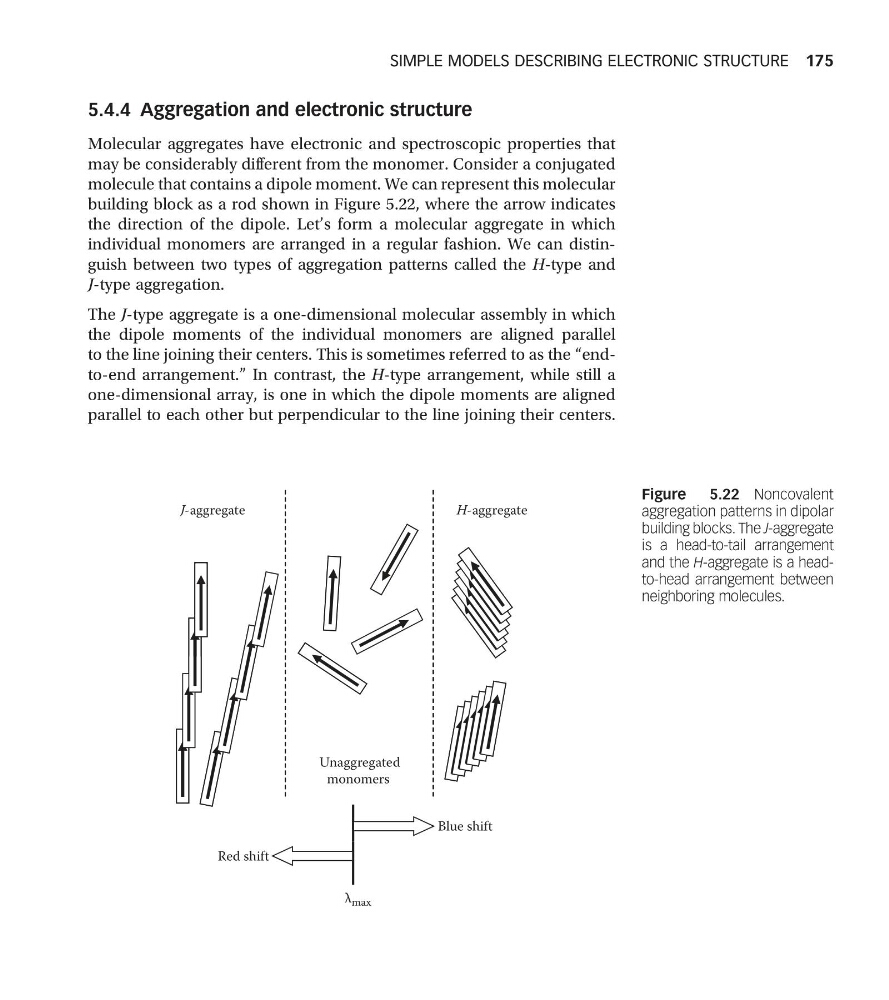
building block as a rod shown in Figure 5.22, where the arrow indicates
the direction of the dipole. Let’s form a molecular aggregate in which
individual monomers are arranged in a regular fashion. We can distinguish between two types of aggregation patterns called the H-type and
J-type aggregation.
The J-type aggregate is a one-dimensional molecular assembly in which
the dipole moments of the individual monomers are aligned parallel
to the line joining their centers. This is sometimes referred to as the “endto-end arrangement.” In contrast, the H-type arrangement, while still a
one-dimensional array, is one in which the dipole moments are aligned
parallel to each other but perpendicular to the line joining their centers.
J-aggregate
H-aggregate
Unaggregated
monomers
Blue shift
λ max
Red shift
Figure
5.22 Noncovalent
aggregation patterns in dipolar
building blocks. The J-aggregate
is a head-to-tail arrangement
and the H-aggregate is a headto-head arrangement between
neighboring molecules.
SIMPLE MODELS DESCRIBING ELECTRONIC STRUCTURE 175
Molecular aggregates have electronic and spectroscopic properties that
may be considerably different from the monomer. Consider a conjugated
molecule that contains a dipole moment. We can represent this molecular
building block as a rod shown in Figure 5.22, where the arrow indicates
the direction of the dipole. Let’s form a molecular aggregate in which
individual monomers are arranged in a regular fashion. We can distinguish between two types of aggregation patterns called the H-type and
J-type aggregation.
The J-type aggregate is a one-dimensional molecular assembly in which
the dipole moments of the individual monomers are aligned parallel
to the line joining their centers. This is sometimes referred to as the “endto-end arrangement.” In contrast, the H-type arrangement, while still a
one-dimensional array, is one in which the dipole moments are aligned
parallel to each other but perpendicular to the line joining their centers.
J-aggregate
H-aggregate
Unaggregated
monomers
Blue shift
λ max
Red shift
Figure
5.22 Noncovalent
aggregation patterns in dipolar
building blocks. The J-aggregate
is a head-to-tail arrangement
and the H-aggregate is a headto-head arrangement between
neighboring molecules.
SIMPLE MODELS DESCRIBING ELECTRONIC STRUCTURE 175