

and the wavelength at which the molecule is excited will become shorter
(blue-shifted). This is called a hypsochromic shift.
The general phenomenon of the wavelength at which a molecule or
nanosystem is excited at shifting due to changes in solvent polarity is
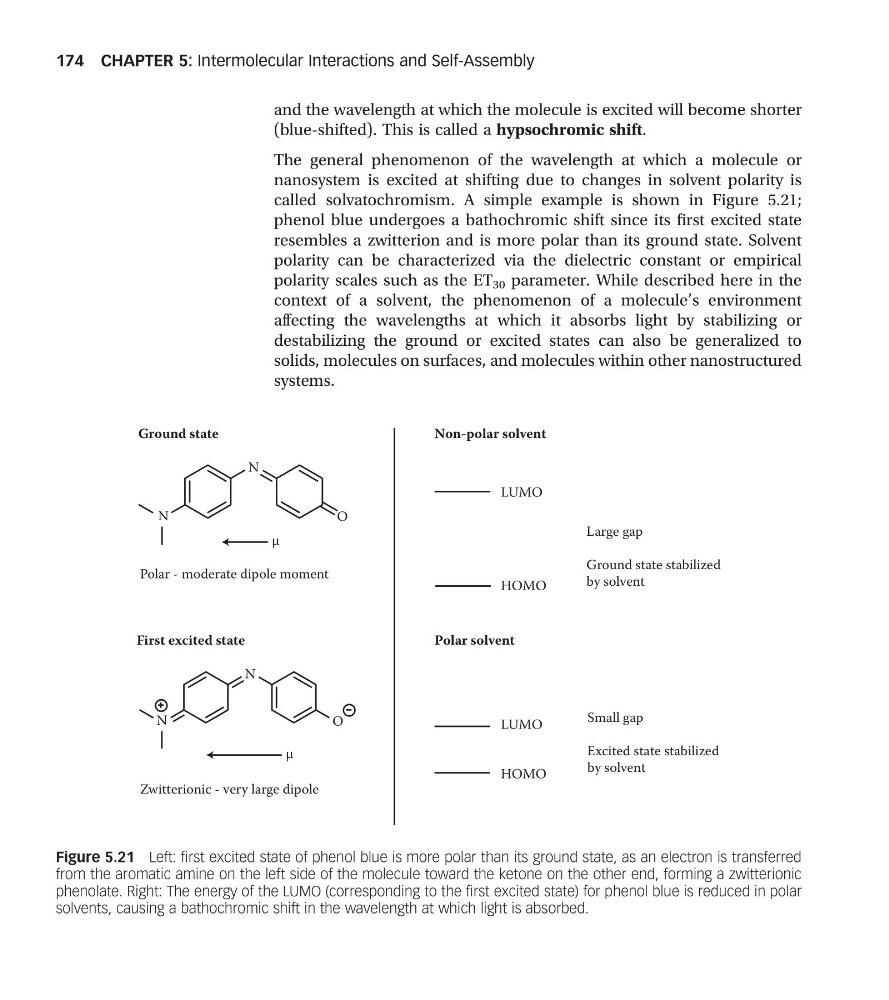
called solvatochromism. A simple example is shown in Figure 5.21;
phenol blue undergoes a bathochromic shift since its first excited state
resembles a zwitterion and is more polar than its ground state. Solvent
polarity can be characterized via the dielectric constant or empirical
polarity scales such as the ET 30 parameter. While described here in the
context of a solvent, the phenomenon of a molecule’s environment
affecting the wavelengths at which it absorbs light by stabilizing or
destabilizing the ground or excited states can also be generalized to
solids, molecules on surfaces, and molecules within other nanostructured
systems.
Ground state
First excited state
μ
μ
Zwitterionic - very large dipole
Polar - moderate dipole moment
HOMO
HOMO
LUMO
LUMO
Polar solvent
Non-polar solvent
Large gap
Ground state stabilized
by solvent
Small gap
Excited state stabilized
by solvent
N
N
N
N
O
O
Figure 5.21 Left: first excited state of phenol blue is more polar than its ground state, as an electron is transferred
from the aromatic amine on the left side of the molecule toward the ketone on the other end, forming a zwitterionic
phenolate. Right: The energy of the LUMO (corresponding to the first excited state) for phenol blue is reduced in polar
solvents, causing a bathochromic shift in the wavelength at which light is absorbed.
CHAPTER 5: Intermolecular Interactions and Self-Assembly
174
(blue-shifted). This is called a hypsochromic shift.
The general phenomenon of the wavelength at which a molecule or
nanosystem is excited at shifting due to changes in solvent polarity is
called solvatochromism. A simple example is shown in Figure 5.21;
phenol blue undergoes a bathochromic shift since its first excited state
resembles a zwitterion and is more polar than its ground state. Solvent
polarity can be characterized via the dielectric constant or empirical
polarity scales such as the ET 30 parameter. While described here in the
context of a solvent, the phenomenon of a molecule’s environment
affecting the wavelengths at which it absorbs light by stabilizing or
destabilizing the ground or excited states can also be generalized to
solids, molecules on surfaces, and molecules within other nanostructured
systems.
Ground state
First excited state
μ
μ
Zwitterionic - very large dipole
Polar - moderate dipole moment
HOMO
HOMO
LUMO
LUMO
Polar solvent
Non-polar solvent
Large gap
Ground state stabilized
by solvent
Small gap
Excited state stabilized
by solvent
N
N
N
N
O
O
Figure 5.21 Left: first excited state of phenol blue is more polar than its ground state, as an electron is transferred
from the aromatic amine on the left side of the molecule toward the ketone on the other end, forming a zwitterionic
phenolate. Right: The energy of the LUMO (corresponding to the first excited state) for phenol blue is reduced in polar
solvents, causing a bathochromic shift in the wavelength at which light is absorbed.
CHAPTER 5: Intermolecular Interactions and Self-Assembly
174