

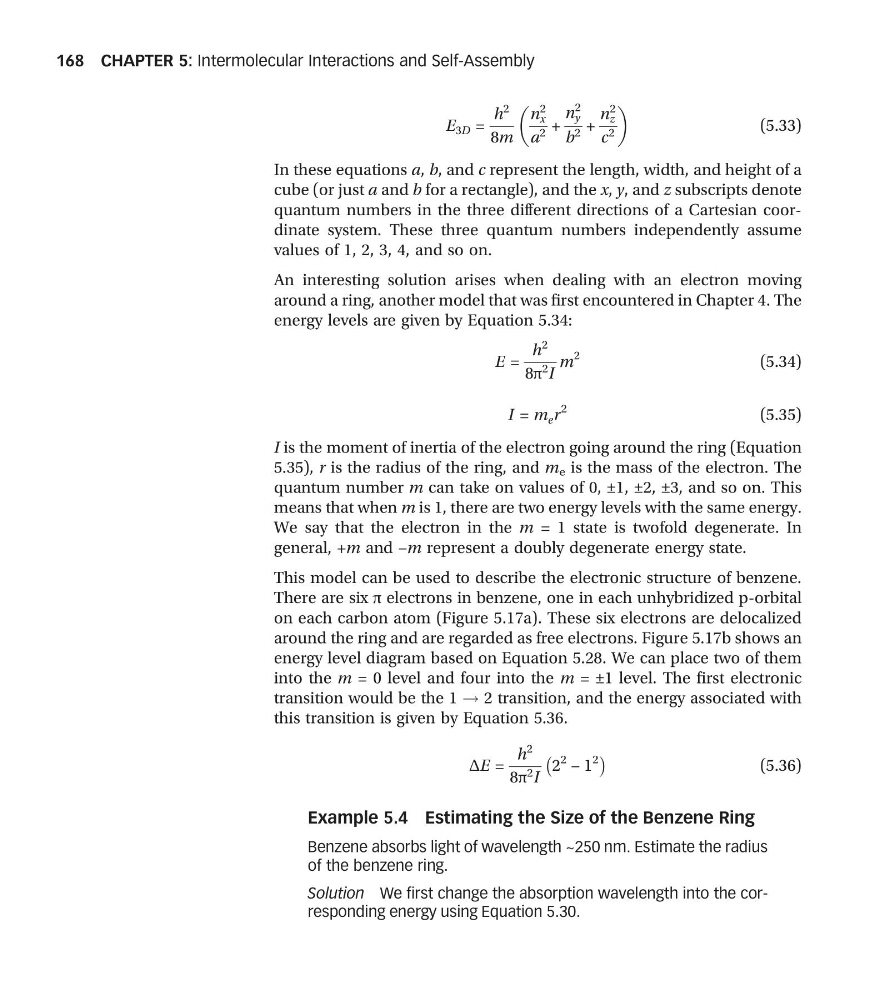
E 3D =
h
2
8m
n
2
x
a
2 +
n
2
y
b
2 +
n
2
z
c
2
(5.33)
In these equations a, b, and c represent the length, width, and height of a
cube (or just a and b for a rectangle), and the x, y, and z subscripts denote
quantum numbers in the three different directions of a Cartesian coordinate system. These three quantum numbers independently assume
values of 1, 2, 3, 4, and so on.
An interesting solution arises when dealing with an electron moving
around a ring, another model that was first encountered in Chapter 4. The
energy levels are given by Equation 5.34:
E =
h
2
8π
2 I
m
2
(5.34)
I = m e r
2
(5.35)
I is the moment of inertia of the electron going around the ring (Equation
5.35), r is the radius of the ring, and m e is the mass of the electron. The
quantum number m can take on values of 0, ±1, ±2, ±3, and so on. This
means that when m is 1, there are two energy levels with the same energy.
We say that the electron in the m = 1 state is twofold degenerate. In
general, +m and −m represent a doubly degenerate energy state.
This model can be used to describe the electronic structure of benzene.
There are six π electrons in benzene, one in each unhybridized p-orbital
on each carbon atom (Figure 5.17a). These six electrons are delocalized
around the ring and are regarded as free electrons. Figure 5.17b shows an
energy level diagram based on Equation 5.28. We can place two of them
into the m = 0 level and four into the m = ±1 level. The first electronic
transition would be the 1 ! 2 transition, and the energy associated with
this transition is given by Equation 5.36.
ΔE =
h
2
8π
2 I
2
2
− 1
2
À
Á
(5.36)
Example 5.4 Estimating the Size of the Benzene Ring
Benzene absorbs light of wavelength ~250 nm. Estimate the radius
of the benzene ring.
Solution We first change the absorption wavelength into the corresponding energy using Equation 5.30.
CHAPTER 5: Intermolecular Interactions and Self-Assembly
168
h
2
8m
n
2
x
a
2 +
n
2
y
b
2 +
n
2
z
c
2
(5.33)
In these equations a, b, and c represent the length, width, and height of a
cube (or just a and b for a rectangle), and the x, y, and z subscripts denote
quantum numbers in the three different directions of a Cartesian coordinate system. These three quantum numbers independently assume
values of 1, 2, 3, 4, and so on.
An interesting solution arises when dealing with an electron moving
around a ring, another model that was first encountered in Chapter 4. The
energy levels are given by Equation 5.34:
E =
h
2
8π
2 I
m
2
(5.34)
I = m e r
2
(5.35)
I is the moment of inertia of the electron going around the ring (Equation
5.35), r is the radius of the ring, and m e is the mass of the electron. The
quantum number m can take on values of 0, ±1, ±2, ±3, and so on. This
means that when m is 1, there are two energy levels with the same energy.
We say that the electron in the m = 1 state is twofold degenerate. In
general, +m and −m represent a doubly degenerate energy state.
This model can be used to describe the electronic structure of benzene.
There are six π electrons in benzene, one in each unhybridized p-orbital
on each carbon atom (Figure 5.17a). These six electrons are delocalized
around the ring and are regarded as free electrons. Figure 5.17b shows an
energy level diagram based on Equation 5.28. We can place two of them
into the m = 0 level and four into the m = ±1 level. The first electronic
transition would be the 1 ! 2 transition, and the energy associated with
this transition is given by Equation 5.36.
ΔE =
h
2
8π
2 I
2
2
− 1
2
À
Á
(5.36)
Example 5.4 Estimating the Size of the Benzene Ring
Benzene absorbs light of wavelength ~250 nm. Estimate the radius
of the benzene ring.
Solution We first change the absorption wavelength into the corresponding energy using Equation 5.30.
CHAPTER 5: Intermolecular Interactions and Self-Assembly
168