

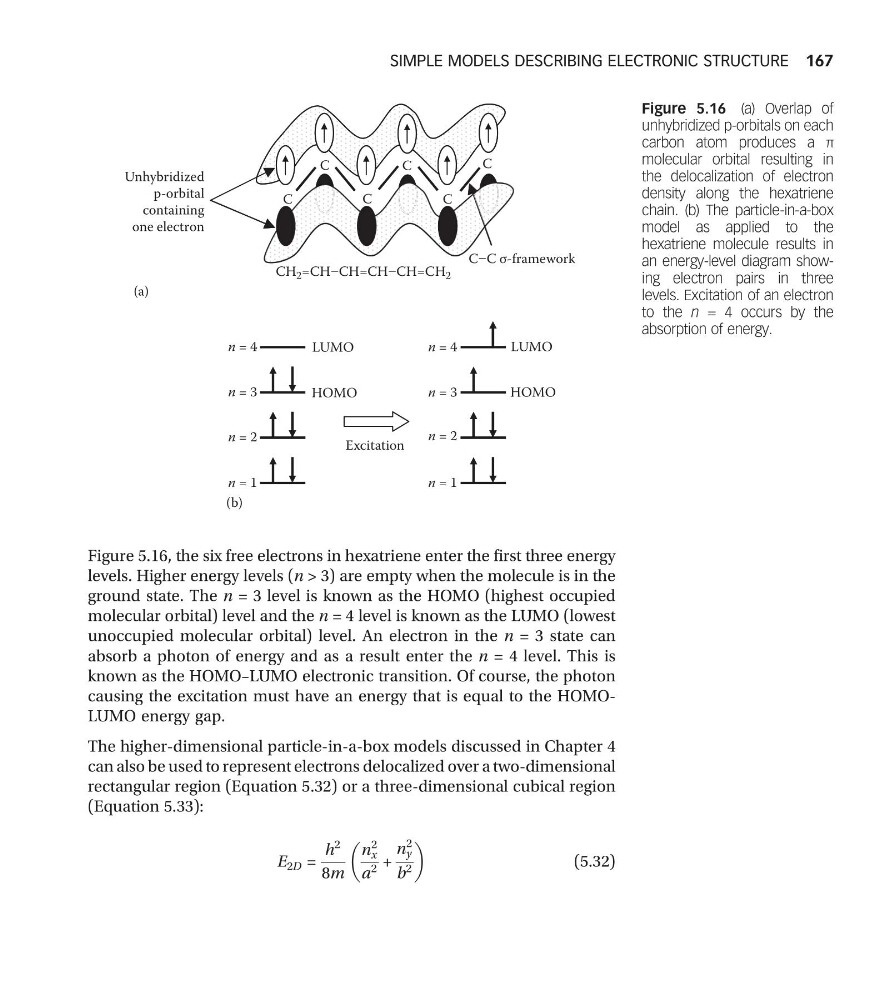
Figure 5.16, the six free electrons in hexatriene enter the first three energy
levels. Higher energy levels (n > 3) are empty when the molecule is in the
ground state. The n = 3 level is known as the HOMO (highest occupied
molecular orbital) level and the n = 4 level is known as the LUMO (lowest
unoccupied molecular orbital) level. An electron in the n = 3 state can
absorb a photon of energy and as a result enter the n = 4 level. This is
known as the HOMO–LUMO electronic transition. Of course, the photon
causing the excitation must have an energy that is equal to the HOMOLUMO energy gap.
The higher-dimensional particle-in-a-box models discussed in Chapter 4
can also be used to represent electrons delocalized over a two-dimensional
rectangular region (Equation 5.32) or a three-dimensional cubical region
(Equation 5.33):
E 2D =
h
2
8m
n
2
x
a
2 +
n
2
y
b
2
(5.32)
(a)
C
C
C
C
C
C
Unhybridized
p-orbital
containing
one electron
C
C
C
CC σ-framework
CH 2 =CHCH=CHCH=CH 2
(b)
n = 3
n = 4
n = 3
n = 4
HOMO
LUMO
HOMO
LUMO
n = 1
n = 2
n = 2
n = 1
Excitation
Figure 5.16 (a) Overlap of
unhybridized p-orbitals on each
carbon atom produces a π
molecular orbital resulting in
the delocalization of electron
density along the hexatriene
chain. (b) The particle-in-a-box
model as applied to the
hexatriene molecule results in
an energy-level diagram showing electron pairs in three
levels. Excitation of an electron
to the n = 4 occurs by the
absorption of energy.
SIMPLE MODELS DESCRIBING ELECTRONIC STRUCTURE 167
levels. Higher energy levels (n > 3) are empty when the molecule is in the
ground state. The n = 3 level is known as the HOMO (highest occupied
molecular orbital) level and the n = 4 level is known as the LUMO (lowest
unoccupied molecular orbital) level. An electron in the n = 3 state can
absorb a photon of energy and as a result enter the n = 4 level. This is
known as the HOMO–LUMO electronic transition. Of course, the photon
causing the excitation must have an energy that is equal to the HOMOLUMO energy gap.
The higher-dimensional particle-in-a-box models discussed in Chapter 4
can also be used to represent electrons delocalized over a two-dimensional
rectangular region (Equation 5.32) or a three-dimensional cubical region
(Equation 5.33):
E 2D =
h
2
8m
n
2
x
a
2 +
n
2
y
b
2
(5.32)
(a)
C
C
C
C
C
C
Unhybridized
p-orbital
containing
one electron
C
C
C
CC σ-framework
CH 2 =CHCH=CHCH=CH 2
(b)
n = 3
n = 4
n = 3
n = 4
HOMO
LUMO
HOMO
LUMO
n = 1
n = 2
n = 2
n = 1
Excitation
Figure 5.16 (a) Overlap of
unhybridized p-orbitals on each
carbon atom produces a π
molecular orbital resulting in
the delocalization of electron
density along the hexatriene
chain. (b) The particle-in-a-box
model as applied to the
hexatriene molecule results in
an energy-level diagram showing electron pairs in three
levels. Excitation of an electron
to the n = 4 occurs by the
absorption of energy.
SIMPLE MODELS DESCRIBING ELECTRONIC STRUCTURE 167