

can be arbitrarily assigned and r i0 is the number density of the ith electrolyte at that same distance x (often chosen to be the limit as x
approaches ∞, which is equivalent to the bulk phase).
5.2.2 The Debye length
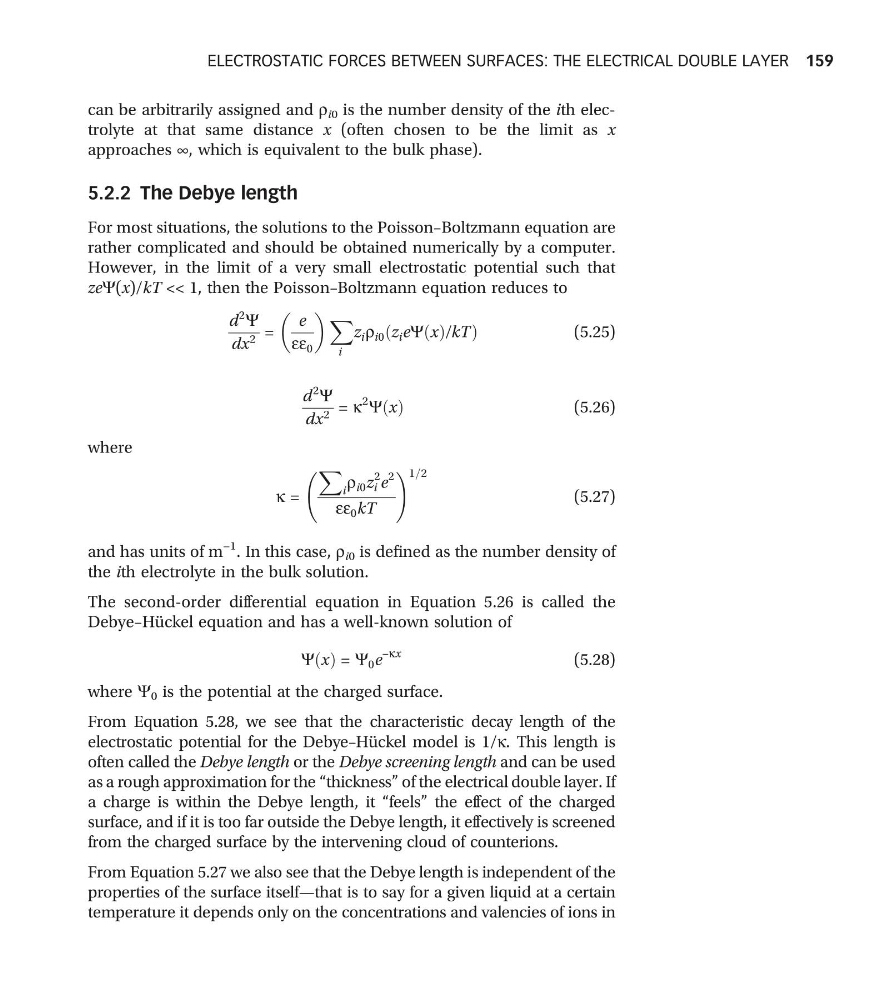
For most situations, the solutions to the Poisson–Boltzmann equation are
rather complicated and should be obtained numerically by a computer.
However, in the limit of a very small electrostatic potential such that
zeY(x)/kT << 1, then the Poisson–Boltzmann equation reduces to
d
2 Y
dx
2 =
e
ee 0
X
i
z i r i0 z i eY x
ð Þ/kT
ð
Þ
(5.25)
d
2 Y
dx 2 = k
2 Y x
ð Þ
(5.26)
where
k =
X
i
r i0 z
2
i e
2
ee 0 kT
! 1=2
(5.27)
and has units of m
−1
. In this case, r i0 is defined as the number density of
the ith electrolyte in the bulk solution.
The second-order differential equation in Equation 5.26 is called the
Debye–Hückel equation and has a well-known solution of
Y x
ð Þ = Y 0 e
−kx
(5.28)
where Y 0 is the potential at the charged surface.
From Equation 5.28, we see that the characteristic decay length of the
electrostatic potential for the Debye–Hückel model is 1/k. This length is
often called the Debye length or the Debye screening length and can be used
as a rough approximation for the “thickness” of the electrical double layer. If
a charge is within the Debye length, it “feels” the effect of the charged
surface, and if it is too far outside the Debye length, it effectively is screened
from the charged surface by the intervening cloud of counterions.
From Equation 5.27 we also see that the Debye length is independent of the
properties of the surface itself—that is to say for a given liquid at a certain
temperature it depends only on the concentrations and valencies of ions in
ELECTROSTATIC FORCES BETWEEN SURFACES: THE ELECTRICAL DOUBLE LAYER 159
approaches ∞, which is equivalent to the bulk phase).
5.2.2 The Debye length
For most situations, the solutions to the Poisson–Boltzmann equation are
rather complicated and should be obtained numerically by a computer.
However, in the limit of a very small electrostatic potential such that
zeY(x)/kT << 1, then the Poisson–Boltzmann equation reduces to
d
2 Y
dx
2 =
e
ee 0
X
i
z i r i0 z i eY x
ð Þ/kT
ð
Þ
(5.25)
d
2 Y
dx 2 = k
2 Y x
ð Þ
(5.26)
where
k =
X
i
r i0 z
2
i e
2
ee 0 kT
! 1=2
(5.27)
and has units of m
−1
. In this case, r i0 is defined as the number density of
the ith electrolyte in the bulk solution.
The second-order differential equation in Equation 5.26 is called the
Debye–Hückel equation and has a well-known solution of
Y x
ð Þ = Y 0 e
−kx
(5.28)
where Y 0 is the potential at the charged surface.
From Equation 5.28, we see that the characteristic decay length of the
electrostatic potential for the Debye–Hückel model is 1/k. This length is
often called the Debye length or the Debye screening length and can be used
as a rough approximation for the “thickness” of the electrical double layer. If
a charge is within the Debye length, it “feels” the effect of the charged
surface, and if it is too far outside the Debye length, it effectively is screened
from the charged surface by the intervening cloud of counterions.
From Equation 5.27 we also see that the Debye length is independent of the
properties of the surface itself—that is to say for a given liquid at a certain
temperature it depends only on the concentrations and valencies of ions in
ELECTROSTATIC FORCES BETWEEN SURFACES: THE ELECTRICAL DOUBLE LAYER 159