

and blood provide further examples of heterogeneous liquid mixtures
that are stabilized by electrical double layers.
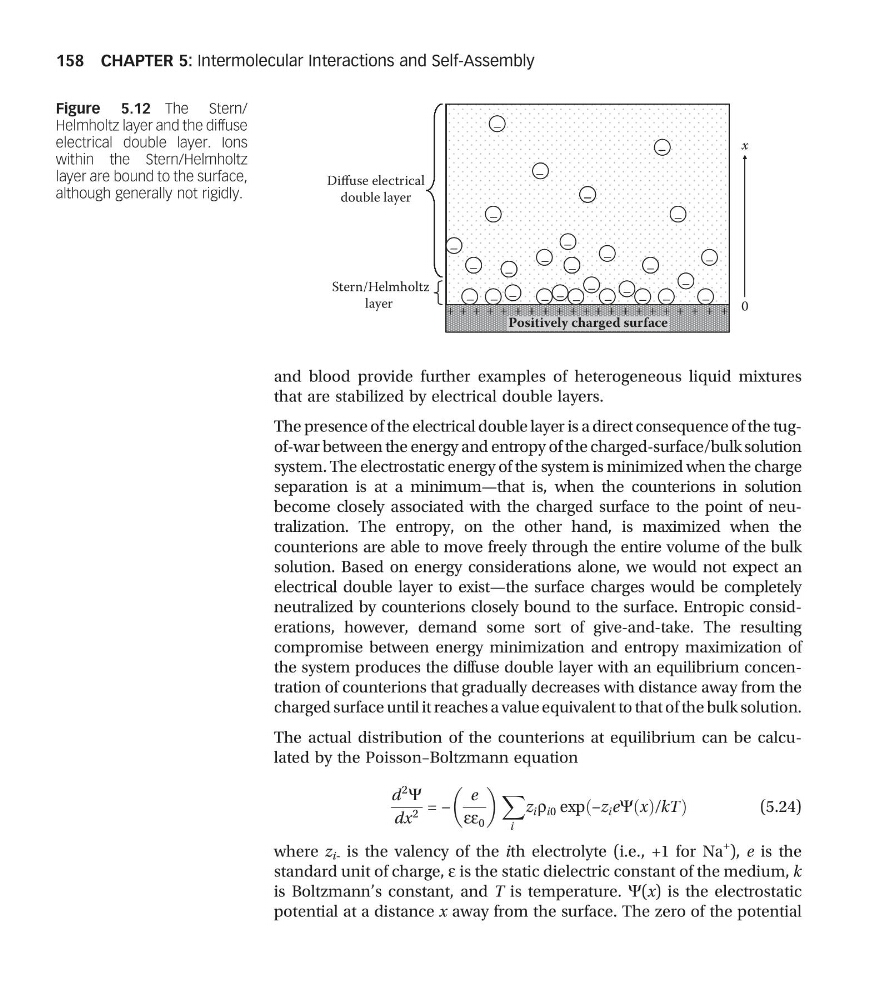
The presence of the electrical double layer is a direct consequence of the tugof-war between the energy and entropy of the charged-surface/bulk solution
system. The electrostatic energy of the system is minimized when the charge
separation is at a minimum—that is, when the counterions in solution
become closely associated with the charged surface to the point of neutralization. The entropy, on the other hand, is maximized when the
counterions are able to move freely through the entire volume of the bulk
solution. Based on energy considerations alone, we would not expect an
electrical double layer to exist—the surface charges would be completely
neutralized by counterions closely bound to the surface. Entropic considerations, however, demand some sort of give-and-take. The resulting
compromise between energy minimization and entropy maximization of
the system produces the diffuse double layer with an equilibrium concentration of counterions that gradually decreases with distance away from the
charged surface until it reaches a value equivalent to that of the bulk solution.
The actual distribution of the counterions at equilibrium can be calculated by the Poisson–Boltzmann equation
d
2 Y
dx
2 = −
e
ee 0
X
i
z i r i0 exp −z i eY x
ð Þ/kT
ð
Þ
(5.24)
where z i- is the valency of the ith electrolyte (i.e., +1 for Na
+
), e is the
standard unit of charge, e is the static dielectric constant of the medium, k
is Boltzmann’s constant, and T is temperature. Y(x) is the electrostatic
potential at a distance x away from the surface. The zero of the potential
-
x
–
–
–
–
–
–
Diffuse electrical
double layer
+ + + + + + + + + + + + + + + + + + + + +
Stern/Helmholtz
layer
0
Positively charged surface
–
–
–
–
– –
–
–
– – –
– – –
–
–
– –
–
–
–
–
–
Figure 5.12 The Stern/
Helmholtz layer and the diffuse
electrical double layer. Ions
within the Stern/Helmholtz
layer are bound to the surface,
although generally not rigidly.
CHAPTER 5: Intermolecular Interactions and Self-Assembly
158
that are stabilized by electrical double layers.
The presence of the electrical double layer is a direct consequence of the tugof-war between the energy and entropy of the charged-surface/bulk solution
system. The electrostatic energy of the system is minimized when the charge
separation is at a minimum—that is, when the counterions in solution
become closely associated with the charged surface to the point of neutralization. The entropy, on the other hand, is maximized when the
counterions are able to move freely through the entire volume of the bulk
solution. Based on energy considerations alone, we would not expect an
electrical double layer to exist—the surface charges would be completely
neutralized by counterions closely bound to the surface. Entropic considerations, however, demand some sort of give-and-take. The resulting
compromise between energy minimization and entropy maximization of
the system produces the diffuse double layer with an equilibrium concentration of counterions that gradually decreases with distance away from the
charged surface until it reaches a value equivalent to that of the bulk solution.
The actual distribution of the counterions at equilibrium can be calculated by the Poisson–Boltzmann equation
d
2 Y
dx
2 = −
e
ee 0
X
i
z i r i0 exp −z i eY x
ð Þ/kT
ð
Þ
(5.24)
where z i- is the valency of the ith electrolyte (i.e., +1 for Na
+
), e is the
standard unit of charge, e is the static dielectric constant of the medium, k
is Boltzmann’s constant, and T is temperature. Y(x) is the electrostatic
potential at a distance x away from the surface. The zero of the potential
-
x
–
–
–
–
–
–
Diffuse electrical
double layer
+ + + + + + + + + + + + + + + + + + + + +
Stern/Helmholtz
layer
0
Positively charged surface
–
–
–
–
– –
–
–
– – –
– – –
–
–
– –
–
–
–
–
–
Figure 5.12 The Stern/
Helmholtz layer and the diffuse
electrical double layer. Ions
within the Stern/Helmholtz
layer are bound to the surface,
although generally not rigidly.
CHAPTER 5: Intermolecular Interactions and Self-Assembly
158