

positive region is pointing toward the cation and the negative region is
pointing away (q = 0), the magnitude of the potential energy is maximized
(but it is repulsive rather than attractive). If, however, the dipole is oriented perpendicularly with respect to the cation (q = π/2), the potential
energy is zero because the attractive interaction between the cation and
the negative region is balanced out by the repulsive interaction with the
positive region. Therefore, the angle dependence of the ion–dipole
interaction is as expected.
It should be noted that some molecules (such as benzene or CO 2 ) may
have partial charge separations but do not have a net dipole moment. For
example, CO 2 has no net dipole moment despite two polar bonds—recall
that the total dipole is the vector sum of bond dipoles, and for CO 2 , the
two bond dipoles are equal in magnitude and opposite in direction.
However, in these types of molecules, higher-order multipoles such as
quadrupoles or octupoles may exist and also results in an intermolecular
force between the molecule and an ionic species. Different equations than
those above must be used to calculate the interaction between molecules
with electrical multipoles and ionic species; however, these are beyond
the scope of this text.
5.1.3 Dipole–dipole interactions
Molecules with permanent dipoles may also interact with each other
through electrostatic means. As might be expected, the strength of the
interaction is also angle-dependent. This type of interaction is analogous
to the magnetic attraction between two bar magnets—the attraction
between the two magnets depends on the angle of rotation of each
magnet relative to the other. A schematic representing the interaction
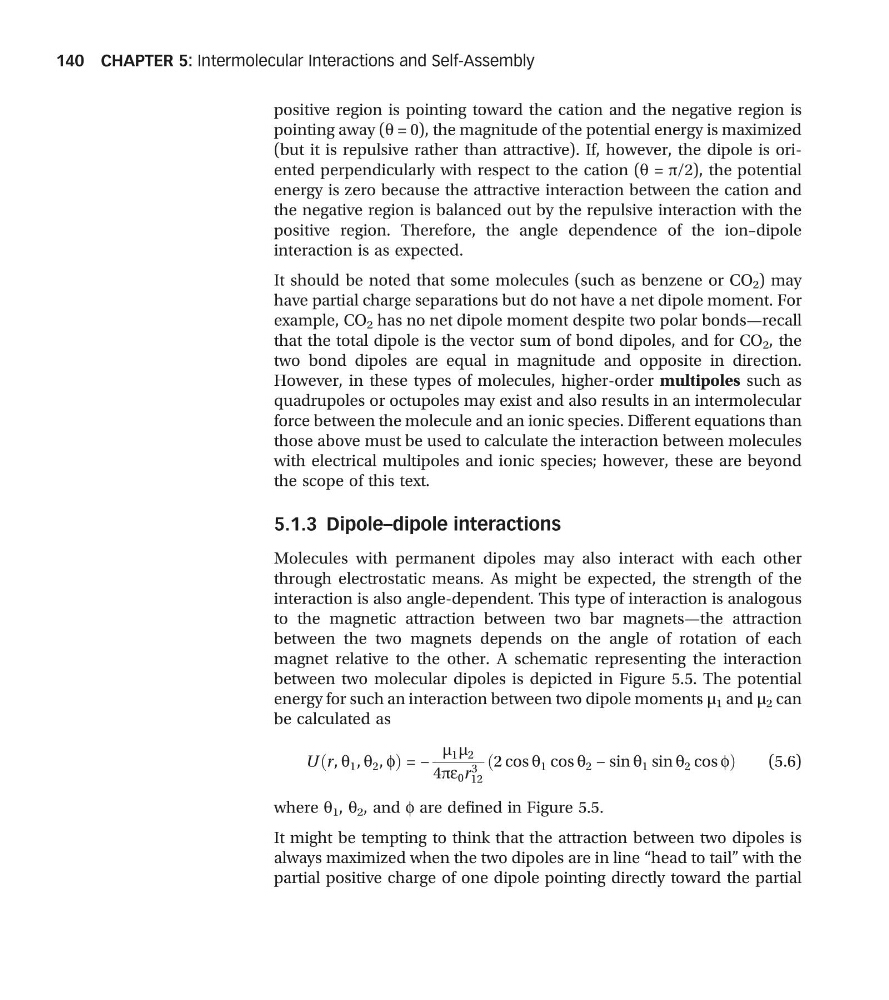
between two molecular dipoles is depicted in Figure 5.5. The potential
energy for such an interaction between two dipole moments µ 1 and µ 2 can
be calculated as
U r, q 1 , q 2 , f
ð
Þ= −
μ 1 μ 2
4πe 0 r
3
12
2 cos q 1 cos q 2 − sin q 1 sin q 2 cos f
ð
Þ
(5.6)
where q 1 , q 2 , and f are defined in Figure 5.5.
It might be tempting to think that the attraction between two dipoles is
always maximized when the two dipoles are in line “head to tail” with the
partial positive charge of one dipole pointing directly toward the partial
CHAPTER 5: Intermolecular Interactions and Self-Assembly
140
pointing away (q = 0), the magnitude of the potential energy is maximized
(but it is repulsive rather than attractive). If, however, the dipole is oriented perpendicularly with respect to the cation (q = π/2), the potential
energy is zero because the attractive interaction between the cation and
the negative region is balanced out by the repulsive interaction with the
positive region. Therefore, the angle dependence of the ion–dipole
interaction is as expected.
It should be noted that some molecules (such as benzene or CO 2 ) may
have partial charge separations but do not have a net dipole moment. For
example, CO 2 has no net dipole moment despite two polar bonds—recall
that the total dipole is the vector sum of bond dipoles, and for CO 2 , the
two bond dipoles are equal in magnitude and opposite in direction.
However, in these types of molecules, higher-order multipoles such as
quadrupoles or octupoles may exist and also results in an intermolecular
force between the molecule and an ionic species. Different equations than
those above must be used to calculate the interaction between molecules
with electrical multipoles and ionic species; however, these are beyond
the scope of this text.
5.1.3 Dipole–dipole interactions
Molecules with permanent dipoles may also interact with each other
through electrostatic means. As might be expected, the strength of the
interaction is also angle-dependent. This type of interaction is analogous
to the magnetic attraction between two bar magnets—the attraction
between the two magnets depends on the angle of rotation of each
magnet relative to the other. A schematic representing the interaction
between two molecular dipoles is depicted in Figure 5.5. The potential
energy for such an interaction between two dipole moments µ 1 and µ 2 can
be calculated as
U r, q 1 , q 2 , f
ð
Þ= −
μ 1 μ 2
4πe 0 r
3
12
2 cos q 1 cos q 2 − sin q 1 sin q 2 cos f
ð
Þ
(5.6)
where q 1 , q 2 , and f are defined in Figure 5.5.
It might be tempting to think that the attraction between two dipoles is
always maximized when the two dipoles are in line “head to tail” with the
partial positive charge of one dipole pointing directly toward the partial
CHAPTER 5: Intermolecular Interactions and Self-Assembly
140