

we describe this through boundary conditions by explicitly stating that the
wavefunction has a value of zero at and below x = 0 and at and above x = L.
Since the wavefunction is zero at any point beyond the line segment, the
probability of finding the electron outside of this region is zero. We write
this boundary condition mathematically as
y x
ð Þ = 0 when 0 ≤ x and L ≥ x
(4.11)
For simplicity we do not allow gravity or electric fields to interact with our
electron meaning that our potential operator, ^
V , is zero within the box
and infinite outside. Since there is no potential energy term within the
box, the Hamiltonian operator, according to Equation 4.10, becomes
simply the kinetic operator, ^
K , as shown in Equation 4.12:
^
H = ^
K = −
h
2
8π
2 m
d
2
dx
2
(4.12)
As mentioned in the last section, the mathematical form of wavefunctions
must obey certain rules: they must be well-behaved, obey the appropriate
boundary conditions, and provide solutions to the Schrödinger equation.
In this particle-on-a-line model, the rules are met by a sinusoidal wavefunction. This function describes the electron as a wave particle and
always yields finite amplitude between x = 0 and x = L. We can view these
wavefunctions as those that can fit an integer or half-integer number of de
Broglie wavelengths between x = 0 and x = L. According to the boundary
condition, the amplitude of this wave must be zero at x = 0 and x = L.
Equation 4.13 is such a wavefunction and describes the behavior of a
particle confined to a line of length L.
y n x
ð Þ = A n sin
nπx
L
(4.13)
In Equation 4.13, A n is a constant that normalizes the wavefunction to
guarantee that the probability of finding the electron between the bounds
is exactly 1. n can take on values of 1, 2, 3, 4, and so on, and is therefore
the quantum number describing each wavefunction. As n increases, so
does the energy of the electron. An important point to make is that any
positive integer value of n provides a meaningful wavefunction so that
there is not simply one solution to the Schrödinger equation obtained
using the Hamiltonian in Equation 4.12. Instead, an infinite number of
equations exist where each equation represents an individual energy state.
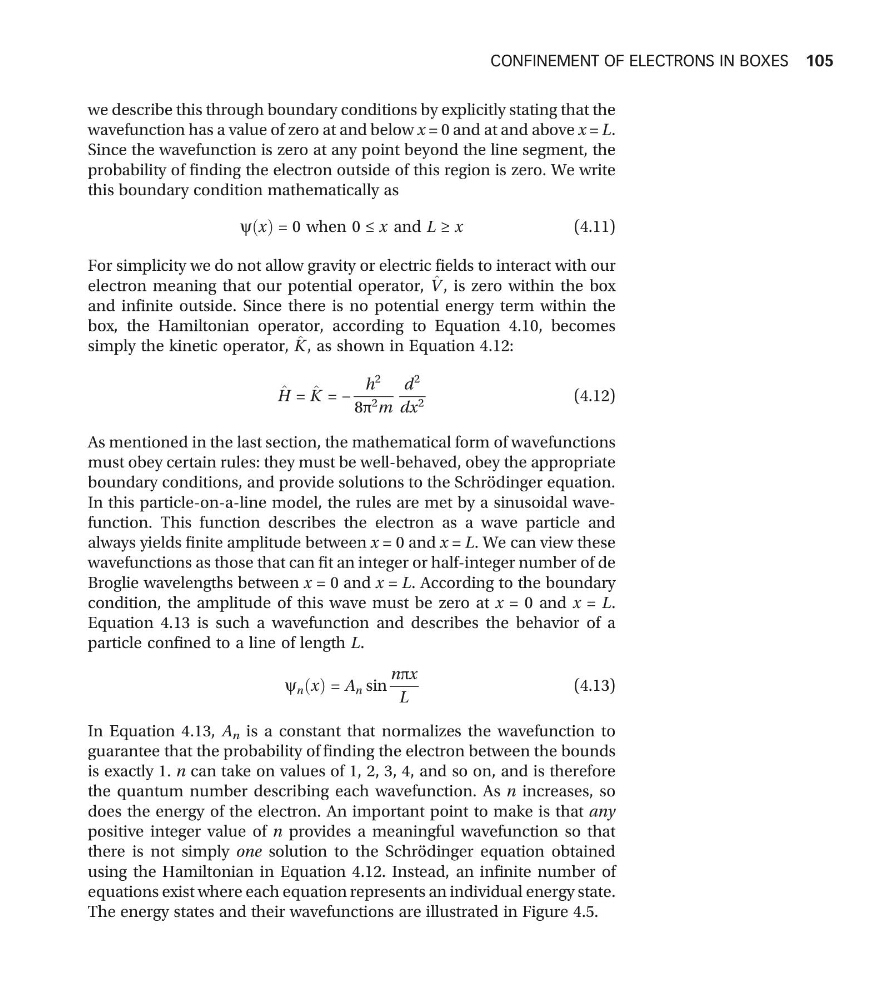
The energy states and their wavefunctions are illustrated in Figure 4.5.
CONFINEMENT OF ELECTRONS IN BOXES 105
wavefunction has a value of zero at and below x = 0 and at and above x = L.
Since the wavefunction is zero at any point beyond the line segment, the
probability of finding the electron outside of this region is zero. We write
this boundary condition mathematically as
y x
ð Þ = 0 when 0 ≤ x and L ≥ x
(4.11)
For simplicity we do not allow gravity or electric fields to interact with our
electron meaning that our potential operator, ^
V , is zero within the box
and infinite outside. Since there is no potential energy term within the
box, the Hamiltonian operator, according to Equation 4.10, becomes
simply the kinetic operator, ^
K , as shown in Equation 4.12:
^
H = ^
K = −
h
2
8π
2 m
d
2
dx
2
(4.12)
As mentioned in the last section, the mathematical form of wavefunctions
must obey certain rules: they must be well-behaved, obey the appropriate
boundary conditions, and provide solutions to the Schrödinger equation.
In this particle-on-a-line model, the rules are met by a sinusoidal wavefunction. This function describes the electron as a wave particle and
always yields finite amplitude between x = 0 and x = L. We can view these
wavefunctions as those that can fit an integer or half-integer number of de
Broglie wavelengths between x = 0 and x = L. According to the boundary
condition, the amplitude of this wave must be zero at x = 0 and x = L.
Equation 4.13 is such a wavefunction and describes the behavior of a
particle confined to a line of length L.
y n x
ð Þ = A n sin
nπx
L
(4.13)
In Equation 4.13, A n is a constant that normalizes the wavefunction to
guarantee that the probability of finding the electron between the bounds
is exactly 1. n can take on values of 1, 2, 3, 4, and so on, and is therefore
the quantum number describing each wavefunction. As n increases, so
does the energy of the electron. An important point to make is that any
positive integer value of n provides a meaningful wavefunction so that
there is not simply one solution to the Schrödinger equation obtained
using the Hamiltonian in Equation 4.12. Instead, an infinite number of
equations exist where each equation represents an individual energy state.
The energy states and their wavefunctions are illustrated in Figure 4.5.
CONFINEMENT OF ELECTRONS IN BOXES 105