

when the photons strike the electron they impart a momentum to the
electron, causing it move and consequently creating uncertainty in its
position. The uncertainty principle is thus a statement on the inherent
uncertainty in a quantum system created by the act of observation. The
uncertainty principle also states that product of the uncertainty in position (Δx) and the uncertainty in momentum (Δp) is on the order of at least
Planck’s constant (Equation 4.5):
Δx Δp ≥
h
2π
or Δx Δp ≥ ℏ
(4.5)
Example 4.2 Uncertainty within a Line of Nanoscale
Dimension
Calculate the uncertainty in speed of an electron trapped within a
10-nm region on a line. The mass of an electron is 9.109 × 10
−31 kg.
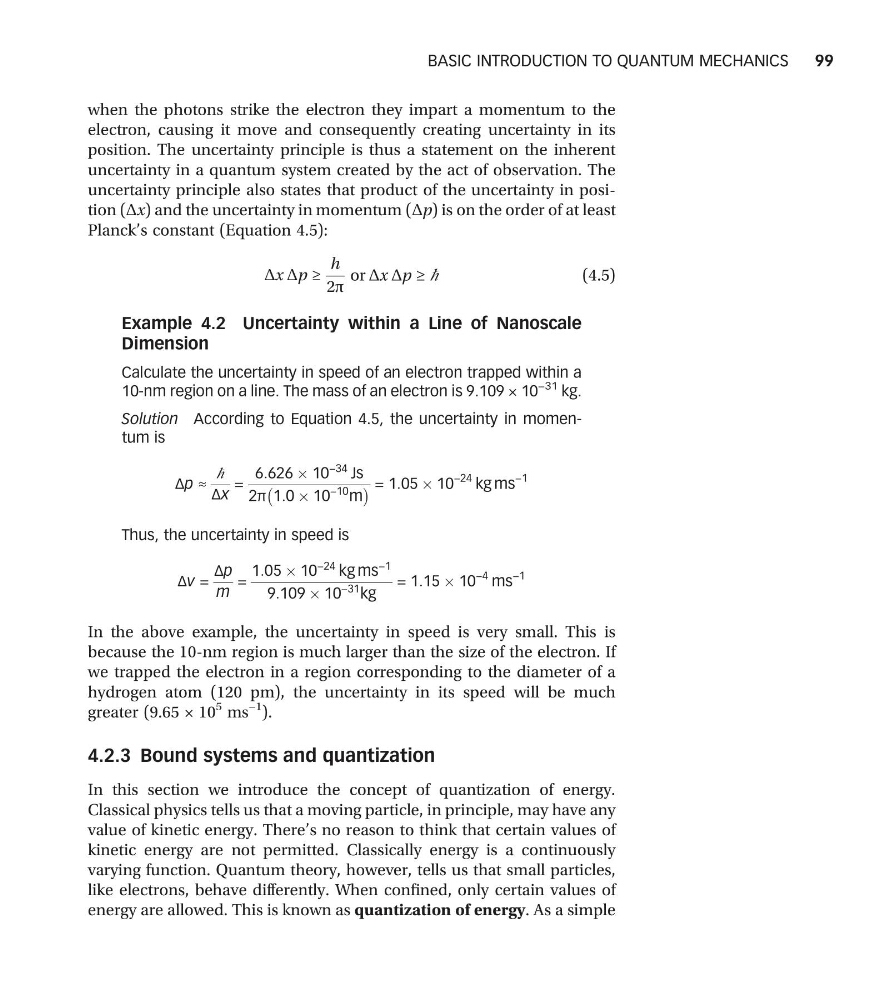
Solution According to Equation 4.5, the uncertainty in momentum is
Δp ≈
ℏ
Δx
=
6:626 Â 10
−34 Js
2π 1:0 Â 10
−10 m
À
Á= 1:05 Â 10
−24 kg ms
−1
Thus, the uncertainty in speed is
Δv =
Δp
m
=
1:05 Â 10
−24 kg ms
−1
9:109 Â 10
−31 kg
= 1:15 Â 10
−4 ms
−1
In the above example, the uncertainty in speed is very small. This is
because the 10-nm region is much larger than the size of the electron. If
we trapped the electron in a region corresponding to the diameter of a
hydrogen atom (120 pm), the uncertainty in its speed will be much
greater (9.65 × 10
5 ms
−1
).
4.2.3 Bound systems and quantization
In this section we introduce the concept of quantization of energy.
Classical physics tells us that a moving particle, in principle, may have any
value of kinetic energy. There’s no reason to think that certain values of
kinetic energy are not permitted. Classically energy is a continuously
varying function. Quantum theory, however, tells us that small particles,
like electrons, behave differently. When confined, only certain values of
energy are allowed. This is known as quantization of energy. As a simple
BASIC INTRODUCTION TO QUANTUM MECHANICS
99
electron, causing it move and consequently creating uncertainty in its
position. The uncertainty principle is thus a statement on the inherent
uncertainty in a quantum system created by the act of observation. The
uncertainty principle also states that product of the uncertainty in position (Δx) and the uncertainty in momentum (Δp) is on the order of at least
Planck’s constant (Equation 4.5):
Δx Δp ≥
h
2π
or Δx Δp ≥ ℏ
(4.5)
Example 4.2 Uncertainty within a Line of Nanoscale
Dimension
Calculate the uncertainty in speed of an electron trapped within a
10-nm region on a line. The mass of an electron is 9.109 × 10
−31 kg.
Solution According to Equation 4.5, the uncertainty in momentum is
Δp ≈
ℏ
Δx
=
6:626 Â 10
−34 Js
2π 1:0 Â 10
−10 m
À
Á= 1:05 Â 10
−24 kg ms
−1
Thus, the uncertainty in speed is
Δv =
Δp
m
=
1:05 Â 10
−24 kg ms
−1
9:109 Â 10
−31 kg
= 1:15 Â 10
−4 ms
−1
In the above example, the uncertainty in speed is very small. This is
because the 10-nm region is much larger than the size of the electron. If
we trapped the electron in a region corresponding to the diameter of a
hydrogen atom (120 pm), the uncertainty in its speed will be much
greater (9.65 × 10
5 ms
−1
).
4.2.3 Bound systems and quantization
In this section we introduce the concept of quantization of energy.
Classical physics tells us that a moving particle, in principle, may have any
value of kinetic energy. There’s no reason to think that certain values of
kinetic energy are not permitted. Classically energy is a continuously
varying function. Quantum theory, however, tells us that small particles,
like electrons, behave differently. When confined, only certain values of
energy are allowed. This is known as quantization of energy. As a simple
BASIC INTRODUCTION TO QUANTUM MECHANICS
99