

66 J. KRANE
Clean Energy Aspirations and Credibility
In 2017, the UAE launched an updated set of power sector goals, the
National Energy Strategy 2050. 25 The strategy is focused on altering the
electricity generation mix, rather than the overall energy balance including
transport and industry. A full 50% of future electricity production is to
be provided by ‘clean’ sources, i.e., nuclear and renewable power. The
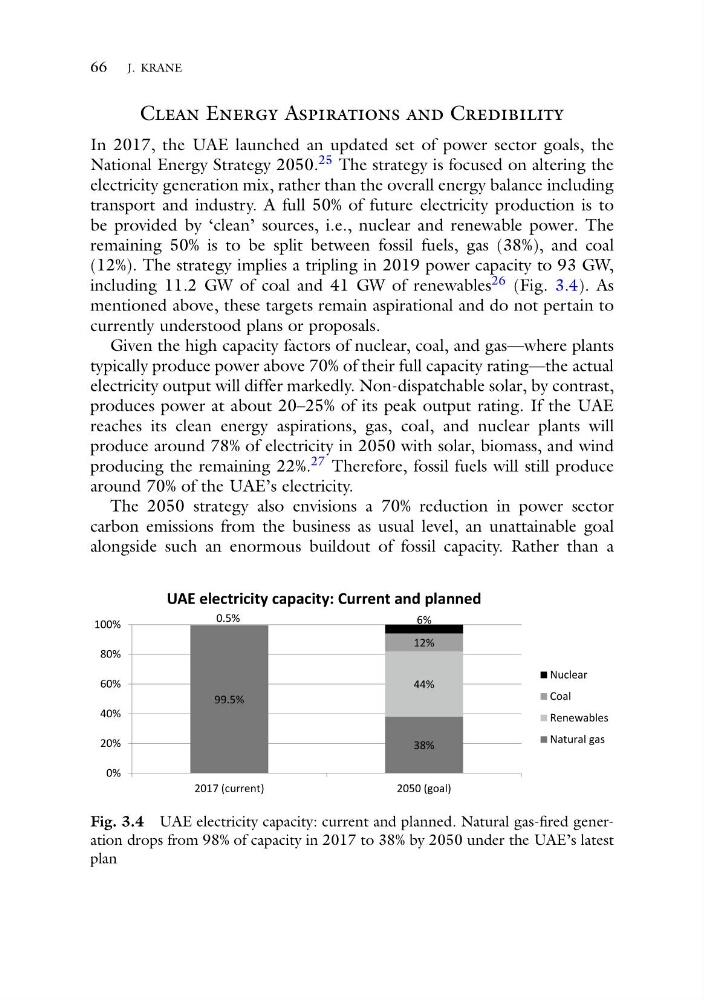
remaining 50% is to be split between fossil fuels, gas (38%), and coal
(12%). The strategy implies a tripling in 2019 power capacity to 93 GW,
including 11.2 GW of coal and 41 GW of renewables 26 (Fig. 3.4). As
mentioned above, these targets remain aspirational and do not pertain to
currently understood plans or proposals.
Given the high capacity factors of nuclear, coal, and gas—where plants
typically produce power above 70% of their full capacity rating—the actual
electricity output will differ markedly. Non-dispatchable solar, by contrast,
produces power at about 20–25% of its peak output rating. If the UAE
reaches its clean energy aspirations, gas, coal, and nuclear plants will
produce around 78% of electricity in 2050 with solar, biomass, and wind
producing the remaining 22%. 27 Therefore, fossil fuels will still produce
around 70% of the UAE’s electricity.
The 2050 strategy also envisions a 70% reduction in power sector
carbon emissions from the business as usual level, an unattainable goal
alongside such an enormous buildout of fossil capacity. Rather than a
99.5%
38%
0.5%
44%
12%
6%
0%
20%
40%
60%
80%
100%
)
l
a
o
g
(
0
5
0
2
)
t
n
e
r
r
u
c
(
7
1
0
2
UAE electricity capacity: Current and planned
Nuclear
Coal
Renewables
Natural gas
Fig. 3.4 UAE electricity capacity: current and planned. Natural gas-fired generation drops from 98% of capacity in 2017 to 38% by 2050 under the UAE’s latest
plan
Clean Energy Aspirations and Credibility
In 2017, the UAE launched an updated set of power sector goals, the
National Energy Strategy 2050. 25 The strategy is focused on altering the
electricity generation mix, rather than the overall energy balance including
transport and industry. A full 50% of future electricity production is to
be provided by ‘clean’ sources, i.e., nuclear and renewable power. The
remaining 50% is to be split between fossil fuels, gas (38%), and coal
(12%). The strategy implies a tripling in 2019 power capacity to 93 GW,
including 11.2 GW of coal and 41 GW of renewables 26 (Fig. 3.4). As
mentioned above, these targets remain aspirational and do not pertain to
currently understood plans or proposals.
Given the high capacity factors of nuclear, coal, and gas—where plants
typically produce power above 70% of their full capacity rating—the actual
electricity output will differ markedly. Non-dispatchable solar, by contrast,
produces power at about 20–25% of its peak output rating. If the UAE
reaches its clean energy aspirations, gas, coal, and nuclear plants will
produce around 78% of electricity in 2050 with solar, biomass, and wind
producing the remaining 22%. 27 Therefore, fossil fuels will still produce
around 70% of the UAE’s electricity.
The 2050 strategy also envisions a 70% reduction in power sector
carbon emissions from the business as usual level, an unattainable goal
alongside such an enormous buildout of fossil capacity. Rather than a
99.5%
38%
0.5%
44%
12%
6%
0%
20%
40%
60%
80%
100%
)
l
a
o
g
(
0
5
0
2
)
t
n
e
r
r
u
c
(
7
1
0
2
UAE electricity capacity: Current and planned
Nuclear
Coal
Renewables
Natural gas
Fig. 3.4 UAE electricity capacity: current and planned. Natural gas-fired generation drops from 98% of capacity in 2017 to 38% by 2050 under the UAE’s latest
plan