

64 J. KRANE
Clean Energy Goals Versus Reality
The onset of coal-fired power in the UAE runs counter to the ‘green’
energy narrative that policy elites have cultivated. In 2006, Abu Dhabi
launched a strategic campaign to champion environmental initiatives,
announcing it would build the world’s first ‘zero-carbon city’. Masdar
City, as the development was called, was to receive $15 billion in government funding for zero-carbon housing for 40,000 residents and 1500
businesses, a carbon management unit, a clean technology investment
fund, and a graduate school affiliated with the Massachusetts Institute of
Technology, and sundry clean energy projects. 19 Amid worldwide accolades over the ambitious project, then-CEO Sultan Ahmed al-Jaber said
in 2007 that Masdar enjoyed ‘an unlimited budget for renewable energy
projects.’ 20
Energy policymakers went further in 2009, declaring that Abu Dhabi
would leverage its ample sunshine and vacant land to join the European
clean energy vanguard. By 2020, the Abu Dhabi government announced,
renewable energy sources were to account for at least 7% of the emirate’s
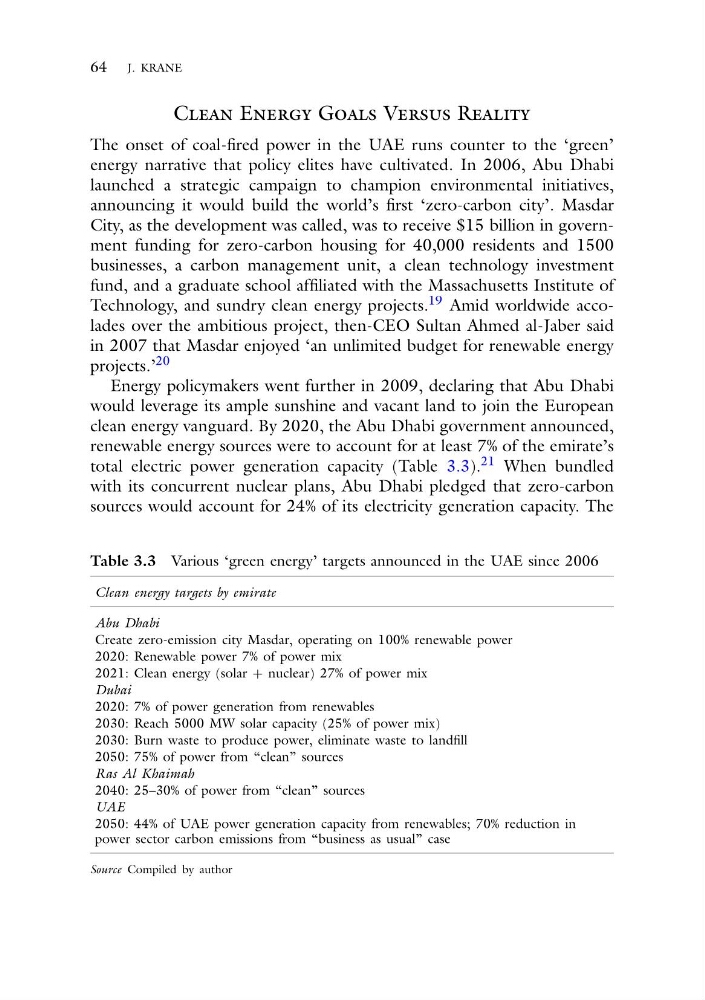
total electric power generation capacity (Table 3.3). 21 When bundled
with its concurrent nuclear plans, Abu Dhabi pledged that zero-carbon
sources would account for 24% of its electricity generation capacity. The
Table 3.3 Various ‘green energy’ targets announced in the UAE since 2006
Clean energy targets by emirate
Abu Dhabi
Create zero-emission city Masdar, operating on 100% renewable power
2020: Renewable power 7% of power mix
2021: Clean energy (solar + nuclear) 27% of power mix
Dubai
2020: 7% of power generation from renewables
2030: Reach 5000 MW solar capacity (25% of power mix)
2030: Burn waste to produce power, eliminate waste to landfill
2050: 75% of power from “clean” sources
Ras Al Khaimah
2040: 25–30% of power from “clean” sources
UAE
2050: 44% of UAE power generation capacity from renewables; 70% reduction in
power sector carbon emissions from “business as usual” case
Source Compiled by author
Clean Energy Goals Versus Reality
The onset of coal-fired power in the UAE runs counter to the ‘green’
energy narrative that policy elites have cultivated. In 2006, Abu Dhabi
launched a strategic campaign to champion environmental initiatives,
announcing it would build the world’s first ‘zero-carbon city’. Masdar
City, as the development was called, was to receive $15 billion in government funding for zero-carbon housing for 40,000 residents and 1500
businesses, a carbon management unit, a clean technology investment
fund, and a graduate school affiliated with the Massachusetts Institute of
Technology, and sundry clean energy projects. 19 Amid worldwide accolades over the ambitious project, then-CEO Sultan Ahmed al-Jaber said
in 2007 that Masdar enjoyed ‘an unlimited budget for renewable energy
projects.’ 20
Energy policymakers went further in 2009, declaring that Abu Dhabi
would leverage its ample sunshine and vacant land to join the European
clean energy vanguard. By 2020, the Abu Dhabi government announced,
renewable energy sources were to account for at least 7% of the emirate’s
total electric power generation capacity (Table 3.3). 21 When bundled
with its concurrent nuclear plans, Abu Dhabi pledged that zero-carbon
sources would account for 24% of its electricity generation capacity. The
Table 3.3 Various ‘green energy’ targets announced in the UAE since 2006
Clean energy targets by emirate
Abu Dhabi
Create zero-emission city Masdar, operating on 100% renewable power
2020: Renewable power 7% of power mix
2021: Clean energy (solar + nuclear) 27% of power mix
Dubai
2020: 7% of power generation from renewables
2030: Reach 5000 MW solar capacity (25% of power mix)
2030: Burn waste to produce power, eliminate waste to landfill
2050: 75% of power from “clean” sources
Ras Al Khaimah
2040: 25–30% of power from “clean” sources
UAE
2050: 44% of UAE power generation capacity from renewables; 70% reduction in
power sector carbon emissions from “business as usual” case
Source Compiled by author