

4 THE RISE OF RENEWABLES IN THE GULF STATES …
105
PV installations—weak. Admittedly this has now begun to change with
the levelized cost of energy (LCOE) of rooftop solar at the commercial
and industrial scale dropping below $0.05/kWh. 29
Despite the fact that developing distributed solar PV is already
economically viable for many energy consumers in the GCC states, the
size of the savings is subject to some uncertainty, being dependent on
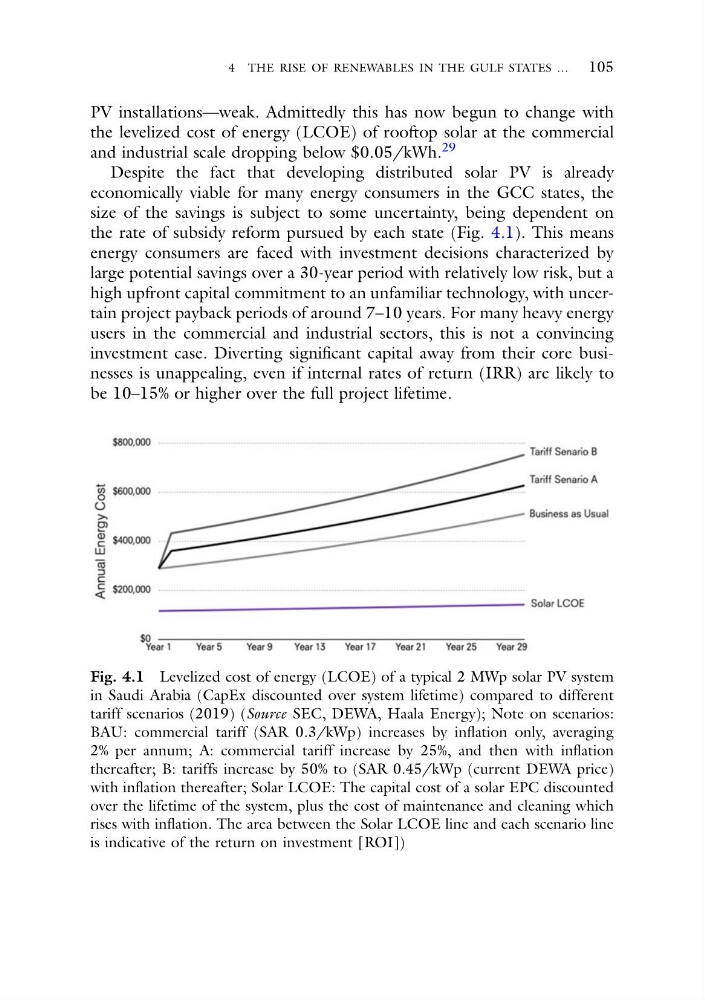
the rate of subsidy reform pursued by each state (Fig. 4.1). This means
energy consumers are faced with investment decisions characterized by
large potential savings over a 30-year period with relatively low risk, but a
high upfront capital commitment to an unfamiliar technology, with uncertain project payback periods of around 7–10 years. For many heavy energy
users in the commercial and industrial sectors, this is not a convincing
investment case. Diverting significant capital away from their core businesses is unappealing, even if internal rates of return (IRR) are likely to
be 10–15% or higher over the full project lifetime.
Fig. 4.1 Levelized cost of energy (LCOE) of a typical 2 MWp solar PV system
in Saudi Arabia (CapEx discounted over system lifetime) compared to different
tariff scenarios (2019) (Source SEC, DEWA, Haala Energy); Note on scenarios:
BAU: commercial tariff (SAR 0.3/kWp) increases by inflation only, averaging
2% per annum; A: commercial tariff increase by 25%, and then with inflation
thereafter; B: tariffs increase by 50% to (SAR 0.45/kWp (current DEWA price)
with inflation thereafter; Solar LCOE: The capital cost of a solar EPC discounted
over the lifetime of the system, plus the cost of maintenance and cleaning which
rises with inflation. The area between the Solar LCOE line and each scenario line
is indicative of the return on investment [ROI])
105
PV installations—weak. Admittedly this has now begun to change with
the levelized cost of energy (LCOE) of rooftop solar at the commercial
and industrial scale dropping below $0.05/kWh. 29
Despite the fact that developing distributed solar PV is already
economically viable for many energy consumers in the GCC states, the
size of the savings is subject to some uncertainty, being dependent on
the rate of subsidy reform pursued by each state (Fig. 4.1). This means
energy consumers are faced with investment decisions characterized by
large potential savings over a 30-year period with relatively low risk, but a
high upfront capital commitment to an unfamiliar technology, with uncertain project payback periods of around 7–10 years. For many heavy energy
users in the commercial and industrial sectors, this is not a convincing
investment case. Diverting significant capital away from their core businesses is unappealing, even if internal rates of return (IRR) are likely to
be 10–15% or higher over the full project lifetime.
Fig. 4.1 Levelized cost of energy (LCOE) of a typical 2 MWp solar PV system
in Saudi Arabia (CapEx discounted over system lifetime) compared to different
tariff scenarios (2019) (Source SEC, DEWA, Haala Energy); Note on scenarios:
BAU: commercial tariff (SAR 0.3/kWp) increases by inflation only, averaging
2% per annum; A: commercial tariff increase by 25%, and then with inflation
thereafter; B: tariffs increase by 50% to (SAR 0.45/kWp (current DEWA price)
with inflation thereafter; Solar LCOE: The capital cost of a solar EPC discounted
over the lifetime of the system, plus the cost of maintenance and cleaning which
rises with inflation. The area between the Solar LCOE line and each scenario line
is indicative of the return on investment [ROI])