

104 F. AL-SULAYMAN
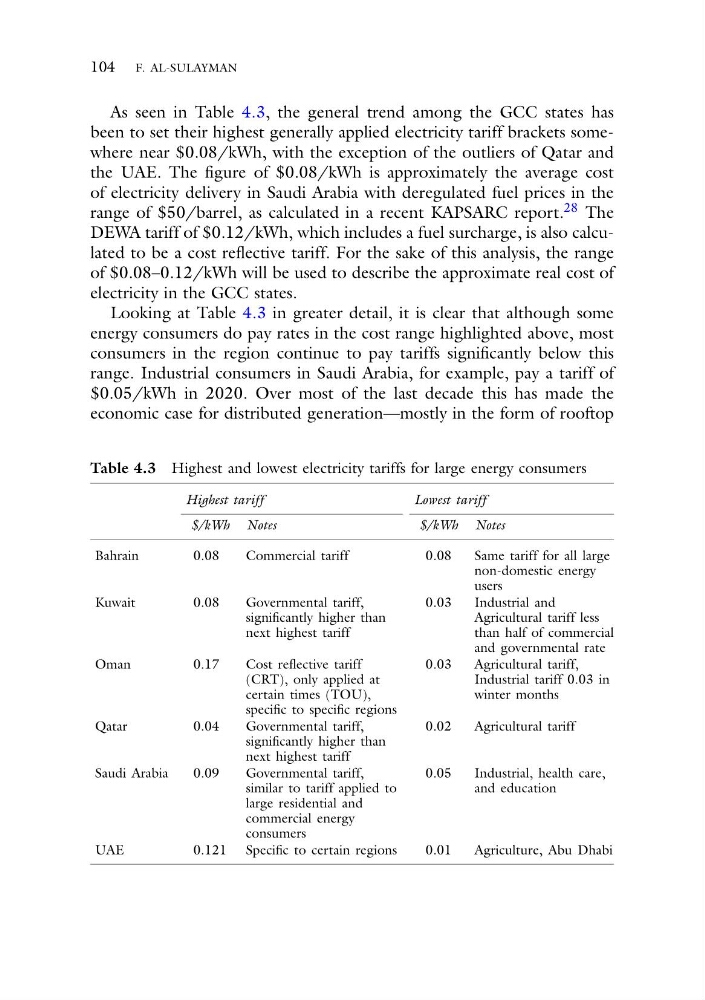
As seen in Table 4.3, the general trend among the GCC states has
been to set their highest generally applied electricity tariff brackets somewhere near $0.08/kWh, with the exception of the outliers of Qatar and
the UAE. The figure of $0.08/kWh is approximately the average cost
of electricity delivery in Saudi Arabia with deregulated fuel prices in the
range of $50/barrel, as calculated in a recent KAPSARC report. 28 The
DEWA tariff of $0.12/kWh, which includes a fuel surcharge, is also calculated to be a cost reflective tariff. For the sake of this analysis, the range
of $0.08–0.12/kWh will be used to describe the approximate real cost of
electricity in the GCC states.
Looking at Table 4.3 in greater detail, it is clear that although some
energy consumers do pay rates in the cost range highlighted above, most
consumers in the region continue to pay tariffs significantly below this
range. Industrial consumers in Saudi Arabia, for example, pay a tariff of
$0.05/kWh in 2020. Over most of the last decade this has made the
economic case for distributed generation—mostly in the form of rooftop
Table 4.3 Highest and lowest electricity tariffs for large energy consumers
Highest tariff
Lowest tariff
$/kWh Notes
$/kWh Notes
Bahrain
0.08
Commercial tariff
0.08
Same tariff for all large
non-domestic energy
users
Kuwait
0.08
Governmental tariff,
significantly higher than
next highest tariff
0.03
Industrial and
Agricultural tariff less
than half of commercial
and governmental rate
Oman
0.17
Cost reflective tariff
(CRT), only applied at
certain times (TOU),
specific to specific regions
0.03
Agricultural tariff,
Industrial tariff 0.03 in
winter months
Qatar
0.04
Governmental tariff,
significantly higher than
next highest tariff
0.02
Agricultural tariff
Saudi Arabia
0.09
Governmental tariff,
similar to tariff applied to
large residential and
commercial energy
consumers
0.05
Industrial, health care,
and education
UAE
0.121 Specific to certain regions
0.01
Agriculture, Abu Dhabi
As seen in Table 4.3, the general trend among the GCC states has
been to set their highest generally applied electricity tariff brackets somewhere near $0.08/kWh, with the exception of the outliers of Qatar and
the UAE. The figure of $0.08/kWh is approximately the average cost
of electricity delivery in Saudi Arabia with deregulated fuel prices in the
range of $50/barrel, as calculated in a recent KAPSARC report. 28 The
DEWA tariff of $0.12/kWh, which includes a fuel surcharge, is also calculated to be a cost reflective tariff. For the sake of this analysis, the range
of $0.08–0.12/kWh will be used to describe the approximate real cost of
electricity in the GCC states.
Looking at Table 4.3 in greater detail, it is clear that although some
energy consumers do pay rates in the cost range highlighted above, most
consumers in the region continue to pay tariffs significantly below this
range. Industrial consumers in Saudi Arabia, for example, pay a tariff of
$0.05/kWh in 2020. Over most of the last decade this has made the
economic case for distributed generation—mostly in the form of rooftop
Table 4.3 Highest and lowest electricity tariffs for large energy consumers
Highest tariff
Lowest tariff
$/kWh Notes
$/kWh Notes
Bahrain
0.08
Commercial tariff
0.08
Same tariff for all large
non-domestic energy
users
Kuwait
0.08
Governmental tariff,
significantly higher than
next highest tariff
0.03
Industrial and
Agricultural tariff less
than half of commercial
and governmental rate
Oman
0.17
Cost reflective tariff
(CRT), only applied at
certain times (TOU),
specific to specific regions
0.03
Agricultural tariff,
Industrial tariff 0.03 in
winter months
Qatar
0.04
Governmental tariff,
significantly higher than
next highest tariff
0.02
Agricultural tariff
Saudi Arabia
0.09
Governmental tariff,
similar to tariff applied to
large residential and
commercial energy
consumers
0.05
Industrial, health care,
and education
UAE
0.121 Specific to certain regions
0.01
Agriculture, Abu Dhabi