

Characteristics of Predominant Microorganisms in Food ◾ 17
limited transport and barrier functions. It contains porin, which allows the transport of selective
small molecules. The resistance of Gram-negative bacteria to many enzymes (lysozyme, which
hydrolyzes peptidoglycan), hydrophobic molecules (sodium dodecyl sulfate [SDS] and bile salts),
and antibiotics (penicillin) is because of the barrier property of the OM. LPS molecules also have
antigenic properties and are known as endotoxin. During infection with Gram-negative bacteria,
LPS is responsible for a rise in body temperature (fever). Beneath the OM is the CW, composed of
a thin layer of peptidoglycan or mucopeptide embedded in the periplasmic materials that contain
several types of proteins, enzymes, and toxins. Beneath the periplasmic materials is the plasma or
cytoplasmic membrane (CM) composed of a phospholipid bilayer in which many types of proteins
are embedded.
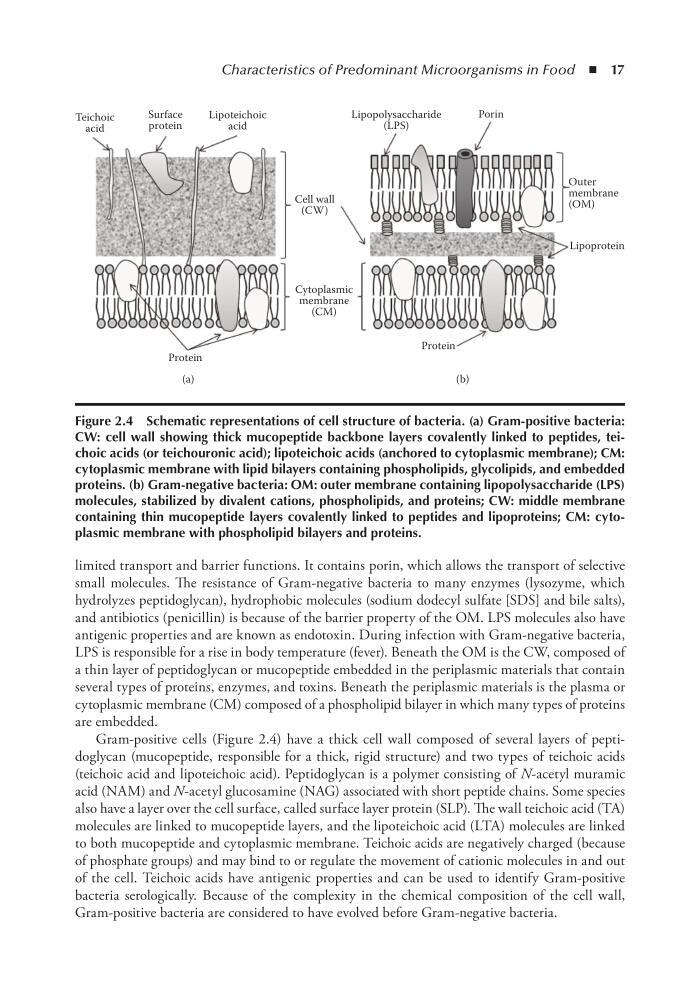
Gram-positive cells (Figure 2.4) have a thick cell wall composed of several layers of peptidoglycan (mucopeptide, responsible for a thick, rigid structure) and two types of teichoic acids
(teichoic acid and lipoteichoic acid). Peptidoglycan is a polymer consisting of N-acetyl muramic
acid (NAM) and N-acetyl glucosamine (NAG) associated with short peptide chains. Some species
also have a layer over the cell surface, called surface layer protein (SLP). The wall teichoic acid (TA)
molecules are linked to mucopeptide layers, and the lipoteichoic acid (LTA) molecules are linked
to both mucopeptide and cytoplasmic membrane. Teichoic acids are negatively charged (because
of phosphate groups) and may bind to or regulate the movement of cationic molecules in and out
of the cell. Teichoic acids have antigenic properties and can be used to identify Gram-positive
bacteria serologically. Because of the complexity in the chemical composition of the cell wall,
Gram-positive bacteria are considered to have evolved before Gram-negative bacteria.
Cell wall
(CW)
Porin
Lipopolysaccharide
(LPS)
Lipoteichoic
acid
Surface
protein
Teichoic
acid
Outer
membrane
(OM)
Lipoprotein
Protein
Protein
(b)
(a)
Cytoplasmic
membrane
(CM)
Figure 2.4 Schematic representations of cell structure of bacteria. (a) Gram-positive bacteria:
CW: cell wall showing thick mucopeptide backbone layers covalently linked to peptides, teichoic acids (or teichouronic acid); lipoteichoic acids (anchored to cytoplasmic membrane); CM:
cytoplasmic membrane with lipid bilayers containing phospholipids, glycolipids, and embedded
proteins. (b) Gram-negative bacteria: oM: outer membrane containing lipopolysaccharide (LPS)
molecules, stabilized by divalent cations, phospholipids, and proteins; CW: middle membrane
containing thin mucopeptide layers covalently linked to peptides and lipoproteins; CM: cytoplasmic membrane with phospholipid bilayers and proteins.
limited transport and barrier functions. It contains porin, which allows the transport of selective
small molecules. The resistance of Gram-negative bacteria to many enzymes (lysozyme, which
hydrolyzes peptidoglycan), hydrophobic molecules (sodium dodecyl sulfate [SDS] and bile salts),
and antibiotics (penicillin) is because of the barrier property of the OM. LPS molecules also have
antigenic properties and are known as endotoxin. During infection with Gram-negative bacteria,
LPS is responsible for a rise in body temperature (fever). Beneath the OM is the CW, composed of
a thin layer of peptidoglycan or mucopeptide embedded in the periplasmic materials that contain
several types of proteins, enzymes, and toxins. Beneath the periplasmic materials is the plasma or
cytoplasmic membrane (CM) composed of a phospholipid bilayer in which many types of proteins
are embedded.
Gram-positive cells (Figure 2.4) have a thick cell wall composed of several layers of peptidoglycan (mucopeptide, responsible for a thick, rigid structure) and two types of teichoic acids
(teichoic acid and lipoteichoic acid). Peptidoglycan is a polymer consisting of N-acetyl muramic
acid (NAM) and N-acetyl glucosamine (NAG) associated with short peptide chains. Some species
also have a layer over the cell surface, called surface layer protein (SLP). The wall teichoic acid (TA)
molecules are linked to mucopeptide layers, and the lipoteichoic acid (LTA) molecules are linked
to both mucopeptide and cytoplasmic membrane. Teichoic acids are negatively charged (because
of phosphate groups) and may bind to or regulate the movement of cationic molecules in and out
of the cell. Teichoic acids have antigenic properties and can be used to identify Gram-positive
bacteria serologically. Because of the complexity in the chemical composition of the cell wall,
Gram-positive bacteria are considered to have evolved before Gram-negative bacteria.
Cell wall
(CW)
Porin
Lipopolysaccharide
(LPS)
Lipoteichoic
acid
Surface
protein
Teichoic
acid
Outer
membrane
(OM)
Lipoprotein
Protein
Protein
(b)
(a)
Cytoplasmic
membrane
(CM)
Figure 2.4 Schematic representations of cell structure of bacteria. (a) Gram-positive bacteria:
CW: cell wall showing thick mucopeptide backbone layers covalently linked to peptides, teichoic acids (or teichouronic acid); lipoteichoic acids (anchored to cytoplasmic membrane); CM:
cytoplasmic membrane with lipid bilayers containing phospholipids, glycolipids, and embedded
proteins. (b) Gram-negative bacteria: oM: outer membrane containing lipopolysaccharide (LPS)
molecules, stabilized by divalent cations, phospholipids, and proteins; CW: middle membrane
containing thin mucopeptide layers covalently linked to peptides and lipoproteins; CM: cytoplasmic membrane with phospholipid bilayers and proteins.