

16 ◾ Fundamental Food Microbiology
An aggregate of hyphae is called mycelium. A hypha can be nonseptate, septate-uninucleate, or
septate-multinucleate. A hypha can be vegetative or reproductive. The reproductive hypha usually
extends in the air and forms exospores, either free (conidia) or in a sack (sporangium). Shape, size,
and color of spores are used for taxonomic classification.
Yeasts are widely distributed in nature. The cells are oval, spherical, or elongated, about 5–30 ×
2–10 μm in size (Figure 2.2). 4 They are nonmotile. The cell wall contains polysaccharides (glycans), proteins, and lipids. The wall can have scars, indicating the sites of budding. The membrane
is beneath the wall. The cytoplasm has a fine granular appearance for ribosomes and organelles.
The nucleus is well defined with a nuclear membrane.
Bacterial Cells
Bacteria are unicellular, most approximately 0.5–1.0 × 2.0–10 μm in size, and have three morphological forms: spherical (cocci), rod shaped (bacilli), and curved (comma) (Figure 2.2). They
can form associations, such as clusters, chains (two or more cells), or tetrads. They can be motile
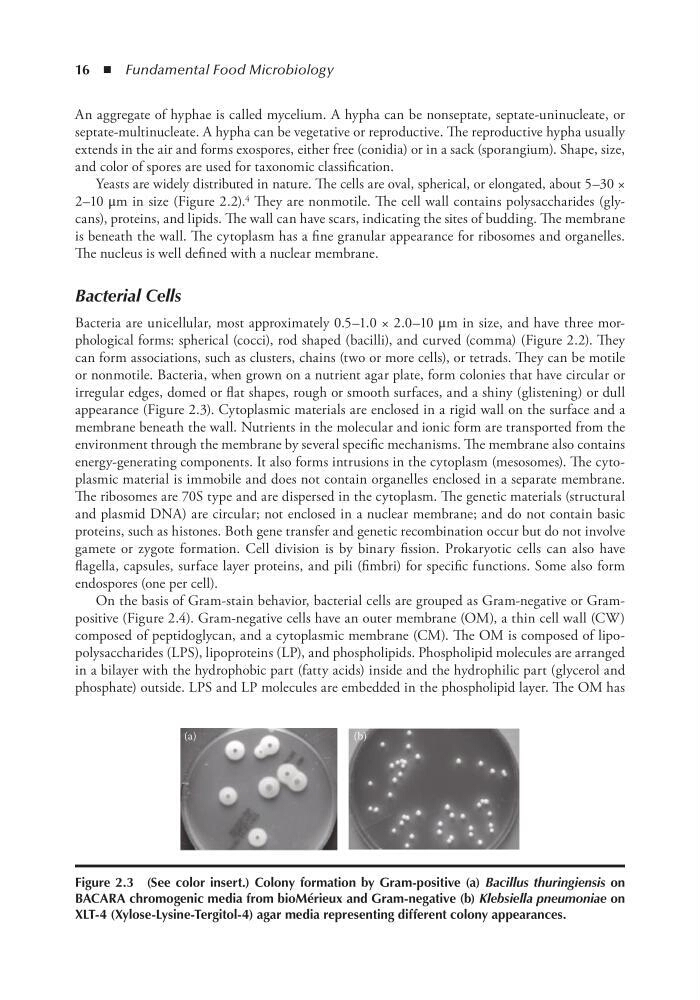
or nonmotile. Bacteria, when grown on a nutrient agar plate, form colonies that have circular or
irregular edges, domed or flat shapes, rough or smooth surfaces, and a shiny (glistening) or dull
appearance (Figure 2.3). Cytoplasmic materials are enclosed in a rigid wall on the surface and a
membrane beneath the wall. Nutrients in the molecular and ionic form are transported from the
environment through the membrane by several specific mechanisms. The membrane also contains
energy-generating components. It also forms intrusions in the cytoplasm (mesosomes). The cytoplasmic material is immobile and does not contain organelles enclosed in a separate membrane.
The ribosomes are 70S type and are dispersed in the cytoplasm. The genetic materials (structural
and plasmid DNA) are circular; not enclosed in a nuclear membrane; and do not contain basic
proteins, such as histones. Both gene transfer and genetic recombination occur but do not involve
gamete or zygote formation. Cell division is by binary fission. Prokaryotic cells can also have
flagella, capsules, surface layer proteins, and pili (fimbri) for specific functions. Some also form
endospores (one per cell).
On the basis of Gram-stain behavior, bacterial cells are grouped as Gram-negative or Grampositive (Figure 2.4). Gram-negative cells have an outer membrane (OM), a thin cell wall (CW)
composed of peptidoglycan, and a cytoplasmic membrane (CM). The OM is composed of lipopolysaccharides (LPS), lipoproteins (LP), and phospholipids. Phospholipid molecules are arranged
in a bilayer with the hydrophobic part (fatty acids) inside and the hydrophilic part (glycerol and
phosphate) outside. LPS and LP molecules are embedded in the phospholipid layer. The OM has
(a)
(b)
Figure 2.3 (See color insert.) Colony formation by Gram-positive (a) Bacillus thuringiensis on
BACARA chromogenic media from bioMérieux and Gram-negative (b) Klebsiella pneumoniae on
XLt-4 (Xylose-Lysine-tergitol-4) agar media representing different colony appearances.
An aggregate of hyphae is called mycelium. A hypha can be nonseptate, septate-uninucleate, or
septate-multinucleate. A hypha can be vegetative or reproductive. The reproductive hypha usually
extends in the air and forms exospores, either free (conidia) or in a sack (sporangium). Shape, size,
and color of spores are used for taxonomic classification.
Yeasts are widely distributed in nature. The cells are oval, spherical, or elongated, about 5–30 ×
2–10 μm in size (Figure 2.2). 4 They are nonmotile. The cell wall contains polysaccharides (glycans), proteins, and lipids. The wall can have scars, indicating the sites of budding. The membrane
is beneath the wall. The cytoplasm has a fine granular appearance for ribosomes and organelles.
The nucleus is well defined with a nuclear membrane.
Bacterial Cells
Bacteria are unicellular, most approximately 0.5–1.0 × 2.0–10 μm in size, and have three morphological forms: spherical (cocci), rod shaped (bacilli), and curved (comma) (Figure 2.2). They
can form associations, such as clusters, chains (two or more cells), or tetrads. They can be motile
or nonmotile. Bacteria, when grown on a nutrient agar plate, form colonies that have circular or
irregular edges, domed or flat shapes, rough or smooth surfaces, and a shiny (glistening) or dull
appearance (Figure 2.3). Cytoplasmic materials are enclosed in a rigid wall on the surface and a
membrane beneath the wall. Nutrients in the molecular and ionic form are transported from the
environment through the membrane by several specific mechanisms. The membrane also contains
energy-generating components. It also forms intrusions in the cytoplasm (mesosomes). The cytoplasmic material is immobile and does not contain organelles enclosed in a separate membrane.
The ribosomes are 70S type and are dispersed in the cytoplasm. The genetic materials (structural
and plasmid DNA) are circular; not enclosed in a nuclear membrane; and do not contain basic
proteins, such as histones. Both gene transfer and genetic recombination occur but do not involve
gamete or zygote formation. Cell division is by binary fission. Prokaryotic cells can also have
flagella, capsules, surface layer proteins, and pili (fimbri) for specific functions. Some also form
endospores (one per cell).
On the basis of Gram-stain behavior, bacterial cells are grouped as Gram-negative or Grampositive (Figure 2.4). Gram-negative cells have an outer membrane (OM), a thin cell wall (CW)
composed of peptidoglycan, and a cytoplasmic membrane (CM). The OM is composed of lipopolysaccharides (LPS), lipoproteins (LP), and phospholipids. Phospholipid molecules are arranged
in a bilayer with the hydrophobic part (fatty acids) inside and the hydrophilic part (glycerol and
phosphate) outside. LPS and LP molecules are embedded in the phospholipid layer. The OM has
(a)
(b)
Figure 2.3 (See color insert.) Colony formation by Gram-positive (a) Bacillus thuringiensis on
BACARA chromogenic media from bioMérieux and Gram-negative (b) Klebsiella pneumoniae on
XLt-4 (Xylose-Lysine-tergitol-4) agar media representing different colony appearances.