

558 ◾ Fundamental Food Microbiology
Light Scattering 28,44,45
Light-scattering technology differentiates samples based on refractive index, size, shape, and composition. Light scattering dates back many decades and has been used for many years in the semiconductor industry to detect defects on the semiconductor chips (wafers). When an illuminated
light from a polarized monochromatic light source shines on a sample (bacteria, for example),
scattered light forms distinct signature patterns that could be used for identification and detection
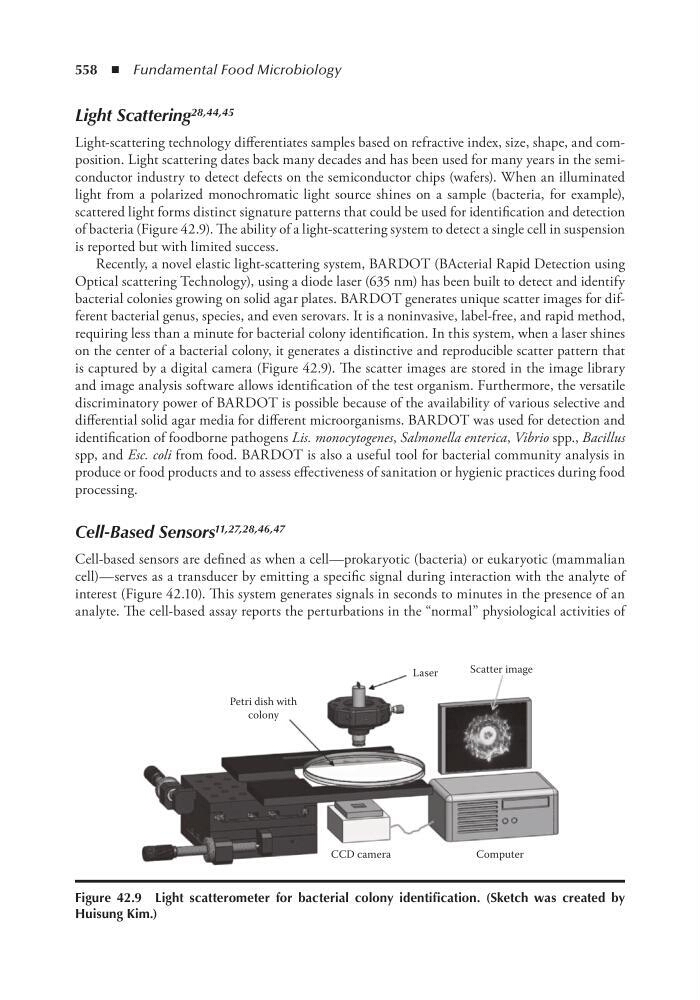
of bacteria (Figure 42.9). The ability of a light-scattering system to detect a single cell in suspension
is reported but with limited success.
Recently, a novel elastic light-scattering system, BARDOT (BActerial Rapid Detection using
Optical scattering Technology), using a diode laser (635 nm) has been built to detect and identify
bacterial colonies growing on solid agar plates. BARDOT generates unique scatter images for different bacterial genus, species, and even serovars. It is a noninvasive, label-free, and rapid method,
requiring less than a minute for bacterial colony identification. In this system, when a laser shines
on the center of a bacterial colony, it generates a distinctive and reproducible scatter pattern that
is captured by a digital camera (Figure 42.9). The scatter images are stored in the image library
and image analysis software allows identification of the test organism. Furthermore, the versatile
discriminatory power of BARDOT is possible because of the availability of various selective and
differential solid agar media for different microorganisms. BARDOT was used for detection and
identification of foodborne pathogens Lis. monocytogenes, Salmonella enterica, Vibrio spp., Bacillus
spp, and Esc. coli from food. BARDOT is also a useful tool for bacterial community analysis in
produce or food products and to assess effectiveness of sanitation or hygienic practices during food
processing.
Cell-Based Sensors 11,27,28,46,47
Cell-based sensors are defined as when a cell—prokaryotic (bacteria) or eukaryotic (mammalian
cell)—serves as a transducer by emitting a specific signal during interaction with the analyte of
interest (Figure 42.10). This system generates signals in seconds to minutes in the presence of an
analyte. The cell-based assay reports the perturbations in the “normal” physiological activities of
Petri dish with
colony
Laser
Scatter image
CCD camera
Computer
Figure 42.9 Light scatterometer for bacterial colony identification. (Sketch was created by
Huisung Kim.)
Light Scattering 28,44,45
Light-scattering technology differentiates samples based on refractive index, size, shape, and composition. Light scattering dates back many decades and has been used for many years in the semiconductor industry to detect defects on the semiconductor chips (wafers). When an illuminated
light from a polarized monochromatic light source shines on a sample (bacteria, for example),
scattered light forms distinct signature patterns that could be used for identification and detection
of bacteria (Figure 42.9). The ability of a light-scattering system to detect a single cell in suspension
is reported but with limited success.
Recently, a novel elastic light-scattering system, BARDOT (BActerial Rapid Detection using
Optical scattering Technology), using a diode laser (635 nm) has been built to detect and identify
bacterial colonies growing on solid agar plates. BARDOT generates unique scatter images for different bacterial genus, species, and even serovars. It is a noninvasive, label-free, and rapid method,
requiring less than a minute for bacterial colony identification. In this system, when a laser shines
on the center of a bacterial colony, it generates a distinctive and reproducible scatter pattern that
is captured by a digital camera (Figure 42.9). The scatter images are stored in the image library
and image analysis software allows identification of the test organism. Furthermore, the versatile
discriminatory power of BARDOT is possible because of the availability of various selective and
differential solid agar media for different microorganisms. BARDOT was used for detection and
identification of foodborne pathogens Lis. monocytogenes, Salmonella enterica, Vibrio spp., Bacillus
spp, and Esc. coli from food. BARDOT is also a useful tool for bacterial community analysis in
produce or food products and to assess effectiveness of sanitation or hygienic practices during food
processing.
Cell-Based Sensors 11,27,28,46,47
Cell-based sensors are defined as when a cell—prokaryotic (bacteria) or eukaryotic (mammalian
cell)—serves as a transducer by emitting a specific signal during interaction with the analyte of
interest (Figure 42.10). This system generates signals in seconds to minutes in the presence of an
analyte. The cell-based assay reports the perturbations in the “normal” physiological activities of
Petri dish with
colony
Laser
Scatter image
CCD camera
Computer
Figure 42.9 Light scatterometer for bacterial colony identification. (Sketch was created by
Huisung Kim.)