

Control by Antimicrobial Preservatives and Bacteriophages ◾ 501
control include Lis. monocytogenes, Salmonella, Escherichia coli O157:H7, Campylobacter jejuni,
Cronobacter sakazaki, and Staphylococcus aureus.
To select bacteriophages for food application, several criteria must be fulfilled: (i) they must
be strongly lytic, (ii) the host range should cover all epidemiologically significant strains, (iii) the
safety of phages must be thoroughly checked to ensure that they do not carry any genes for virulence, and (iv) they must be stable in the food environment in which they are intended for use. In
general, bacteriophages are stable at pH range 5–9 and are inactivated at 60°C for 30 minutes; thus
they are considered favorable attributes for food application. Several bacteriophages are approved
by the FDA for application in the food industry. In 2006, a commercial bacteriophage mixture of
six (LMP-102) has been approved for controlling Lis. monocytogenes in ready-to-eat meat and poultry products. Another commercial anti-Listeria phage product, LISTEX TM P100 received GRAS
status to control Lis. monocytogenes. Likewise, bacteriophages to control Escherichia coli O157:H7
and Salmonella in meat, cattle hides, and poultry feathers have received regulatory approval by
USDA-FSIS.
The advantages of bacteriophage use in food safety include (i) they infect only live bacterial
cells, (ii) interaction is highly host-specific (i.e., an E. coli–specific phage will not infect Salmonella
or other bacteria), (iii) the interaction with host bacteria is irreversible, (iv) there is no apparent ill
effect on humans or animals, and (v) the phages can be inactivated by thermal processing. The
disadvantages are (i) the bacteriophages do not work on bacterial toxins or any other microbes;
(ii) because a majority of foods are solid, diffusion/distribution of bacteriophages throughout the
food matrix when a target pathogen is present may be limited; (iii) high concentrations of phases
(1 × 10 8 PFU/mL) need to be applied to foods so that bacteriophages have the chance to come
in contact with fewer bacterial pathogens present in processed or minimally processed foods;
(iv) bacteriophages require live bacteria as a host, and if most target host cells are killed, desirable
bacteriophage titers may not be maintained in the product for prolonged duration; and (v) a narrow host spectrum sometimes makes bacteriophages undesirable as antimicrobials. To overcome
this problem, mixtures of bacteriophages (bacteriophage cocktails) are used.
Plaque
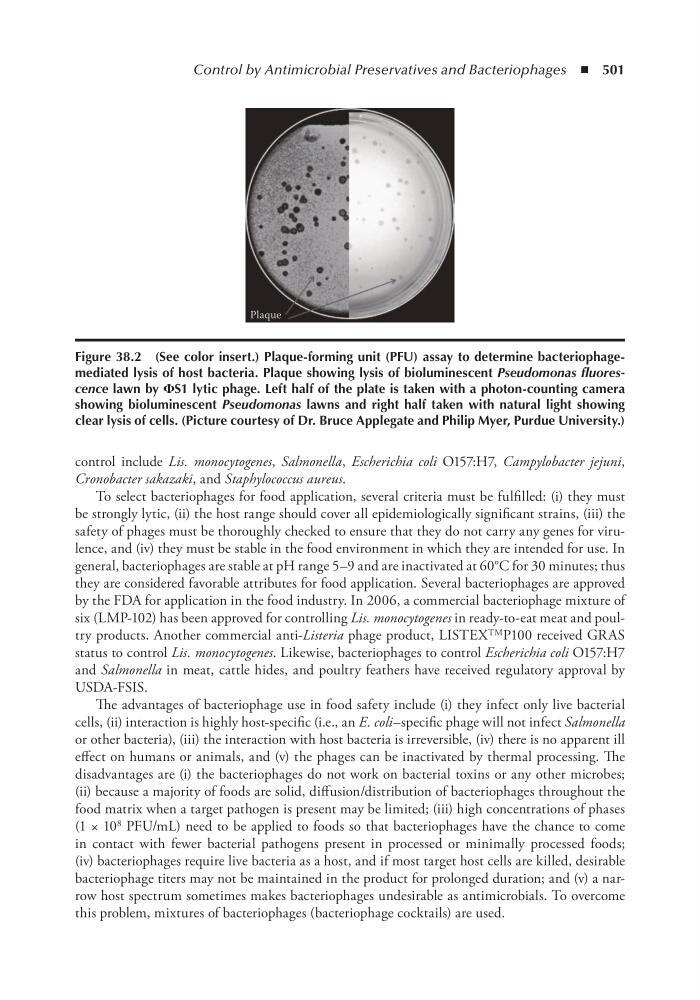
Figure 38.2 (See color insert.) Plaque-forming unit (PFU) assay to determine bacteriophagemediated lysis of host bacteria. Plaque showing lysis of bioluminescent Pseudomonas fluorescence lawn by ΦS1 lytic phage. Left half of the plate is taken with a photon-counting camera
showing bioluminescent Pseudomonas lawns and right half taken with natural light showing
clear lysis of cells. (Picture courtesy of Dr. Bruce Applegate and Philip Myer, Purdue University.)
control include Lis. monocytogenes, Salmonella, Escherichia coli O157:H7, Campylobacter jejuni,
Cronobacter sakazaki, and Staphylococcus aureus.
To select bacteriophages for food application, several criteria must be fulfilled: (i) they must
be strongly lytic, (ii) the host range should cover all epidemiologically significant strains, (iii) the
safety of phages must be thoroughly checked to ensure that they do not carry any genes for virulence, and (iv) they must be stable in the food environment in which they are intended for use. In
general, bacteriophages are stable at pH range 5–9 and are inactivated at 60°C for 30 minutes; thus
they are considered favorable attributes for food application. Several bacteriophages are approved
by the FDA for application in the food industry. In 2006, a commercial bacteriophage mixture of
six (LMP-102) has been approved for controlling Lis. monocytogenes in ready-to-eat meat and poultry products. Another commercial anti-Listeria phage product, LISTEX TM P100 received GRAS
status to control Lis. monocytogenes. Likewise, bacteriophages to control Escherichia coli O157:H7
and Salmonella in meat, cattle hides, and poultry feathers have received regulatory approval by
USDA-FSIS.
The advantages of bacteriophage use in food safety include (i) they infect only live bacterial
cells, (ii) interaction is highly host-specific (i.e., an E. coli–specific phage will not infect Salmonella
or other bacteria), (iii) the interaction with host bacteria is irreversible, (iv) there is no apparent ill
effect on humans or animals, and (v) the phages can be inactivated by thermal processing. The
disadvantages are (i) the bacteriophages do not work on bacterial toxins or any other microbes;
(ii) because a majority of foods are solid, diffusion/distribution of bacteriophages throughout the
food matrix when a target pathogen is present may be limited; (iii) high concentrations of phases
(1 × 10 8 PFU/mL) need to be applied to foods so that bacteriophages have the chance to come
in contact with fewer bacterial pathogens present in processed or minimally processed foods;
(iv) bacteriophages require live bacteria as a host, and if most target host cells are killed, desirable
bacteriophage titers may not be maintained in the product for prolonged duration; and (v) a narrow host spectrum sometimes makes bacteriophages undesirable as antimicrobials. To overcome
this problem, mixtures of bacteriophages (bacteriophage cocktails) are used.
Plaque
Figure 38.2 (See color insert.) Plaque-forming unit (PFU) assay to determine bacteriophagemediated lysis of host bacteria. Plaque showing lysis of bioluminescent Pseudomonas fluorescence lawn by ΦS1 lytic phage. Left half of the plate is taken with a photon-counting camera
showing bioluminescent Pseudomonas lawns and right half taken with natural light showing
clear lysis of cells. (Picture courtesy of Dr. Bruce Applegate and Philip Myer, Purdue University.)