

500 ◾ Fundamental Food Microbiology
cholera in India. Currently, it is being used in countries in Eastern Europe, especially in Russia
and Poland. Bacteriophages are now considered attractive therapeutic agents because of the emergence of antibiotic-resistant bacterial strains.
Bacteriophages to Control Pathogens in Food 11–13
As discussed in Chapter 14, the bacteriophage life cycle is of two types: (i) the virulent or lytic and
(ii) the temperate or lysogenic. The infection steps are comprised of initial attachment, penetration (injection of nucleic acid), the latent period, maturation, and lysis or lysogeny (Figure 14.3).
During attachment, bacteriophage tail fibers interact with a specific receptor on the bacterial
surface, and binding is irreversible. In the penetration step, viral nucleic acid is injected into the
host cell while the remainder of the viral body stays behind. In the latent period, integration of
phase DNA into the host genome, replication of the phage genome, viral protein transcription,
and translation occur. In the maturation phase, new phage components are assembled, and DNA
is packaged into heads, and virions are made. In the lysis phase, the bacteriophage makes two
lytic enzymes: holin to form a pore in the cytoplasmic membrane and endolysin to degrade peptidoglycan (cell wall), and all matured viruses are released from bacteria after lysis of the cells. In
the laboratory, bacteriophages are counted as plaque-forming units (PFU) based on the number
of plaques they form on a lawn of bacterial cells on an agar plate (Figure 38.2). The entire cycle
may last for one to two hours. In the lysogenic life cycle, viral DNA remains incorporated into
the host genome and maintained as prophage (temperate phage) without producing any virions or
lysis of bacteria.
Bacteriophage application in food safety is divided into two broad areas: (i) preharvest control of pathogens in meat-producing animals, and (ii) post-harvest control in raw or processed
foods. For preharvest controls, bacteriophages are either applied on hides or feathers or introduced orally or intramuscularly to prevent pathogen colonization in cattle, swine, and poultry.
The most common pathogens that were targeted for phage therapy include Listeria, Salmonella,
Escherichia, and Campylobacter. For post-harvest control of pathogens, phages are applied to raw or
processed meat (hotdogs, deli meats); smoked salmon; cheeses; fresh produce, such as sprouts, lettuce, melon, apples, cantaloupes, etc. The foodborne pathogens that were a target for post-harvest
(a)
(b)
(c)
Head
DNA
Head-tail connection
Tail shealth
Base plate
Tail fiber
0.2 µm
0.2 µm
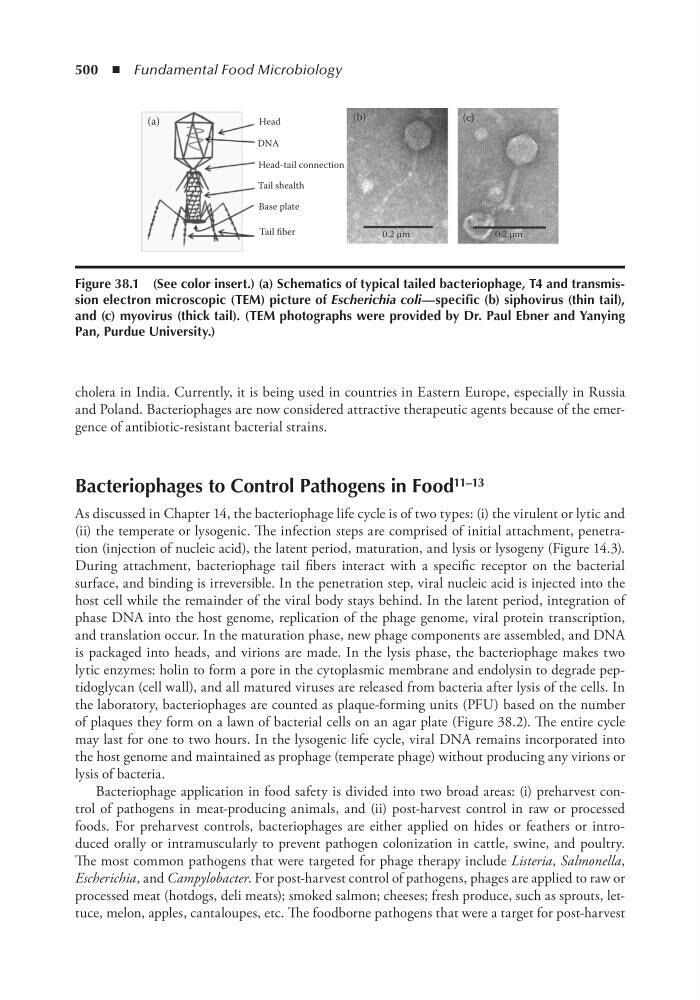
Figure 38.1 (See color insert.) (a) Schematics of typical tailed bacteriophage, t4 and transmission electron microscopic (teM) picture of Escherichia coli—specific (b) siphovirus (thin tail),
and (c) myovirus (thick tail). (teM photographs were provided by Dr. Paul ebner and Yanying
Pan, Purdue University.)
cholera in India. Currently, it is being used in countries in Eastern Europe, especially in Russia
and Poland. Bacteriophages are now considered attractive therapeutic agents because of the emergence of antibiotic-resistant bacterial strains.
Bacteriophages to Control Pathogens in Food 11–13
As discussed in Chapter 14, the bacteriophage life cycle is of two types: (i) the virulent or lytic and
(ii) the temperate or lysogenic. The infection steps are comprised of initial attachment, penetration (injection of nucleic acid), the latent period, maturation, and lysis or lysogeny (Figure 14.3).
During attachment, bacteriophage tail fibers interact with a specific receptor on the bacterial
surface, and binding is irreversible. In the penetration step, viral nucleic acid is injected into the
host cell while the remainder of the viral body stays behind. In the latent period, integration of
phase DNA into the host genome, replication of the phage genome, viral protein transcription,
and translation occur. In the maturation phase, new phage components are assembled, and DNA
is packaged into heads, and virions are made. In the lysis phase, the bacteriophage makes two
lytic enzymes: holin to form a pore in the cytoplasmic membrane and endolysin to degrade peptidoglycan (cell wall), and all matured viruses are released from bacteria after lysis of the cells. In
the laboratory, bacteriophages are counted as plaque-forming units (PFU) based on the number
of plaques they form on a lawn of bacterial cells on an agar plate (Figure 38.2). The entire cycle
may last for one to two hours. In the lysogenic life cycle, viral DNA remains incorporated into
the host genome and maintained as prophage (temperate phage) without producing any virions or
lysis of bacteria.
Bacteriophage application in food safety is divided into two broad areas: (i) preharvest control of pathogens in meat-producing animals, and (ii) post-harvest control in raw or processed
foods. For preharvest controls, bacteriophages are either applied on hides or feathers or introduced orally or intramuscularly to prevent pathogen colonization in cattle, swine, and poultry.
The most common pathogens that were targeted for phage therapy include Listeria, Salmonella,
Escherichia, and Campylobacter. For post-harvest control of pathogens, phages are applied to raw or
processed meat (hotdogs, deli meats); smoked salmon; cheeses; fresh produce, such as sprouts, lettuce, melon, apples, cantaloupes, etc. The foodborne pathogens that were a target for post-harvest
(a)
(b)
(c)
Head
DNA
Head-tail connection
Tail shealth
Base plate
Tail fiber
0.2 µm
0.2 µm
Figure 38.1 (See color insert.) (a) Schematics of typical tailed bacteriophage, t4 and transmission electron microscopic (teM) picture of Escherichia coli—specific (b) siphovirus (thin tail),
and (c) myovirus (thick tail). (teM photographs were provided by Dr. Paul ebner and Yanying
Pan, Purdue University.)