

492 ◾ Fundamental Food Microbiology
Food-Grade Chemicals
Nitrates and Nitrites
Sodium and potassium nitrites (NaNO 2 and KNO 2 ) or sodium and potassium nitrates (NaNO 3
and KNO 3 ) are used as curing agents in the meat. 7 Curing agents that contain nitrite, together
with NaCl, sugar, spices, ascorbate, and erythorbate, are permitted for use in heat-processed meat,
poultry, and fish products to control growth and toxin production by Clo. botulinum. Nitrate
and nitrite are also used in several European countries in some cheeses to prevent gas blowing
by Clo. butyricum and Clo. tyrobutyricum. The mechanisms of antibacterial action of nitrite are
not properly understood, but the inhibitory effect is probably produced in several ways, such as
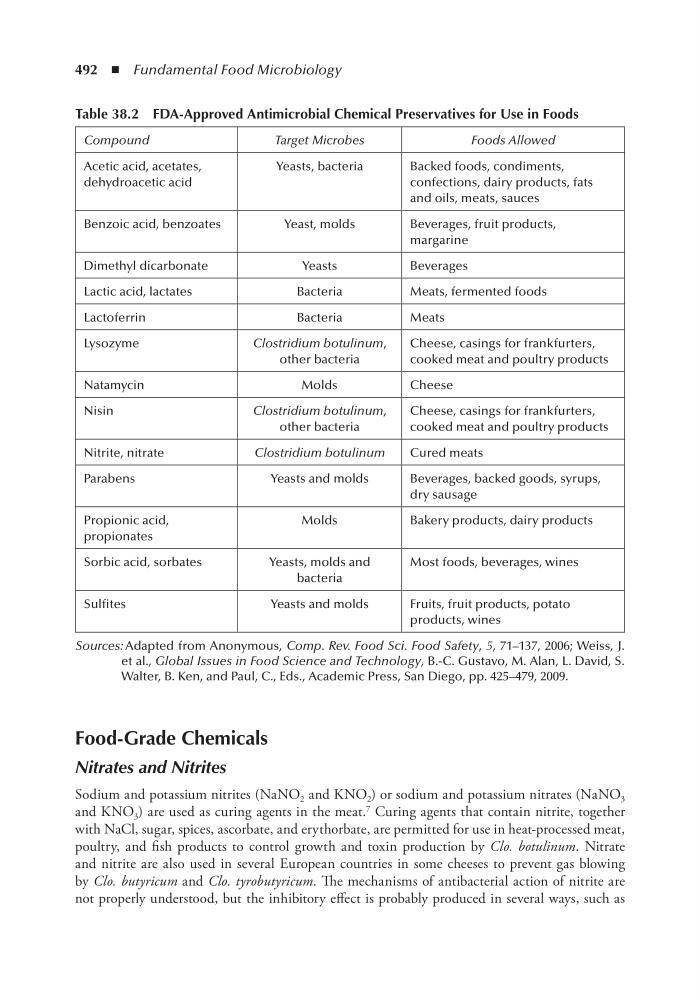
table 38.2 FDA-Approved Antimicrobial Chemical Preservatives for Use in Foods
Compound
Target Microbes
Foods Allowed
Acetic acid, acetates,
dehydroacetic acid
Yeasts, bacteria
Backed foods, condiments,
confections, dairy products, fats
and oils, meats, sauces
Benzoic acid, benzoates
Yeast, molds
Beverages, fruit products,
margarine
Dimethyl dicarbonate
Yeasts
Beverages
Lactic acid, lactates
Bacteria
Meats, fermented foods
Lactoferrin
Bacteria
Meats
Lysozyme
Clostridium botulinum,
other bacteria
Cheese, casings for frankfurters,
cooked meat and poultry products
Natamycin
Molds
Cheese
Nisin
Clostridium botulinum,
other bacteria
Cheese, casings for frankfurters,
cooked meat and poultry products
Nitrite, nitrate
Clostridium botulinum
Cured meats
Parabens
Yeasts and molds
Beverages, backed goods, syrups,
dry sausage
Propionic acid,
propionates
Molds
Bakery products, dairy products
Sorbic acid, sorbates
Yeasts, molds and
bacteria
Most foods, beverages, wines
Sulfites
Yeasts and molds
Fruits, fruit products, potato
products, wines
Sources: Adapted from Anonymous, Comp. Rev. Food Sci. Food Safety, 5, 71–137, 2006; Weiss, J.
et al., Global Issues in Food Science and Technology, B.-C. Gustavo, M. Alan, L. David, S.
Walter, B. Ken, and Paul, C., Eds., Academic Press, San Diego, pp. 425–479, 2009.
Food-Grade Chemicals
Nitrates and Nitrites
Sodium and potassium nitrites (NaNO 2 and KNO 2 ) or sodium and potassium nitrates (NaNO 3
and KNO 3 ) are used as curing agents in the meat. 7 Curing agents that contain nitrite, together
with NaCl, sugar, spices, ascorbate, and erythorbate, are permitted for use in heat-processed meat,
poultry, and fish products to control growth and toxin production by Clo. botulinum. Nitrate
and nitrite are also used in several European countries in some cheeses to prevent gas blowing
by Clo. butyricum and Clo. tyrobutyricum. The mechanisms of antibacterial action of nitrite are
not properly understood, but the inhibitory effect is probably produced in several ways, such as
table 38.2 FDA-Approved Antimicrobial Chemical Preservatives for Use in Foods
Compound
Target Microbes
Foods Allowed
Acetic acid, acetates,
dehydroacetic acid
Yeasts, bacteria
Backed foods, condiments,
confections, dairy products, fats
and oils, meats, sauces
Benzoic acid, benzoates
Yeast, molds
Beverages, fruit products,
margarine
Dimethyl dicarbonate
Yeasts
Beverages
Lactic acid, lactates
Bacteria
Meats, fermented foods
Lactoferrin
Bacteria
Meats
Lysozyme
Clostridium botulinum,
other bacteria
Cheese, casings for frankfurters,
cooked meat and poultry products
Natamycin
Molds
Cheese
Nisin
Clostridium botulinum,
other bacteria
Cheese, casings for frankfurters,
cooked meat and poultry products
Nitrite, nitrate
Clostridium botulinum
Cured meats
Parabens
Yeasts and molds
Beverages, backed goods, syrups,
dry sausage
Propionic acid,
propionates
Molds
Bakery products, dairy products
Sorbic acid, sorbates
Yeasts, molds and
bacteria
Most foods, beverages, wines
Sulfites
Yeasts and molds
Fruits, fruit products, potato
products, wines
Sources: Adapted from Anonymous, Comp. Rev. Food Sci. Food Safety, 5, 71–137, 2006; Weiss, J.
et al., Global Issues in Food Science and Technology, B.-C. Gustavo, M. Alan, L. David, S.
Walter, B. Ken, and Paul, C., Eds., Academic Press, San Diego, pp. 425–479, 2009.