

Control by Antimicrobial Preservatives and Bacteriophages ◾ 491
of microorganisms. Under such circumstances, a preservative that can effectively control the growth of
the microorganisms of concern can be used alone.
To be suitable for application in a food, a compound should not only have the desired antimicrobial property but also not affect the normal quality of a food (texture, flavor, or color). It should
not interact with food constituents and become inactive. It should have a high antimicrobial property at the pH, A W , Eh, and storage temperature of the food. It should be stable during the storage
life of the food. Finally, it should be economical and readily available.
The regulatory requirements include the expected effectiveness of an antimicrobial agent in a
food system. It should be effective in small concentrations and should not hide any fault of a food
(e.g., conceal poor quality and spoilage). Most importantly, it should be safe for human consumption. Finally, when required, it should be listed on the label, indicating its purpose in the food.
examples of Antimicrobial Preservatives
Foods can have antimicrobial compounds in three ways: present naturally, formed during processing, or added as ingredients. Antimicrobial agents may be of animal, plant, or microbial origin or from other food-grade chemicals. Those added have to be GRAS-listed and approved by
regulatory agencies. Some of these are added specifically as antimicrobial preservatives, whereas
others, although they have antimicrobial properties, are added for different reasons. Those in the
latter group are also called indirect antimicrobials. In this chapter, the antimicrobial effectiveness,
mode of action, and uses in foods of some inorganic and organic antimicrobials added to foods
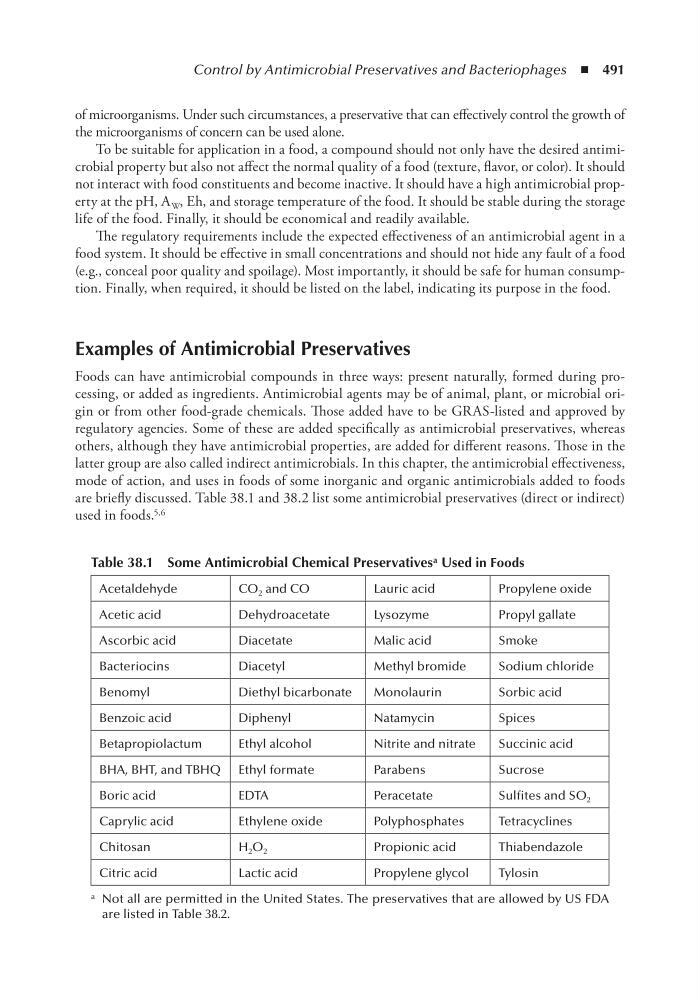
are briefly discussed. Table 38.1 and 38.2 list some antimicrobial preservatives (direct or indirect)
used in foods. 5,6
table 38.1 Some Antimicrobial Chemical Preservatives a Used in Foods
Acetaldehyde
CO 2 and CO
Lauric acid
Propylene oxide
Acetic acid
Dehydroacetate
Lysozyme
Propyl gallate
Ascorbic acid
Diacetate
Malic acid
Smoke
Bacteriocins
Diacetyl
Methyl bromide
Sodium chloride
Benomyl
Diethyl bicarbonate
Monolaurin
Sorbic acid
Benzoic acid
Diphenyl
Natamycin
Spices
Betapropiolactum
Ethyl alcohol
Nitrite and nitrate
Succinic acid
BHA, BHT, and TBHQ Ethyl formate
Parabens
Sucrose
Boric acid
EDTA
Peracetate
Sulfites and SO 2
Caprylic acid
Ethylene oxide
Polyphosphates
Tetracyclines
Chitosan
H 2 O 2
Propionic acid
Thiabendazole
Citric acid
Lactic acid
Propylene glycol
Tylosin
a Not all are permitted in the United States. The preservatives that are allowed by US FDA
are listed in Table 38.2.
of microorganisms. Under such circumstances, a preservative that can effectively control the growth of
the microorganisms of concern can be used alone.
To be suitable for application in a food, a compound should not only have the desired antimicrobial property but also not affect the normal quality of a food (texture, flavor, or color). It should
not interact with food constituents and become inactive. It should have a high antimicrobial property at the pH, A W , Eh, and storage temperature of the food. It should be stable during the storage
life of the food. Finally, it should be economical and readily available.
The regulatory requirements include the expected effectiveness of an antimicrobial agent in a
food system. It should be effective in small concentrations and should not hide any fault of a food
(e.g., conceal poor quality and spoilage). Most importantly, it should be safe for human consumption. Finally, when required, it should be listed on the label, indicating its purpose in the food.
examples of Antimicrobial Preservatives
Foods can have antimicrobial compounds in three ways: present naturally, formed during processing, or added as ingredients. Antimicrobial agents may be of animal, plant, or microbial origin or from other food-grade chemicals. Those added have to be GRAS-listed and approved by
regulatory agencies. Some of these are added specifically as antimicrobial preservatives, whereas
others, although they have antimicrobial properties, are added for different reasons. Those in the
latter group are also called indirect antimicrobials. In this chapter, the antimicrobial effectiveness,
mode of action, and uses in foods of some inorganic and organic antimicrobials added to foods
are briefly discussed. Table 38.1 and 38.2 list some antimicrobial preservatives (direct or indirect)
used in foods. 5,6
table 38.1 Some Antimicrobial Chemical Preservatives a Used in Foods
Acetaldehyde
CO 2 and CO
Lauric acid
Propylene oxide
Acetic acid
Dehydroacetate
Lysozyme
Propyl gallate
Ascorbic acid
Diacetate
Malic acid
Smoke
Bacteriocins
Diacetyl
Methyl bromide
Sodium chloride
Benomyl
Diethyl bicarbonate
Monolaurin
Sorbic acid
Benzoic acid
Diphenyl
Natamycin
Spices
Betapropiolactum
Ethyl alcohol
Nitrite and nitrate
Succinic acid
BHA, BHT, and TBHQ Ethyl formate
Parabens
Sucrose
Boric acid
EDTA
Peracetate
Sulfites and SO 2
Caprylic acid
Ethylene oxide
Polyphosphates
Tetracyclines
Chitosan
H 2 O 2
Propionic acid
Thiabendazole
Citric acid
Lactic acid
Propylene glycol
Tylosin
a Not all are permitted in the United States. The preservatives that are allowed by US FDA
are listed in Table 38.2.