

454 ◾ Fundamental Food Microbiology
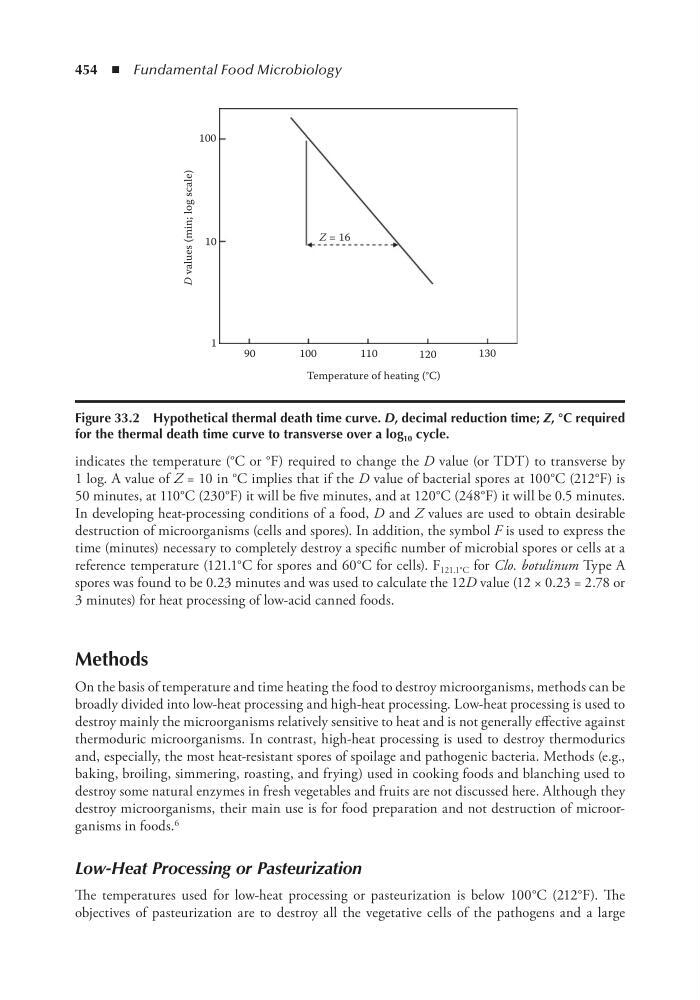
indicates the temperature (°C or °F) required to change the D value (or TDT) to transverse by
1 log. A value of Z = 10 in °C implies that if the D value of bacterial spores at 100°C (212°F) is
50 minutes, at 110°C (230°F) it will be five minutes, and at 120°C (248°F) it will be 0.5 minutes.
In developing heat-processing conditions of a food, D and Z values are used to obtain desirable
destruction of microorganisms (cells and spores). In addition, the symbol F is used to express the
time (minutes) necessary to completely destroy a specific number of microbial spores or cells at a
reference temperature (121.1°C for spores and 60°C for cells). F 121.1°C for Clo. botulinum Type A
spores was found to be 0.23 minutes and was used to calculate the 12D value (12 × 0.23 = 2.78 or
3 minutes) for heat processing of low-acid canned foods.
Methods
On the basis of temperature and time heating the food to destroy microorganisms, methods can be
broadly divided into low-heat processing and high-heat processing. Low-heat processing is used to
destroy mainly the microorganisms relatively sensitive to heat and is not generally effective against
thermoduric microorganisms. In contrast, high-heat processing is used to destroy thermodurics
and, especially, the most heat-resistant spores of spoilage and pathogenic bacteria. Methods (e.g.,
baking, broiling, simmering, roasting, and frying) used in cooking foods and blanching used to
destroy some natural enzymes in fresh vegetables and fruits are not discussed here. Although they
destroy microorganisms, their main use is for food preparation and not destruction of microorganisms in foods. 6
Low-Heat Processing or Pasteurization
The temperatures used for low-heat processing or pasteurization is below 100°C (212°F). The
objectives of pasteurization are to destroy all the vegetative cells of the pathogens and a large
100
10
Z = 16
1
90
100
110
120
130
Temperature of heating (°C)
D
values (min; log scale)
Figure 33.2 Hypothetical thermal death time curve. D, decimal reduction time; Z, °C required
for the thermal death time curve to transverse over a log 10 cycle.
indicates the temperature (°C or °F) required to change the D value (or TDT) to transverse by
1 log. A value of Z = 10 in °C implies that if the D value of bacterial spores at 100°C (212°F) is
50 minutes, at 110°C (230°F) it will be five minutes, and at 120°C (248°F) it will be 0.5 minutes.
In developing heat-processing conditions of a food, D and Z values are used to obtain desirable
destruction of microorganisms (cells and spores). In addition, the symbol F is used to express the
time (minutes) necessary to completely destroy a specific number of microbial spores or cells at a
reference temperature (121.1°C for spores and 60°C for cells). F 121.1°C for Clo. botulinum Type A
spores was found to be 0.23 minutes and was used to calculate the 12D value (12 × 0.23 = 2.78 or
3 minutes) for heat processing of low-acid canned foods.
Methods
On the basis of temperature and time heating the food to destroy microorganisms, methods can be
broadly divided into low-heat processing and high-heat processing. Low-heat processing is used to
destroy mainly the microorganisms relatively sensitive to heat and is not generally effective against
thermoduric microorganisms. In contrast, high-heat processing is used to destroy thermodurics
and, especially, the most heat-resistant spores of spoilage and pathogenic bacteria. Methods (e.g.,
baking, broiling, simmering, roasting, and frying) used in cooking foods and blanching used to
destroy some natural enzymes in fresh vegetables and fruits are not discussed here. Although they
destroy microorganisms, their main use is for food preparation and not destruction of microorganisms in foods. 6
Low-Heat Processing or Pasteurization
The temperatures used for low-heat processing or pasteurization is below 100°C (212°F). The
objectives of pasteurization are to destroy all the vegetative cells of the pathogens and a large
100
10
Z = 16
1
90
100
110
120
130
Temperature of heating (°C)
D
values (min; log scale)
Figure 33.2 Hypothetical thermal death time curve. D, decimal reduction time; Z, °C required
for the thermal death time curve to transverse over a log 10 cycle.