

452 ◾ Fundamental Food Microbiology
heat sensitivity. This is especially important if a food is heat treated on the basis of results obtained
by using a heat-sensitive species or strain but contains heat-resistant variants.
Cells at the exponential stage of growth are more susceptible to heat than resting cells (stationary phase). Also, cells previously exposed to low heat become relatively resistant to subsequent heat
treatment (a result of the synthesis of stress proteins). 4 Finally, the higher the initial microbial load
in a food, the longer the time it takes at a given temperature to reduce the population to a predetermined level. This is because the rate of heat destruction of microorganisms follows first-order
kinetics, which is discussed later. This suggests the importance of lower initial microbial loads
(through sanitation and controlling growth) in a food before heat treatment.
Nature of Process
Microbial destruction in food by heat is expressed in terms of its exposure to a specific temperature for a period of time, and these are inversely related: The higher the temperature, the shorter
the period of time required to obtain the same amount of destruction when other factors are kept
constant. As a food is heated by conduction (molecule-to-molecule energy transfer) and convection (movement of heated molecules), a liquid food is heated more rapidly than a solid food, and
a container with high conduction (metal) is better. Also, food in a small container is heated more
rapidly than in a large container. A product can have a cold point at the center (in a solid food in
a can) or near the end (in a liquid food in a can), which may not attain the desired temperature
within the given time. Finally, it needs to be emphasized that heating a food at a given temperature
for a specific time means that every particle of that food should be heated to the specified temperature (say 71.6°C or 161°F) and stay at that temperature for the specified time (15 seconds used
in milk pasteurization). This time is also called the holding time. The time during which milk is
heated before the temperature reaches 161°F in this case is not considered (but considered in the
commercial sterilization process, which uses a much higher temperature).
Mathematical expressions
When a population of microbial cell suspension is heated at a specific temperature, the cells die at
a constant rate. This observation helps in expressing the microbial death rate resulting from heat
as a function of time and temperature under a given condition. These expressions are helpful to
design a heat-treatment method for a food.
Decimal Reduction Time (D Value)
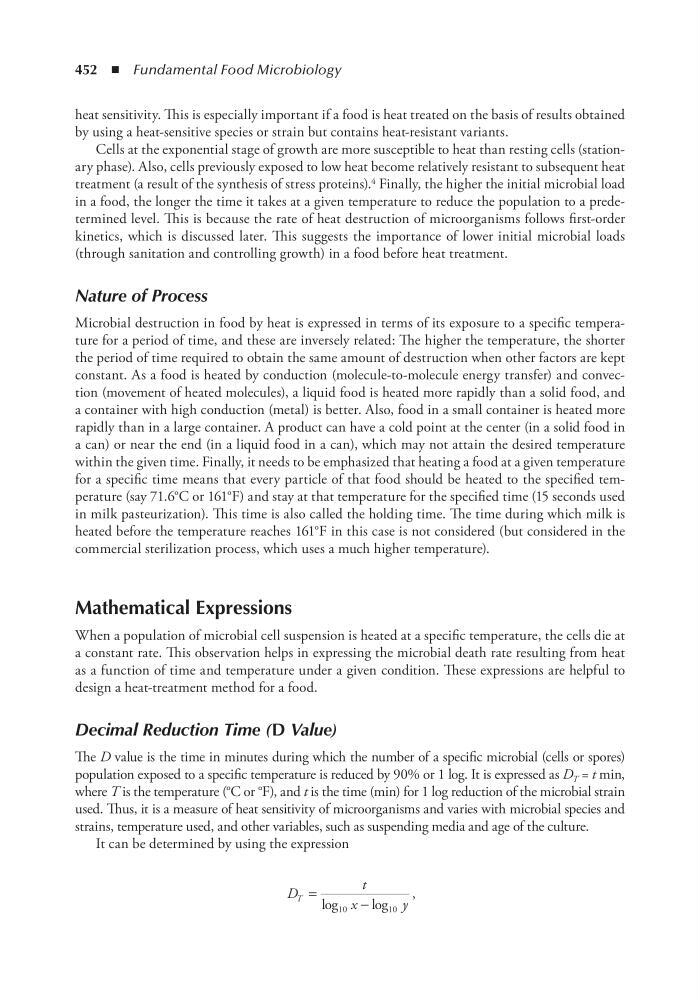
The D value is the time in minutes during which the number of a specific microbial (cells or spores)
population exposed to a specific temperature is reduced by 90% or 1 log. It is expressed as D T = t min,
where T is the temperature (°C or °F), and t is the time (min) for 1 log reduction of the microbial strain
used. Thus, it is a measure of heat sensitivity of microorganisms and varies with microbial species and
strains, temperature used, and other variables, such as suspending media and age of the culture.
It can be determined by using the expression
D
t
x
y
T =
−
log
log
10
10
,
heat sensitivity. This is especially important if a food is heat treated on the basis of results obtained
by using a heat-sensitive species or strain but contains heat-resistant variants.
Cells at the exponential stage of growth are more susceptible to heat than resting cells (stationary phase). Also, cells previously exposed to low heat become relatively resistant to subsequent heat
treatment (a result of the synthesis of stress proteins). 4 Finally, the higher the initial microbial load
in a food, the longer the time it takes at a given temperature to reduce the population to a predetermined level. This is because the rate of heat destruction of microorganisms follows first-order
kinetics, which is discussed later. This suggests the importance of lower initial microbial loads
(through sanitation and controlling growth) in a food before heat treatment.
Nature of Process
Microbial destruction in food by heat is expressed in terms of its exposure to a specific temperature for a period of time, and these are inversely related: The higher the temperature, the shorter
the period of time required to obtain the same amount of destruction when other factors are kept
constant. As a food is heated by conduction (molecule-to-molecule energy transfer) and convection (movement of heated molecules), a liquid food is heated more rapidly than a solid food, and
a container with high conduction (metal) is better. Also, food in a small container is heated more
rapidly than in a large container. A product can have a cold point at the center (in a solid food in
a can) or near the end (in a liquid food in a can), which may not attain the desired temperature
within the given time. Finally, it needs to be emphasized that heating a food at a given temperature
for a specific time means that every particle of that food should be heated to the specified temperature (say 71.6°C or 161°F) and stay at that temperature for the specified time (15 seconds used
in milk pasteurization). This time is also called the holding time. The time during which milk is
heated before the temperature reaches 161°F in this case is not considered (but considered in the
commercial sterilization process, which uses a much higher temperature).
Mathematical expressions
When a population of microbial cell suspension is heated at a specific temperature, the cells die at
a constant rate. This observation helps in expressing the microbial death rate resulting from heat
as a function of time and temperature under a given condition. These expressions are helpful to
design a heat-treatment method for a food.
Decimal Reduction Time (D Value)
The D value is the time in minutes during which the number of a specific microbial (cells or spores)
population exposed to a specific temperature is reduced by 90% or 1 log. It is expressed as D T = t min,
where T is the temperature (°C or °F), and t is the time (min) for 1 log reduction of the microbial strain
used. Thus, it is a measure of heat sensitivity of microorganisms and varies with microbial species and
strains, temperature used, and other variables, such as suspending media and age of the culture.
It can be determined by using the expression
D
t
x
y
T =
−
log
log
10
10
,