

New and Emerging Foodborne Pathogens ◾ 413
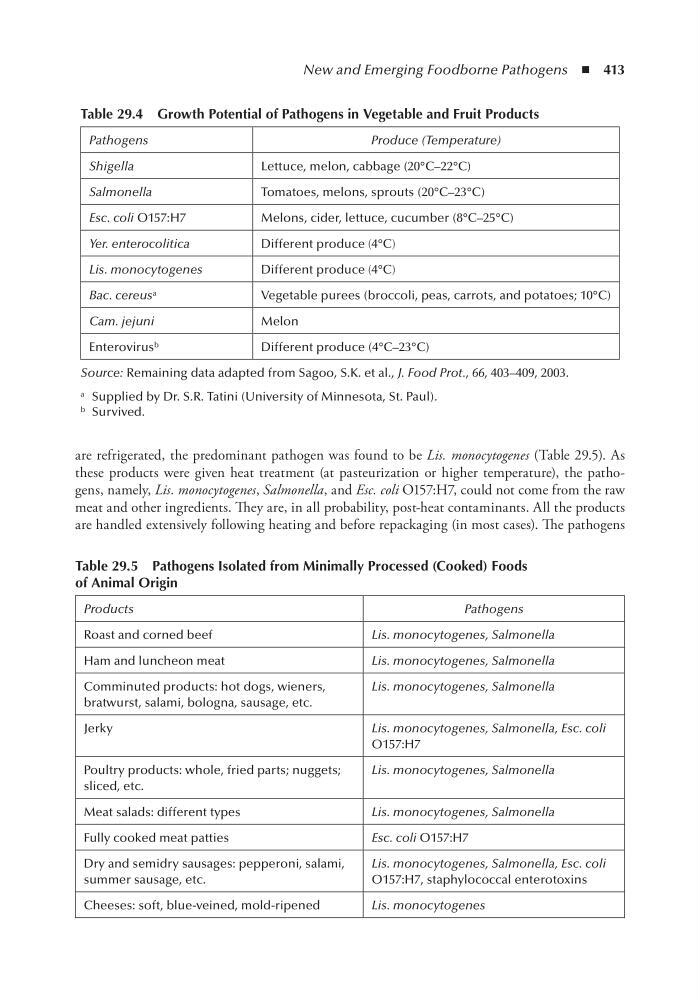
are refrigerated, the predominant pathogen was found to be Lis. monocytogenes (Table 29.5). As
these products were given heat treatment (at pasteurization or higher temperature), the pathogens, namely, Lis. monocytogenes, Salmonella, and Esc. coli O157:H7, could not come from the raw
meat and other ingredients. They are, in all probability, post-heat contaminants. All the products
are handled extensively following heating and before repackaging (in most cases). The pathogens
table 29.4 Growth Potential of Pathogens in Vegetable and Fruit Products
Pathogens
Produce (Temperature)
Shigella
Lettuce, melon, cabbage (20°C–22°C)
Salmonella
Tomatoes, melons, sprouts (20°C–23°C)
Esc. coli O157:H7
Melons, cider, lettuce, cucumber (8°C–25°C)
Yer. enterocolitica
Different produce (4°C)
Lis. monocytogenes
Different produce (4°C)
Bac. cereus a
Vegetable purees (broccoli, peas, carrots, and potatoes; 10°C)
Cam. jejuni
Melon
Enterovirus b
Different produce (4°C–23°C)
Source: Remaining data adapted from Sagoo, S.K. et al., J. Food Prot., 66, 403–409, 2003.
a Supplied by Dr. S.R. Tatini (University of Minnesota, St. Paul).
b Survived.
table 29.5 Pathogens isolated from Minimally Processed (Cooked) Foods
of Animal origin
Products
Pathogens
Roast and corned beef
Lis. monocytogenes, Salmonella
Ham and luncheon meat
Lis. monocytogenes, Salmonella
Comminuted products: hot dogs, wieners,
bratwurst, salami, bologna, sausage, etc.
Lis. monocytogenes, Salmonella
Jerky
Lis. monocytogenes, Salmonella, Esc. coli
O157:H7
Poultry products: whole, fried parts; nuggets;
sliced, etc.
Lis. monocytogenes, Salmonella
Meat salads: different types
Lis. monocytogenes, Salmonella
Fully cooked meat patties
Esc. coli O157:H7
Dry and semidry sausages: pepperoni, salami,
summer sausage, etc.
Lis. monocytogenes, Salmonella, Esc. coli
O157:H7, staphylococcal enterotoxins
Cheeses: soft, blue-veined, mold-ripened
Lis. monocytogenes
are refrigerated, the predominant pathogen was found to be Lis. monocytogenes (Table 29.5). As
these products were given heat treatment (at pasteurization or higher temperature), the pathogens, namely, Lis. monocytogenes, Salmonella, and Esc. coli O157:H7, could not come from the raw
meat and other ingredients. They are, in all probability, post-heat contaminants. All the products
are handled extensively following heating and before repackaging (in most cases). The pathogens
table 29.4 Growth Potential of Pathogens in Vegetable and Fruit Products
Pathogens
Produce (Temperature)
Shigella
Lettuce, melon, cabbage (20°C–22°C)
Salmonella
Tomatoes, melons, sprouts (20°C–23°C)
Esc. coli O157:H7
Melons, cider, lettuce, cucumber (8°C–25°C)
Yer. enterocolitica
Different produce (4°C)
Lis. monocytogenes
Different produce (4°C)
Bac. cereus a
Vegetable purees (broccoli, peas, carrots, and potatoes; 10°C)
Cam. jejuni
Melon
Enterovirus b
Different produce (4°C–23°C)
Source: Remaining data adapted from Sagoo, S.K. et al., J. Food Prot., 66, 403–409, 2003.
a Supplied by Dr. S.R. Tatini (University of Minnesota, St. Paul).
b Survived.
table 29.5 Pathogens isolated from Minimally Processed (Cooked) Foods
of Animal origin
Products
Pathogens
Roast and corned beef
Lis. monocytogenes, Salmonella
Ham and luncheon meat
Lis. monocytogenes, Salmonella
Comminuted products: hot dogs, wieners,
bratwurst, salami, bologna, sausage, etc.
Lis. monocytogenes, Salmonella
Jerky
Lis. monocytogenes, Salmonella, Esc. coli
O157:H7
Poultry products: whole, fried parts; nuggets;
sliced, etc.
Lis. monocytogenes, Salmonella
Meat salads: different types
Lis. monocytogenes, Salmonella
Fully cooked meat patties
Esc. coli O157:H7
Dry and semidry sausages: pepperoni, salami,
summer sausage, etc.
Lis. monocytogenes, Salmonella, Esc. coli
O157:H7, staphylococcal enterotoxins
Cheeses: soft, blue-veined, mold-ripened
Lis. monocytogenes