

412 ◾ Fundamental Food Microbiology
at refrigerated temperature. Chapter 21 gives examples of many psychrotrophic bacteria being
associated with the spoilage of minimally processed foods. Most of these spoilage bacteria gain
access to the products as post-heat contaminants, generally in low numbers; during long storage,
they multiply to reach the spoilage-detection levels. Many of them are new spoilage bacteria or
bacteria not previously suspected to be spoilage bacteria. A similar situation can exist for the presence of pathogens in minimally processed foods. The storage temperature of these products ranges
from 4°C to 15°C or more (during display). Psychrotrophic and many mesophilic pathogens can
multiply during storage and from a very low contamination level (e.g., ca. 1/25 g) can reach the
hazard potential level.
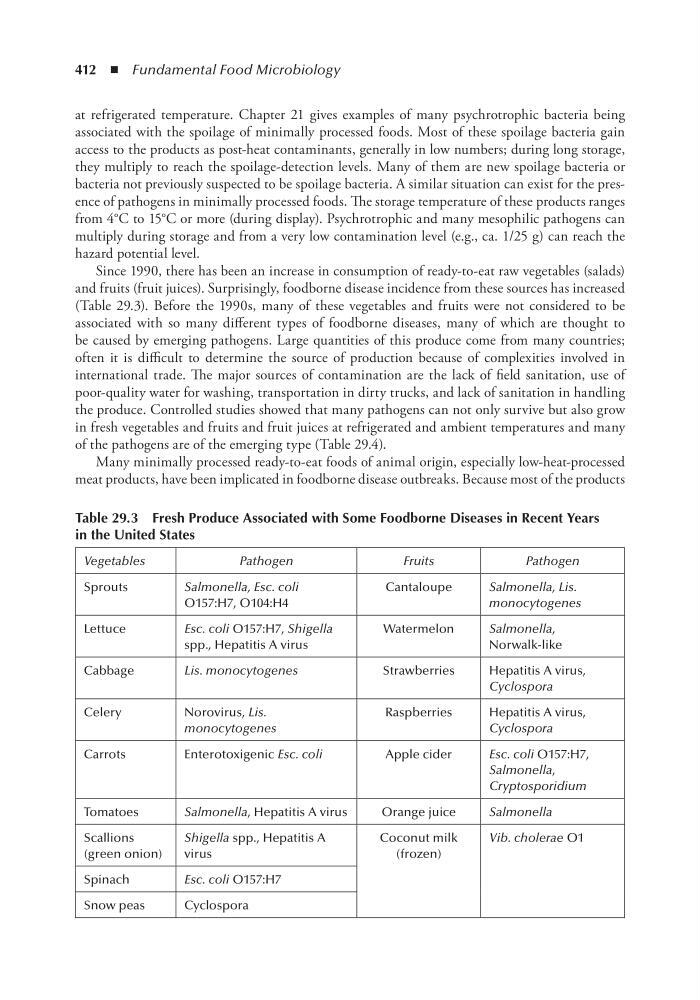
Since 1990, there has been an increase in consumption of ready-to-eat raw vegetables (salads)
and fruits (fruit juices). Surprisingly, foodborne disease incidence from these sources has increased
(Table 29.3). Before the 1990s, many of these vegetables and fruits were not considered to be
associated with so many different types of foodborne diseases, many of which are thought to
be caused by emerging pathogens. Large quantities of this produce come from many countries;
often it is difficult to determine the source of production because of complexities involved in
international trade. The major sources of contamination are the lack of field sanitation, use of
poor-quality water for washing, transportation in dirty trucks, and lack of sanitation in handling
the produce. Controlled studies showed that many pathogens can not only survive but also grow
in fresh vegetables and fruits and fruit juices at refrigerated and ambient temperatures and many
of the pathogens are of the emerging type (Table 29.4).
Many minimally processed ready-to-eat foods of animal origin, especially low-heat-processed
meat products, have been implicated in foodborne disease outbreaks. Because most of the products
table 29.3 Fresh Produce Associated with Some Foodborne Diseases in Recent Years
in the United States
Vegetables
Pathogen
Fruits
Pathogen
Sprouts
Salmonella, Esc. coli
O157:H7, O104:H4
Cantaloupe
Salmonella, Lis.
monocytogenes
Lettuce
Esc. coli O157:H7, Shigella
spp., Hepatitis A virus
Watermelon
Salmonella,
Norwalk-like
Cabbage
Lis. monocytogenes
Strawberries
Hepatitis A virus,
Cyclospora
Celery
Norovirus, Lis.
monocytogenes
Raspberries
Hepatitis A virus,
Cyclospora
Carrots
Enterotoxigenic Esc. coli
Apple cider
Esc. coli O157:H7,
Salmonella,
Cryptosporidium
Tomatoes
Salmonella, Hepatitis A virus
Orange juice
Salmonella
Scallions
(green onion)
Shigella spp., Hepatitis A
virus
Coconut milk
(frozen)
Vib. cholerae O1
Spinach
Esc. coli O157:H7
Snow peas
Cyclospora
at refrigerated temperature. Chapter 21 gives examples of many psychrotrophic bacteria being
associated with the spoilage of minimally processed foods. Most of these spoilage bacteria gain
access to the products as post-heat contaminants, generally in low numbers; during long storage,
they multiply to reach the spoilage-detection levels. Many of them are new spoilage bacteria or
bacteria not previously suspected to be spoilage bacteria. A similar situation can exist for the presence of pathogens in minimally processed foods. The storage temperature of these products ranges
from 4°C to 15°C or more (during display). Psychrotrophic and many mesophilic pathogens can
multiply during storage and from a very low contamination level (e.g., ca. 1/25 g) can reach the
hazard potential level.
Since 1990, there has been an increase in consumption of ready-to-eat raw vegetables (salads)
and fruits (fruit juices). Surprisingly, foodborne disease incidence from these sources has increased
(Table 29.3). Before the 1990s, many of these vegetables and fruits were not considered to be
associated with so many different types of foodborne diseases, many of which are thought to
be caused by emerging pathogens. Large quantities of this produce come from many countries;
often it is difficult to determine the source of production because of complexities involved in
international trade. The major sources of contamination are the lack of field sanitation, use of
poor-quality water for washing, transportation in dirty trucks, and lack of sanitation in handling
the produce. Controlled studies showed that many pathogens can not only survive but also grow
in fresh vegetables and fruits and fruit juices at refrigerated and ambient temperatures and many
of the pathogens are of the emerging type (Table 29.4).
Many minimally processed ready-to-eat foods of animal origin, especially low-heat-processed
meat products, have been implicated in foodborne disease outbreaks. Because most of the products
table 29.3 Fresh Produce Associated with Some Foodborne Diseases in Recent Years
in the United States
Vegetables
Pathogen
Fruits
Pathogen
Sprouts
Salmonella, Esc. coli
O157:H7, O104:H4
Cantaloupe
Salmonella, Lis.
monocytogenes
Lettuce
Esc. coli O157:H7, Shigella
spp., Hepatitis A virus
Watermelon
Salmonella,
Norwalk-like
Cabbage
Lis. monocytogenes
Strawberries
Hepatitis A virus,
Cyclospora
Celery
Norovirus, Lis.
monocytogenes
Raspberries
Hepatitis A virus,
Cyclospora
Carrots
Enterotoxigenic Esc. coli
Apple cider
Esc. coli O157:H7,
Salmonella,
Cryptosporidium
Tomatoes
Salmonella, Hepatitis A virus
Orange juice
Salmonella
Scallions
(green onion)
Shigella spp., Hepatitis A
virus
Coconut milk
(frozen)
Vib. cholerae O1
Spinach
Esc. coli O157:H7
Snow peas
Cyclospora