

New and Emerging Foodborne Pathogens ◾ 409
the convergence model takes into account the complex interaction among humans, pathogens,
domestic and wild animals, and the environment, some of which are summarized in Table 29.2.
Better Knowledge of Pathogens
There are more than 200 known microbial, chemical, or physical agents that can cause foodborne
illness when ingested. The Centers for Disease Control and Prevention (CDC) estimates that
foodborne agents affect 48 million people, 128,000 hospitalizations, and 3,000 deaths annually
in the United States, of which 9.4 million cases are attributed to 31 known pathogens while the
etiological agents for 38.4 million cases, that is, 90% of cases are not known. 3 In general, among
etiological agents, bacterial and viral pathogens are the major causes of foodborne illnesses. Many
of these with unknown etiology are considered to be of bacterial, viral, parasitic, or other origins,
such as mushroom and marine biotoxins, metals, and other inorganic toxins, or emerging pathogens for which no diagnostic tests have been developed. In a reported outbreak, when the food
and environmental samples and samples from the patients are available, they are examined for
the presence of the most likely or most common pathogens. Thus, in many incidents, the samples
will usually not be tested for pathogens that are not considered at that time to be a foodborne
pathogen. This is generally the situation with reported sporadic cases or small outbreaks. In case
of a large outbreak or a similar type of outbreak occurring frequently or if the incident results in
death or severe consequences, the samples are generally tested for other suspected pathogens along
with the common foodborne pathogens. Most of the new foodborne pathogens were discovered
this way. In the United States, the association of Yer. enterocolitica, Cam. jejuni, Lis. monocytogenes,
Cronobacter sakazaki and Esc. coli O157:H7 in foodborne outbreaks has been confirmed this way.
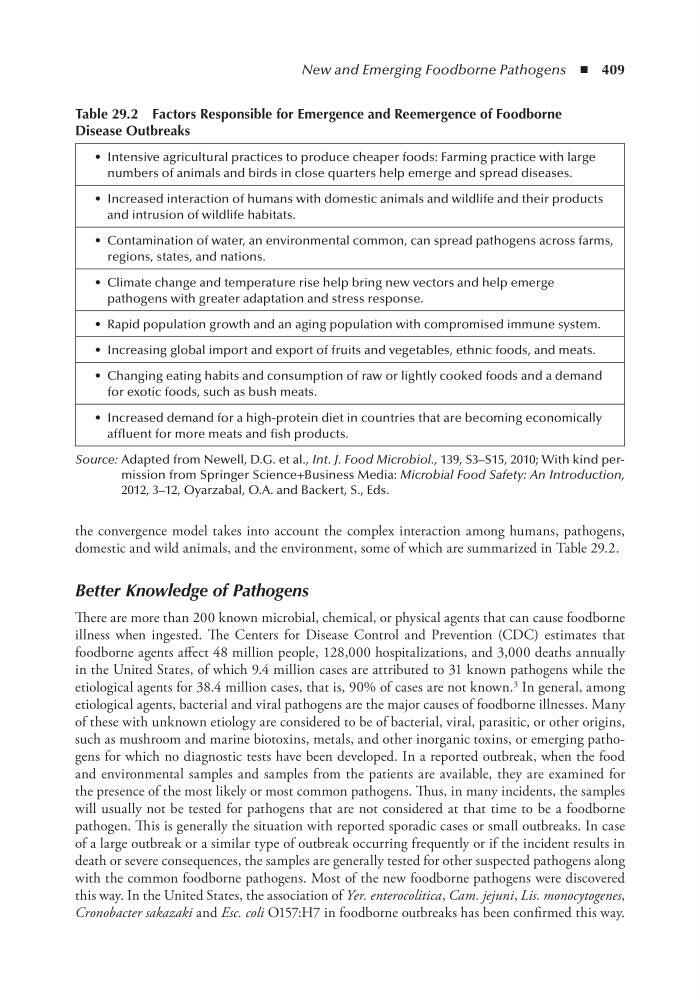
table 29.2 Factors Responsible for emergence and Reemergence of Foodborne
Disease outbreaks
• Intensive agricultural practices to produce cheaper foods: Farming practice with large
numbers of animals and birds in close quarters help emerge and spread diseases.
• Increased interaction of humans with domestic animals and wildlife and their products
and intrusion of wildlife habitats.
• Contamination of water, an environmental common, can spread pathogens across farms,
regions, states, and nations.
• Climate change and temperature rise help bring new vectors and help emerge
pathogens with greater adaptation and stress response.
• Rapid population growth and an aging population with compromised immune system.
• Increasing global import and export of fruits and vegetables, ethnic foods, and meats.
• Changing eating habits and consumption of raw or lightly cooked foods and a demand
for exotic foods, such as bush meats.
• Increased demand for a high-protein diet in countries that are becoming economically
affluent for more meats and fish products.
Source: Adapted from Newell, D.G. et al., Int. J. Food Microbiol., 139, S3–S15, 2010; With kind permission from Springer Science+Business Media: Microbial Food Safety: An Introduction,
2012, 3–12, Oyarzabal, O.A. and Backert, S., Eds.
the convergence model takes into account the complex interaction among humans, pathogens,
domestic and wild animals, and the environment, some of which are summarized in Table 29.2.
Better Knowledge of Pathogens
There are more than 200 known microbial, chemical, or physical agents that can cause foodborne
illness when ingested. The Centers for Disease Control and Prevention (CDC) estimates that
foodborne agents affect 48 million people, 128,000 hospitalizations, and 3,000 deaths annually
in the United States, of which 9.4 million cases are attributed to 31 known pathogens while the
etiological agents for 38.4 million cases, that is, 90% of cases are not known. 3 In general, among
etiological agents, bacterial and viral pathogens are the major causes of foodborne illnesses. Many
of these with unknown etiology are considered to be of bacterial, viral, parasitic, or other origins,
such as mushroom and marine biotoxins, metals, and other inorganic toxins, or emerging pathogens for which no diagnostic tests have been developed. In a reported outbreak, when the food
and environmental samples and samples from the patients are available, they are examined for
the presence of the most likely or most common pathogens. Thus, in many incidents, the samples
will usually not be tested for pathogens that are not considered at that time to be a foodborne
pathogen. This is generally the situation with reported sporadic cases or small outbreaks. In case
of a large outbreak or a similar type of outbreak occurring frequently or if the incident results in
death or severe consequences, the samples are generally tested for other suspected pathogens along
with the common foodborne pathogens. Most of the new foodborne pathogens were discovered
this way. In the United States, the association of Yer. enterocolitica, Cam. jejuni, Lis. monocytogenes,
Cronobacter sakazaki and Esc. coli O157:H7 in foodborne outbreaks has been confirmed this way.
table 29.2 Factors Responsible for emergence and Reemergence of Foodborne
Disease outbreaks
• Intensive agricultural practices to produce cheaper foods: Farming practice with large
numbers of animals and birds in close quarters help emerge and spread diseases.
• Increased interaction of humans with domestic animals and wildlife and their products
and intrusion of wildlife habitats.
• Contamination of water, an environmental common, can spread pathogens across farms,
regions, states, and nations.
• Climate change and temperature rise help bring new vectors and help emerge
pathogens with greater adaptation and stress response.
• Rapid population growth and an aging population with compromised immune system.
• Increasing global import and export of fruits and vegetables, ethnic foods, and meats.
• Changing eating habits and consumption of raw or lightly cooked foods and a demand
for exotic foods, such as bush meats.
• Increased demand for a high-protein diet in countries that are becoming economically
affluent for more meats and fish products.
Source: Adapted from Newell, D.G. et al., Int. J. Food Microbiol., 139, S3–S15, 2010; With kind permission from Springer Science+Business Media: Microbial Food Safety: An Introduction,
2012, 3–12, Oyarzabal, O.A. and Backert, S., Eds.