

408 ◾ Fundamental Food Microbiology
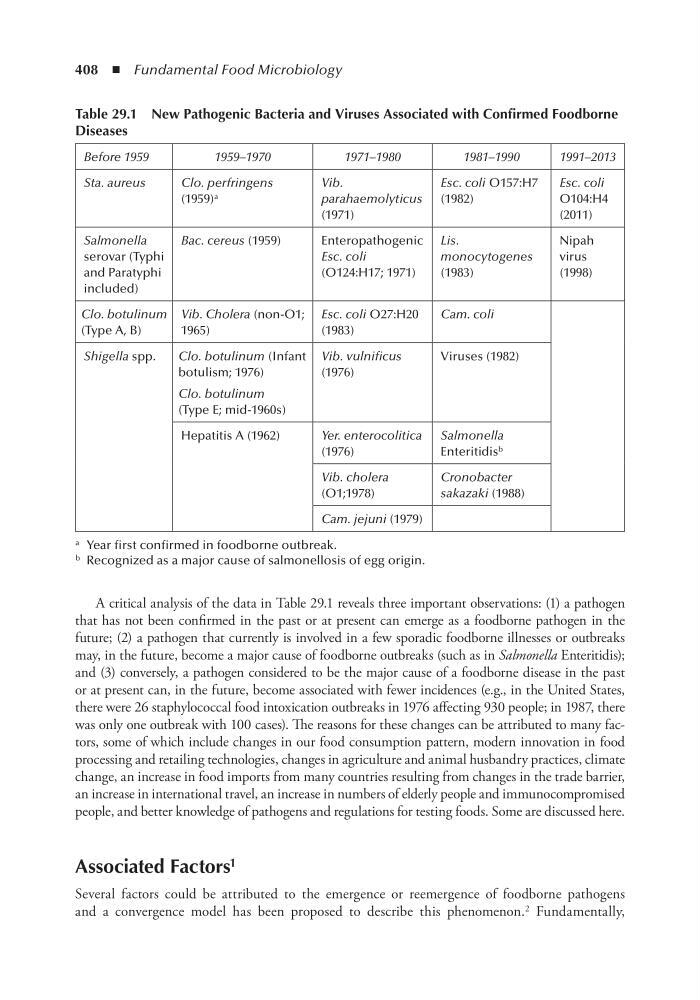
A critical analysis of the data in Table 29.1 reveals three important observations: (1) a pathogen
that has not been confirmed in the past or at present can emerge as a foodborne pathogen in the
future; (2) a pathogen that currently is involved in a few sporadic foodborne illnesses or outbreaks
may, in the future, become a major cause of foodborne outbreaks (such as in Salmonella Enteritidis);
and (3) conversely, a pathogen considered to be the major cause of a foodborne disease in the past
or at present can, in the future, become associated with fewer incidences (e.g., in the United States,
there were 26 staphylococcal food intoxication outbreaks in 1976 affecting 930 people; in 1987, there
was only one outbreak with 100 cases). The reasons for these changes can be attributed to many factors, some of which include changes in our food consumption pattern, modern innovation in food
processing and retailing technologies, changes in agriculture and animal husbandry practices, climate
change, an increase in food imports from many countries resulting from changes in the trade barrier,
an increase in international travel, an increase in numbers of elderly people and immunocompromised
people, and better knowledge of pathogens and regulations for testing foods. Some are discussed here.
Associated Factors 1
Several factors could be attributed to the emergence or reemergence of foodborne pathogens
and a convergence model has been proposed to describe this phenomenon. 2 Fundamentally,
table 29.1 new Pathogenic Bacteria and Viruses Associated with Confirmed Foodborne
Diseases
Before 1959
1959–1970
1971–1980
1981–1990
1991–2013
Sta. aureus
Clo. perfringens
(1959) a
Vib.
parahaemolyticus
(1971)
Esc. coli O157:H7
(1982)
Esc. coli
O104:H4
(2011)
Salmonella
serovar (Typhi
and Paratyphi
included)
Bac. cereus (1959)
Enteropathogenic
Esc. coli
(O124:H17; 1971)
Lis.
monocytogenes
(1983)
Nipah
virus
(1998)
Clo. botulinum
(Type A, B)
Vib. Cholera (non-O1;
1965)
Esc. coli O27:H20
(1983)
Cam. coli
Shigella spp.
Clo. botulinum (Infant
botulism; 1976)
Clo. botulinum
(Type E; mid-1960s)
Vib. vulnificus
(1976)
Viruses (1982)
Hepatitis A (1962)
Yer. enterocolitica
(1976)
Salmonella
Enteritidis b
Vib. cholera
(O1;1978)
Cronobacter
sakazaki (1988)
Cam. jejuni (1979)
a Year first confirmed in foodborne outbreak.
b Recognized as a major cause of salmonellosis of egg origin.
A critical analysis of the data in Table 29.1 reveals three important observations: (1) a pathogen
that has not been confirmed in the past or at present can emerge as a foodborne pathogen in the
future; (2) a pathogen that currently is involved in a few sporadic foodborne illnesses or outbreaks
may, in the future, become a major cause of foodborne outbreaks (such as in Salmonella Enteritidis);
and (3) conversely, a pathogen considered to be the major cause of a foodborne disease in the past
or at present can, in the future, become associated with fewer incidences (e.g., in the United States,
there were 26 staphylococcal food intoxication outbreaks in 1976 affecting 930 people; in 1987, there
was only one outbreak with 100 cases). The reasons for these changes can be attributed to many factors, some of which include changes in our food consumption pattern, modern innovation in food
processing and retailing technologies, changes in agriculture and animal husbandry practices, climate
change, an increase in food imports from many countries resulting from changes in the trade barrier,
an increase in international travel, an increase in numbers of elderly people and immunocompromised
people, and better knowledge of pathogens and regulations for testing foods. Some are discussed here.
Associated Factors 1
Several factors could be attributed to the emergence or reemergence of foodborne pathogens
and a convergence model has been proposed to describe this phenomenon. 2 Fundamentally,
table 29.1 new Pathogenic Bacteria and Viruses Associated with Confirmed Foodborne
Diseases
Before 1959
1959–1970
1971–1980
1981–1990
1991–2013
Sta. aureus
Clo. perfringens
(1959) a
Vib.
parahaemolyticus
(1971)
Esc. coli O157:H7
(1982)
Esc. coli
O104:H4
(2011)
Salmonella
serovar (Typhi
and Paratyphi
included)
Bac. cereus (1959)
Enteropathogenic
Esc. coli
(O124:H17; 1971)
Lis.
monocytogenes
(1983)
Nipah
virus
(1998)
Clo. botulinum
(Type A, B)
Vib. Cholera (non-O1;
1965)
Esc. coli O27:H20
(1983)
Cam. coli
Shigella spp.
Clo. botulinum (Infant
botulism; 1976)
Clo. botulinum
(Type E; mid-1960s)
Vib. vulnificus
(1976)
Viruses (1982)
Hepatitis A (1962)
Yer. enterocolitica
(1976)
Salmonella
Enteritidis b
Vib. cholera
(O1;1978)
Cronobacter
sakazaki (1988)
Cam. jejuni (1979)
a Year first confirmed in foodborne outbreak.
b Recognized as a major cause of salmonellosis of egg origin.