

Foodborne Toxico-Infections ◾ 377
following consumption of a food containing the viable cells. Symptoms include abdominal pain,
profuse watery diarrhea, and perhaps nausea, but no vomiting or fever. Recovery is usually within
24 hours. These symptoms in many respects are similar to those produced by Clo. perfringens.
In the emetic form, the symptoms occur one to five hours following ingestion of a food containing the toxin and viable cells. As the toxin is heat stable, once the toxin is formed in cells,
heating food containing a large number of cells before eating can still cause disease. Symptoms
are nausea and vomiting; abdominal pain and diarrhea may also be present. Symptoms last for
approximately 24 hours and are self-limiting. In some respects, the symptoms are similar to those
of staphylococcal gastroenteritis.
Food Association
Many types of food can contain small numbers of cells and spores of Bac. cereus. Consumption of
these foods does not cause the disease. However, when these foods are abused to facilitate spore
germination and cell multiplication, the population of live cells can reach the high levels necessary
for the disease. In the diarrheal outbreaks, a variety of foods, including vegetables, salads, meats,
pudding, casseroles, sauces, and soups, has been implicated, mostly because of their improper
cooling. However, in the emetic form, outbreaks mostly involve rice, pasta, and sometimes other
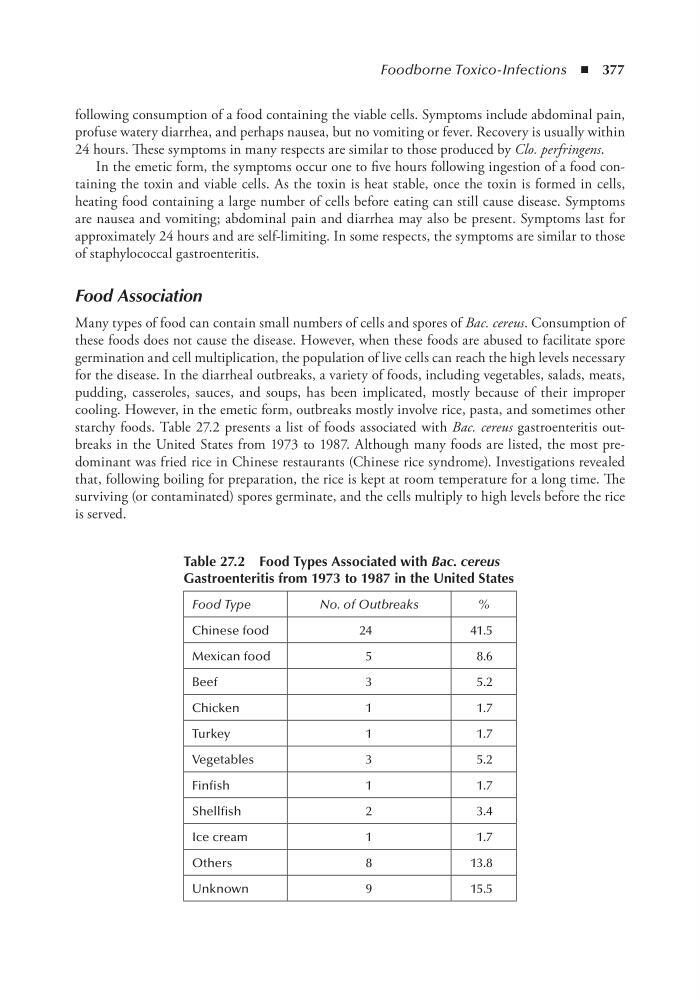
starchy foods. Table 27.2 presents a list of foods associated with Bac. cereus gastroenteritis outbreaks in the United States from 1973 to 1987. Although many foods are listed, the most predominant was fried rice in Chinese restaurants (Chinese rice syndrome). Investigations revealed
that, following boiling for preparation, the rice is kept at room temperature for a long time. The
surviving (or contaminated) spores germinate, and the cells multiply to high levels before the rice
is served.
table 27.2 Food types Associated with Bac. cereus
Gastroenteritis from 1973 to 1987 in the United States
Food Type
No. of Outbreaks
%
Chinese food
24
41.5
Mexican food
5
8.6
Beef
3
5.2
Chicken
1
1.7
Turkey
1
1.7
Vegetables
3
5.2
Finfish
1
1.7
Shellfish
2
3.4
Ice cream
1
1.7
Others
8
13.8
Unknown
9
15.5
following consumption of a food containing the viable cells. Symptoms include abdominal pain,
profuse watery diarrhea, and perhaps nausea, but no vomiting or fever. Recovery is usually within
24 hours. These symptoms in many respects are similar to those produced by Clo. perfringens.
In the emetic form, the symptoms occur one to five hours following ingestion of a food containing the toxin and viable cells. As the toxin is heat stable, once the toxin is formed in cells,
heating food containing a large number of cells before eating can still cause disease. Symptoms
are nausea and vomiting; abdominal pain and diarrhea may also be present. Symptoms last for
approximately 24 hours and are self-limiting. In some respects, the symptoms are similar to those
of staphylococcal gastroenteritis.
Food Association
Many types of food can contain small numbers of cells and spores of Bac. cereus. Consumption of
these foods does not cause the disease. However, when these foods are abused to facilitate spore
germination and cell multiplication, the population of live cells can reach the high levels necessary
for the disease. In the diarrheal outbreaks, a variety of foods, including vegetables, salads, meats,
pudding, casseroles, sauces, and soups, has been implicated, mostly because of their improper
cooling. However, in the emetic form, outbreaks mostly involve rice, pasta, and sometimes other
starchy foods. Table 27.2 presents a list of foods associated with Bac. cereus gastroenteritis outbreaks in the United States from 1973 to 1987. Although many foods are listed, the most predominant was fried rice in Chinese restaurants (Chinese rice syndrome). Investigations revealed
that, following boiling for preparation, the rice is kept at room temperature for a long time. The
surviving (or contaminated) spores germinate, and the cells multiply to high levels before the rice
is served.
table 27.2 Food types Associated with Bac. cereus
Gastroenteritis from 1973 to 1987 in the United States
Food Type
No. of Outbreaks
%
Chinese food
24
41.5
Mexican food
5
8.6
Beef
3
5.2
Chicken
1
1.7
Turkey
1
1.7
Vegetables
3
5.2
Finfish
1
1.7
Shellfish
2
3.4
Ice cream
1
1.7
Others
8
13.8
Unknown
9
15.5