

Foodborne Bacterial Infections ◾ 351
Pathogenic Escherichia coli
Importance
Since its discovery in 1885 by Theodor Escheric, Escherichia coli was considered as a harmless, gramnegative, motile, nonsporulating, rod-shaped, facultative anaerobic bacterium, a normal inhabitant
of the intestinal tract of humans and warm-blooded animals and birds. Because it is normally present at a very high level (in millions per gram of the content of the large intestine), for a long time
it has been used as an index organism of possible fecal contamination and the presence of enteric
pathogens in food and water (see Chapter 30). Since the mid-1940s, evidence has accumulated that
certain Esc. coli strains cause diarrhea, particularly in infants, and they were designated as EPEC.
However, current evidence indicates that pathogenic strains of Esc. coli are more than one type. They
are subdivided into six groups based on their ability to produce toxins and to adhere to and to invade
epithelial cells. They are enterotoxigenic Esc. coli (ETEC), enteropathogenic Esc. coli (EPEC), enteroinvasive Esc. coli (EIEC), enterohemorrhagic Esc. coli (EHEC), enteroaggregative Esc. coli (EAEC),
and diffuse-adhering Esc. coli (DAEC). The mechanism of infection and the symptoms produced by
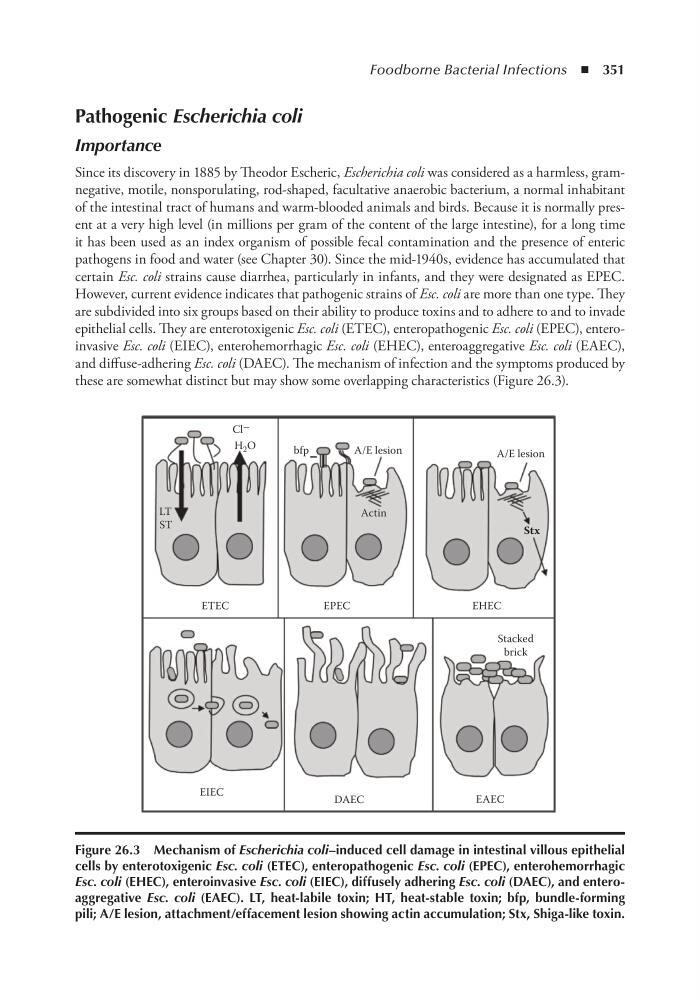
these are somewhat distinct but may show some overlapping characteristics (Figure 26.3).
ETEC
EPEC
EHEC
EIEC
DAEC
EAEC
Stacked
brick
Actin
Stx
A/E lesion
A/E lesion
bfp
Cl –
H 2 O
LT
ST
Figure 26.3 Mechanism of Escherichia coli–induced cell damage in intestinal villous epithelial
cells by enterotoxigenic Esc. coli (eteC), enteropathogenic Esc. coli (ePeC), enterohemorrhagic
Esc. coli (eHeC), enteroinvasive Esc. coli (eieC), diffusely adhering Esc. coli (DAeC), and enteroaggregative Esc. coli (eAeC). Lt, heat-labile toxin; Ht, heat-stable toxin; bfp, bundle-forming
pili; A/e lesion, attachment/effacement lesion showing actin accumulation; Stx, Shiga-like toxin.
Pathogenic Escherichia coli
Importance
Since its discovery in 1885 by Theodor Escheric, Escherichia coli was considered as a harmless, gramnegative, motile, nonsporulating, rod-shaped, facultative anaerobic bacterium, a normal inhabitant
of the intestinal tract of humans and warm-blooded animals and birds. Because it is normally present at a very high level (in millions per gram of the content of the large intestine), for a long time
it has been used as an index organism of possible fecal contamination and the presence of enteric
pathogens in food and water (see Chapter 30). Since the mid-1940s, evidence has accumulated that
certain Esc. coli strains cause diarrhea, particularly in infants, and they were designated as EPEC.
However, current evidence indicates that pathogenic strains of Esc. coli are more than one type. They
are subdivided into six groups based on their ability to produce toxins and to adhere to and to invade
epithelial cells. They are enterotoxigenic Esc. coli (ETEC), enteropathogenic Esc. coli (EPEC), enteroinvasive Esc. coli (EIEC), enterohemorrhagic Esc. coli (EHEC), enteroaggregative Esc. coli (EAEC),
and diffuse-adhering Esc. coli (DAEC). The mechanism of infection and the symptoms produced by
these are somewhat distinct but may show some overlapping characteristics (Figure 26.3).
ETEC
EPEC
EHEC
EIEC
DAEC
EAEC
Stacked
brick
Actin
Stx
A/E lesion
A/E lesion
bfp
Cl –
H 2 O
LT
ST
Figure 26.3 Mechanism of Escherichia coli–induced cell damage in intestinal villous epithelial
cells by enterotoxigenic Esc. coli (eteC), enteropathogenic Esc. coli (ePeC), enterohemorrhagic
Esc. coli (eHeC), enteroinvasive Esc. coli (eieC), diffusely adhering Esc. coli (DAeC), and enteroaggregative Esc. coli (eAeC). Lt, heat-labile toxin; Ht, heat-stable toxin; bfp, bundle-forming
pili; A/e lesion, attachment/effacement lesion showing actin accumulation; Stx, Shiga-like toxin.