

348 ◾ Fundamental Food Microbiology
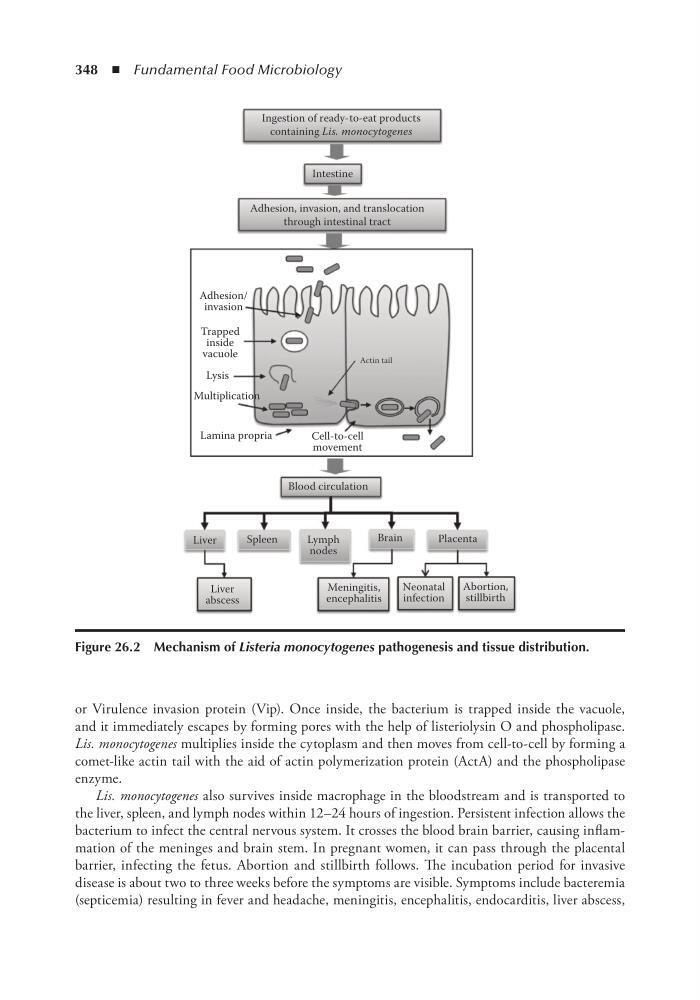
or Virulence invasion protein (Vip). Once inside, the bacterium is trapped inside the vacuole,
and it immediately escapes by forming pores with the help of listeriolysin O and phospholipase.
Lis. monocytogenes multiplies inside the cytoplasm and then moves from cell-to-cell by forming a
comet-like actin tail with the aid of actin polymerization protein (ActA) and the phospholipase
enzyme.
Lis. monocytogenes also survives inside macrophage in the bloodstream and is transported to
the liver, spleen, and lymph nodes within 12–24 hours of ingestion. Persistent infection allows the
bacterium to infect the central nervous system. It crosses the blood brain barrier, causing inflammation of the meninges and brain stem. In pregnant women, it can pass through the placental
barrier, infecting the fetus. Abortion and stillbirth follows. The incubation period for invasive
disease is about two to three weeks before the symptoms are visible. Symptoms include bacteremia
(septicemia) resulting in fever and headache, meningitis, encephalitis, endocarditis, liver abscess,
Ingestion of ready-to-eat products
containing Lis. monocytogenes
Intestine
Adhesion, invasion, and translocation
through intestinal tract
Adhesion/
invasion
Trapped
inside
vacuole
Lysis
Multiplication
Lamina propria
Cell-to-cell
movement
Actin tail
Blood circulation
Liver
Spleen
Lymph
nodes
Brain
Placenta
Liver
abscess
Meningitis,
encephalitis
Neonatal
infection
Abortion,
stillbirth
Figure 26.2 Mechanism of Listeria monocytogenes pathogenesis and tissue distribution.
or Virulence invasion protein (Vip). Once inside, the bacterium is trapped inside the vacuole,
and it immediately escapes by forming pores with the help of listeriolysin O and phospholipase.
Lis. monocytogenes multiplies inside the cytoplasm and then moves from cell-to-cell by forming a
comet-like actin tail with the aid of actin polymerization protein (ActA) and the phospholipase
enzyme.
Lis. monocytogenes also survives inside macrophage in the bloodstream and is transported to
the liver, spleen, and lymph nodes within 12–24 hours of ingestion. Persistent infection allows the
bacterium to infect the central nervous system. It crosses the blood brain barrier, causing inflammation of the meninges and brain stem. In pregnant women, it can pass through the placental
barrier, infecting the fetus. Abortion and stillbirth follows. The incubation period for invasive
disease is about two to three weeks before the symptoms are visible. Symptoms include bacteremia
(septicemia) resulting in fever and headache, meningitis, encephalitis, endocarditis, liver abscess,
Ingestion of ready-to-eat products
containing Lis. monocytogenes
Intestine
Adhesion, invasion, and translocation
through intestinal tract
Adhesion/
invasion
Trapped
inside
vacuole
Lysis
Multiplication
Lamina propria
Cell-to-cell
movement
Actin tail
Blood circulation
Liver
Spleen
Lymph
nodes
Brain
Placenta
Liver
abscess
Meningitis,
encephalitis
Neonatal
infection
Abortion,
stillbirth
Figure 26.2 Mechanism of Listeria monocytogenes pathogenesis and tissue distribution.