

New Food Spoilage Bacteria in Refrigerated Foods ◾ 283
The results (Table 21.1) revealed that in the four-day-old products the levels of five bacterial
groups were not unexpectedly high for a diced meat product. Similar levels for APC were also
obtained in one-day-old products, which were tested in the processor’s laboratory. After 24 days
at 30°F (–1.1°C), both APCs and psychrotroph counts increased but remained below the usually
accepted spoilage detection level (ca. ≥10 7 /g). However, levels of coliforms and Enterobacteriaceae
decreased during storage. Interestingly, fresh samples had approximately 6 × 10 2 /g Proteus, but
the 24-day-old samples did not have any in a 10 –1 dilution. It was suspected that cells of
Enterobacteriaceae, including Proteus sp., were killed during storage by the combined action of
1.8% lactate, 1.2% salt, and 30°F (–1.1°C). Their proteolytic enzymes (exocellular and endocellular) were able to break down proteins and sulfur-containing amino acids to produce a small
amount of H 2 S associated with the egg odor. To overcome such problems, an important objective
will be to keep the level of Enterobacteriaceae, as well as the level of Gram-negative bacteria, very
low.
Off-Odor in Frozen Chicken Meat Product
Skinless and boneless chicken thigh meat was diced and marinated (the mixture contained different ingredients, including 3% sodium lactate and 1.8% salt). The products (pH 6.3) were vacuum
packaged and frozen to –20°C. The product, expected to have a shelf life of 90 days or more, is
thawed by customers immediately before use. When thawed during storage, the products gave an
off-odor, which increased in intensity with storage period.
Vacuum-packaged meat samples consisting of frozen unmarinated and marinated and frozen
samples stored for 25 days and 100 days were enumerated for the levels of several bacterial groups
by the methods described in the section on egg odor in refrigerated fresh chicken meat products.
The packages of the marinated products were loose, and the thawed meat had an off-flavor, which
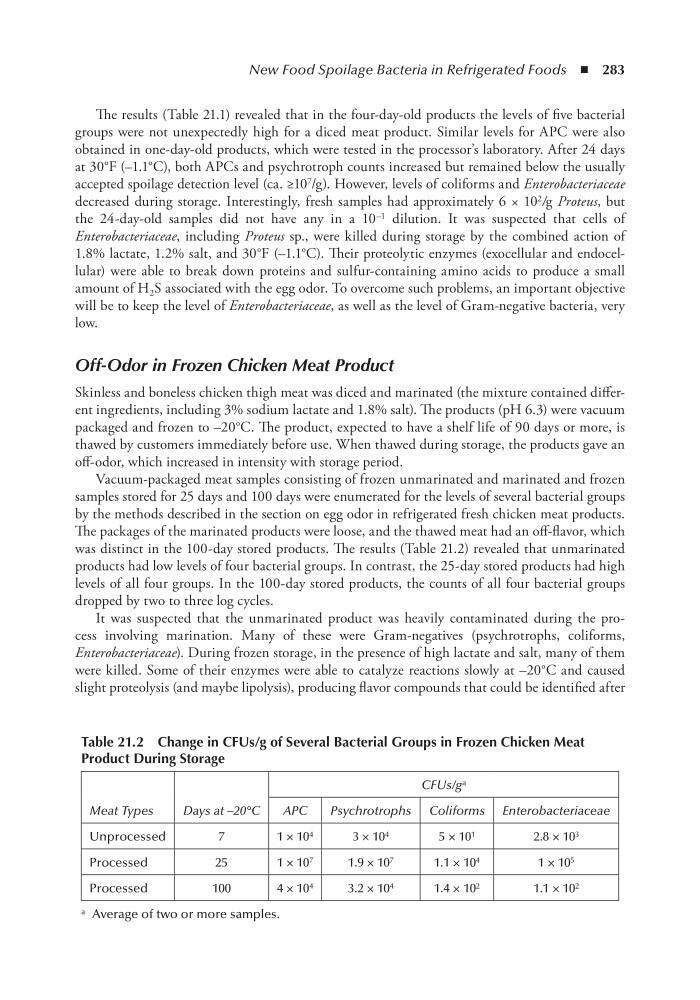
was distinct in the 100-day stored products. The results (Table 21.2) revealed that unmarinated
products had low levels of four bacterial groups. In contrast, the 25-day stored products had high
levels of all four groups. In the 100-day stored products, the counts of all four bacterial groups
dropped by two to three log cycles.
It was suspected that the unmarinated product was heavily contaminated during the process involving marination. Many of these were Gram-negatives (psychrotrophs, coliforms,
Enterobacteriaceae). During frozen storage, in the presence of high lactate and salt, many of them
were killed. Some of their enzymes were able to catalyze reactions slowly at –20°C and caused
slight proteolysis (and maybe lipolysis), producing flavor compounds that could be identified after
table 21.2 Change in CFUs/g of Several Bacterial Groups in Frozen Chicken Meat
Product During Storage
Meat Types
Days at –20°C
CFUs/g a
APC
Psychrotrophs Coliforms Enterobacteriaceae
Unprocessed
7
1 × 10 4
3 × 10 4
5 × 10 1
2.8 × 10 3
Processed
25
1 × 10 7
1.9 × 10 7
1.1 × 10 4
1 × 10 5
Processed
100
4 × 10 4
3.2 × 10 4
1.4 × 10 2
1.1 × 10 2
a Average of two or more samples.
The results (Table 21.1) revealed that in the four-day-old products the levels of five bacterial
groups were not unexpectedly high for a diced meat product. Similar levels for APC were also
obtained in one-day-old products, which were tested in the processor’s laboratory. After 24 days
at 30°F (–1.1°C), both APCs and psychrotroph counts increased but remained below the usually
accepted spoilage detection level (ca. ≥10 7 /g). However, levels of coliforms and Enterobacteriaceae
decreased during storage. Interestingly, fresh samples had approximately 6 × 10 2 /g Proteus, but
the 24-day-old samples did not have any in a 10 –1 dilution. It was suspected that cells of
Enterobacteriaceae, including Proteus sp., were killed during storage by the combined action of
1.8% lactate, 1.2% salt, and 30°F (–1.1°C). Their proteolytic enzymes (exocellular and endocellular) were able to break down proteins and sulfur-containing amino acids to produce a small
amount of H 2 S associated with the egg odor. To overcome such problems, an important objective
will be to keep the level of Enterobacteriaceae, as well as the level of Gram-negative bacteria, very
low.
Off-Odor in Frozen Chicken Meat Product
Skinless and boneless chicken thigh meat was diced and marinated (the mixture contained different ingredients, including 3% sodium lactate and 1.8% salt). The products (pH 6.3) were vacuum
packaged and frozen to –20°C. The product, expected to have a shelf life of 90 days or more, is
thawed by customers immediately before use. When thawed during storage, the products gave an
off-odor, which increased in intensity with storage period.
Vacuum-packaged meat samples consisting of frozen unmarinated and marinated and frozen
samples stored for 25 days and 100 days were enumerated for the levels of several bacterial groups
by the methods described in the section on egg odor in refrigerated fresh chicken meat products.
The packages of the marinated products were loose, and the thawed meat had an off-flavor, which
was distinct in the 100-day stored products. The results (Table 21.2) revealed that unmarinated
products had low levels of four bacterial groups. In contrast, the 25-day stored products had high
levels of all four groups. In the 100-day stored products, the counts of all four bacterial groups
dropped by two to three log cycles.
It was suspected that the unmarinated product was heavily contaminated during the process involving marination. Many of these were Gram-negatives (psychrotrophs, coliforms,
Enterobacteriaceae). During frozen storage, in the presence of high lactate and salt, many of them
were killed. Some of their enzymes were able to catalyze reactions slowly at –20°C and caused
slight proteolysis (and maybe lipolysis), producing flavor compounds that could be identified after
table 21.2 Change in CFUs/g of Several Bacterial Groups in Frozen Chicken Meat
Product During Storage
Meat Types
Days at –20°C
CFUs/g a
APC
Psychrotrophs Coliforms Enterobacteriaceae
Unprocessed
7
1 × 10 4
3 × 10 4
5 × 10 1
2.8 × 10 3
Processed
25
1 × 10 7
1.9 × 10 7
1.1 × 10 4
1 × 10 5
Processed
100
4 × 10 4
3.2 × 10 4
1.4 × 10 2
1.1 × 10 2
a Average of two or more samples.