

238 ◾ Fundamental Food Microbiology
Immobilized Enzymes
Enzymes are biocatalysts and can be recycled. An enzyme is used only once when added to a
substrate in liquid or solid food. In contrast, if the molecules of an enzyme are attached to a solid
surface (immobilized), the enzyme can be exposed repeatedly to a specific substrate. 16 The major
advantage is the economical use of an enzyme, especially if the enzyme is very costly.
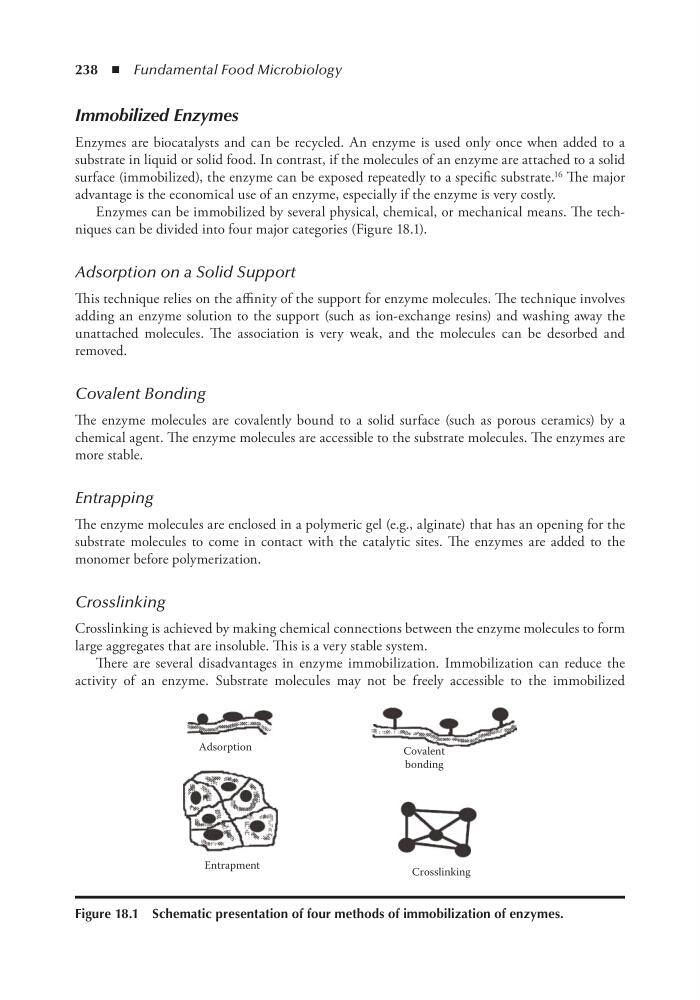
Enzymes can be immobilized by several physical, chemical, or mechanical means. The techniques can be divided into four major categories (Figure 18.1).
Adsorption on a Solid Support
This technique relies on the affinity of the support for enzyme molecules. The technique involves
adding an enzyme solution to the support (such as ion-exchange resins) and washing away the
unattached molecules. The association is very weak, and the molecules can be desorbed and
removed.
Covalent Bonding
The enzyme molecules are covalently bound to a solid surface (such as porous ceramics) by a
chemical agent. The enzyme molecules are accessible to the substrate molecules. The enzymes are
more stable.
Entrapping
The enzyme molecules are enclosed in a polymeric gel (e.g., alginate) that has an opening for the
substrate molecules to come in contact with the catalytic sites. The enzymes are added to the
monomer before polymerization.
Crosslinking
Crosslinking is achieved by making chemical connections between the enzyme molecules to form
large aggregates that are insoluble. This is a very stable system.
There are several disadvantages in enzyme immobilization. Immobilization can reduce the
activity of an enzyme. Substrate molecules may not be freely accessible to the immobilized
Adsorption
Covalent
bonding
Entrapment
Crosslinking
Figure 18.1 Schematic presentation of four methods of immobilization of enzymes.
Immobilized Enzymes
Enzymes are biocatalysts and can be recycled. An enzyme is used only once when added to a
substrate in liquid or solid food. In contrast, if the molecules of an enzyme are attached to a solid
surface (immobilized), the enzyme can be exposed repeatedly to a specific substrate. 16 The major
advantage is the economical use of an enzyme, especially if the enzyme is very costly.
Enzymes can be immobilized by several physical, chemical, or mechanical means. The techniques can be divided into four major categories (Figure 18.1).
Adsorption on a Solid Support
This technique relies on the affinity of the support for enzyme molecules. The technique involves
adding an enzyme solution to the support (such as ion-exchange resins) and washing away the
unattached molecules. The association is very weak, and the molecules can be desorbed and
removed.
Covalent Bonding
The enzyme molecules are covalently bound to a solid surface (such as porous ceramics) by a
chemical agent. The enzyme molecules are accessible to the substrate molecules. The enzymes are
more stable.
Entrapping
The enzyme molecules are enclosed in a polymeric gel (e.g., alginate) that has an opening for the
substrate molecules to come in contact with the catalytic sites. The enzymes are added to the
monomer before polymerization.
Crosslinking
Crosslinking is achieved by making chemical connections between the enzyme molecules to form
large aggregates that are insoluble. This is a very stable system.
There are several disadvantages in enzyme immobilization. Immobilization can reduce the
activity of an enzyme. Substrate molecules may not be freely accessible to the immobilized
Adsorption
Covalent
bonding
Entrapment
Crosslinking
Figure 18.1 Schematic presentation of four methods of immobilization of enzymes.