

Food Ingredients and Enzymes of Microbial Origin ◾ 237
Enzyme Production by Recombinant DNA Technology
The enzymes that are currently used in food processing are obtained from bacteria, yeasts, molds,
plants, and mammalian sources. They have been approved by regulatory agencies, and their
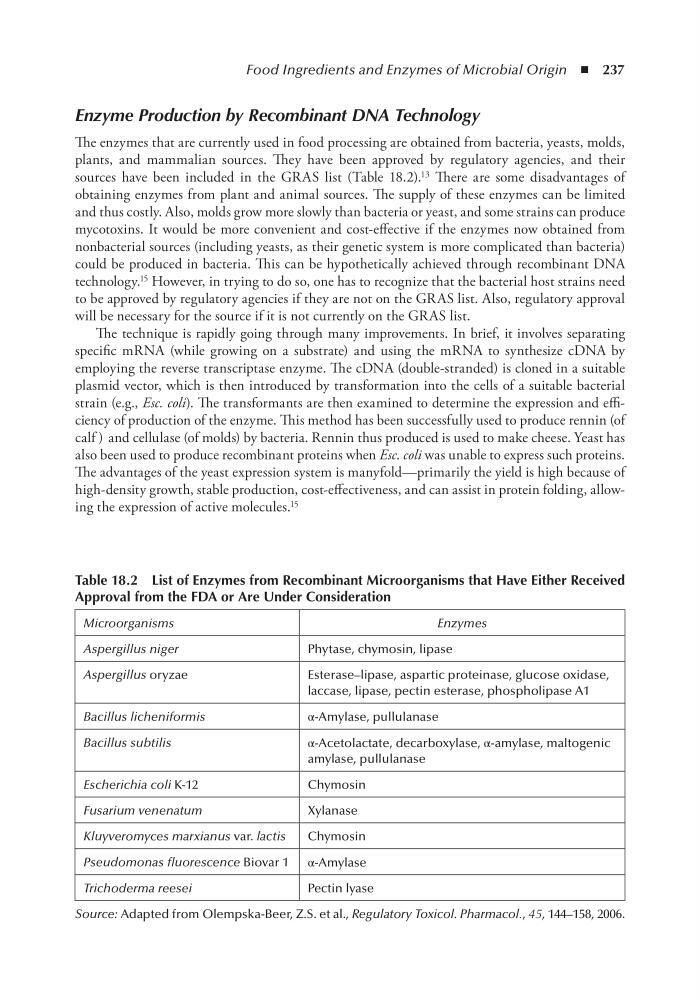
sources have been included in the GRAS list (Table 18.2). 13 There are some disadvantages of
obtaining enzymes from plant and animal sources. The supply of these enzymes can be limited
and thus costly. Also, molds grow more slowly than bacteria or yeast, and some strains can produce
mycotoxins. It would be more convenient and cost-effective if the enzymes now obtained from
nonbacterial sources (including yeasts, as their genetic system is more complicated than bacteria)
could be produced in bacteria. This can be hypothetically achieved through recombinant DNA
technology. 15 However, in trying to do so, one has to recognize that the bacterial host strains need
to be approved by regulatory agencies if they are not on the GRAS list. Also, regulatory approval
will be necessary for the source if it is not currently on the GRAS list.
The technique is rapidly going through many improvements. In brief, it involves separating
specific mRNA (while growing on a substrate) and using the mRNA to synthesize cDNA by
employing the reverse transcriptase enzyme. The cDNA (double-stranded) is cloned in a suitable
plasmid vector, which is then introduced by transformation into the cells of a suitable bacterial
strain (e.g., Esc. coli). The transformants are then examined to determine the expression and efficiency of production of the enzyme. This method has been successfully used to produce rennin (of
calf ) and cellulase (of molds) by bacteria. Rennin thus produced is used to make cheese. Yeast has
also been used to produce recombinant proteins when Esc. coli was unable to express such proteins.
The advantages of the yeast expression system is manyfold—primarily the yield is high because of
high-density growth, stable production, cost-effectiveness, and can assist in protein folding, allowing the expression of active molecules. 15
table 18.2 List of enzymes from Recombinant Microorganisms that Have either Received
Approval from the FDA or Are Under Consideration
Microorganisms
Enzymes
Aspergillus niger
Phytase, chymosin, lipase
Aspergillus oryzae
Esterase–lipase, aspartic proteinase, glucose oxidase,
laccase, lipase, pectin esterase, phospholipase A1
Bacillus licheniformis
α-Amylase, pullulanase
Bacillus subtilis
α-Acetolactate, decarboxylase, α-amylase, maltogenic
amylase, pullulanase
Escherichia coli K-12
Chymosin
Fusarium venenatum
Xylanase
Kluyveromyces marxianus var. lactis
Chymosin
Pseudomonas fluorescence Biovar 1
α-Amylase
Trichoderma reesei
Pectin lyase
Source: Adapted from Olempska-Beer, Z.S. et al., Regulatory Toxicol. Pharmacol., 45, 144–158, 2006.
Enzyme Production by Recombinant DNA Technology
The enzymes that are currently used in food processing are obtained from bacteria, yeasts, molds,
plants, and mammalian sources. They have been approved by regulatory agencies, and their
sources have been included in the GRAS list (Table 18.2). 13 There are some disadvantages of
obtaining enzymes from plant and animal sources. The supply of these enzymes can be limited
and thus costly. Also, molds grow more slowly than bacteria or yeast, and some strains can produce
mycotoxins. It would be more convenient and cost-effective if the enzymes now obtained from
nonbacterial sources (including yeasts, as their genetic system is more complicated than bacteria)
could be produced in bacteria. This can be hypothetically achieved through recombinant DNA
technology. 15 However, in trying to do so, one has to recognize that the bacterial host strains need
to be approved by regulatory agencies if they are not on the GRAS list. Also, regulatory approval
will be necessary for the source if it is not currently on the GRAS list.
The technique is rapidly going through many improvements. In brief, it involves separating
specific mRNA (while growing on a substrate) and using the mRNA to synthesize cDNA by
employing the reverse transcriptase enzyme. The cDNA (double-stranded) is cloned in a suitable
plasmid vector, which is then introduced by transformation into the cells of a suitable bacterial
strain (e.g., Esc. coli). The transformants are then examined to determine the expression and efficiency of production of the enzyme. This method has been successfully used to produce rennin (of
calf ) and cellulase (of molds) by bacteria. Rennin thus produced is used to make cheese. Yeast has
also been used to produce recombinant proteins when Esc. coli was unable to express such proteins.
The advantages of the yeast expression system is manyfold—primarily the yield is high because of
high-density growth, stable production, cost-effectiveness, and can assist in protein folding, allowing the expression of active molecules. 15
table 18.2 List of enzymes from Recombinant Microorganisms that Have either Received
Approval from the FDA or Are Under Consideration
Microorganisms
Enzymes
Aspergillus niger
Phytase, chymosin, lipase
Aspergillus oryzae
Esterase–lipase, aspartic proteinase, glucose oxidase,
laccase, lipase, pectin esterase, phospholipase A1
Bacillus licheniformis
α-Amylase, pullulanase
Bacillus subtilis
α-Acetolactate, decarboxylase, α-amylase, maltogenic
amylase, pullulanase
Escherichia coli K-12
Chymosin
Fusarium venenatum
Xylanase
Kluyveromyces marxianus var. lactis
Chymosin
Pseudomonas fluorescence Biovar 1
α-Amylase
Trichoderma reesei
Pectin lyase
Source: Adapted from Olempska-Beer, Z.S. et al., Regulatory Toxicol. Pharmacol., 45, 144–158, 2006.