

Food Biopreservatives of Microbial Origin, Bacteriocin, and Nanotechnology ◾ 227
Liposomes 19
Liposomes are vesicles composed of a phospholipid bilayer containing aqueous media. They are
prepared as multilamellar or unilamellar vesicles with sizes varying from 20 nm to 1 µm. The
polar headgroups in phospholipids (phosphatidyl choline or phosphatidyl glycerol) are exposed to
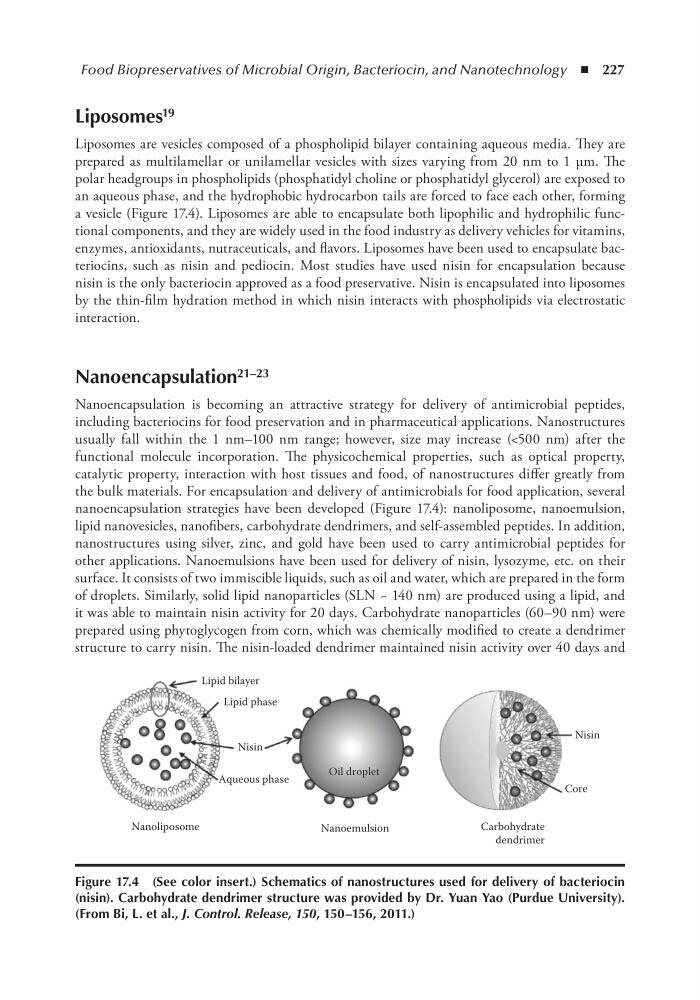
an aqueous phase, and the hydrophobic hydrocarbon tails are forced to face each other, forming
a vesicle (Figure 17.4). Liposomes are able to encapsulate both lipophilic and hydrophilic functional components, and they are widely used in the food industry as delivery vehicles for vitamins,
enzymes, antioxidants, nutraceuticals, and flavors. Liposomes have been used to encapsulate bacteriocins, such as nisin and pediocin. Most studies have used nisin for encapsulation because
nisin is the only bacteriocin approved as a food preservative. Nisin is encapsulated into liposomes
by the thin-film hydration method in which nisin interacts with phospholipids via electrostatic
interaction.
nanoencapsulation 21–23
Nanoencapsulation is becoming an attractive strategy for delivery of antimicrobial peptides,
including bacteriocins for food preservation and in pharmaceutical applications. Nanostructures
usually fall within the 1 nm–100 nm range; however, size may increase (<500 nm) after the
functional molecule incorporation. The physicochemical properties, such as optical property,
catalytic property, interaction with host tissues and food, of nanostructures differ greatly from
the bulk materials. For encapsulation and delivery of antimicrobials for food application, several
nanoencapsulation strategies have been developed (Figure 17.4): nanoliposome, nanoemulsion,
lipid nanovesicles, nanofibers, carbohydrate dendrimers, and self-assembled peptides. In addition,
nanostructures using silver, zinc, and gold have been used to carry antimicrobial peptides for
other applications. Nanoemulsions have been used for delivery of nisin, lysozyme, etc. on their
surface. It consists of two immiscible liquids, such as oil and water, which are prepared in the form
of droplets. Similarly, solid lipid nanoparticles (SLN ~ 140 nm) are produced using a lipid, and
it was able to maintain nisin activity for 20 days. Carbohydrate nanoparticles (60–90 nm) were
prepared using phytoglycogen from corn, which was chemically modified to create a dendrimer
structure to carry nisin. The nisin-loaded dendrimer maintained nisin activity over 40 days and
Lipid bilayer
Lipid phase
Nisin
Aqueous phase
Oil droplet
Nanoemulsion
Nanoliposome
Carbohydrate
dendrimer
Nisin
Core
Figure 17.4 (See color insert.) Schematics of nanostructures used for delivery of bacteriocin
(nisin). Carbohydrate dendrimer structure was provided by Dr. Yuan Yao (Purdue University).
(From Bi, L. et al., J. Control. Release, 150, 150–156, 2011.)
Liposomes 19
Liposomes are vesicles composed of a phospholipid bilayer containing aqueous media. They are
prepared as multilamellar or unilamellar vesicles with sizes varying from 20 nm to 1 µm. The
polar headgroups in phospholipids (phosphatidyl choline or phosphatidyl glycerol) are exposed to
an aqueous phase, and the hydrophobic hydrocarbon tails are forced to face each other, forming
a vesicle (Figure 17.4). Liposomes are able to encapsulate both lipophilic and hydrophilic functional components, and they are widely used in the food industry as delivery vehicles for vitamins,
enzymes, antioxidants, nutraceuticals, and flavors. Liposomes have been used to encapsulate bacteriocins, such as nisin and pediocin. Most studies have used nisin for encapsulation because
nisin is the only bacteriocin approved as a food preservative. Nisin is encapsulated into liposomes
by the thin-film hydration method in which nisin interacts with phospholipids via electrostatic
interaction.
nanoencapsulation 21–23
Nanoencapsulation is becoming an attractive strategy for delivery of antimicrobial peptides,
including bacteriocins for food preservation and in pharmaceutical applications. Nanostructures
usually fall within the 1 nm–100 nm range; however, size may increase (<500 nm) after the
functional molecule incorporation. The physicochemical properties, such as optical property,
catalytic property, interaction with host tissues and food, of nanostructures differ greatly from
the bulk materials. For encapsulation and delivery of antimicrobials for food application, several
nanoencapsulation strategies have been developed (Figure 17.4): nanoliposome, nanoemulsion,
lipid nanovesicles, nanofibers, carbohydrate dendrimers, and self-assembled peptides. In addition,
nanostructures using silver, zinc, and gold have been used to carry antimicrobial peptides for
other applications. Nanoemulsions have been used for delivery of nisin, lysozyme, etc. on their
surface. It consists of two immiscible liquids, such as oil and water, which are prepared in the form
of droplets. Similarly, solid lipid nanoparticles (SLN ~ 140 nm) are produced using a lipid, and
it was able to maintain nisin activity for 20 days. Carbohydrate nanoparticles (60–90 nm) were
prepared using phytoglycogen from corn, which was chemically modified to create a dendrimer
structure to carry nisin. The nisin-loaded dendrimer maintained nisin activity over 40 days and
Lipid bilayer
Lipid phase
Nisin
Aqueous phase
Oil droplet
Nanoemulsion
Nanoliposome
Carbohydrate
dendrimer
Nisin
Core
Figure 17.4 (See color insert.) Schematics of nanostructures used for delivery of bacteriocin
(nisin). Carbohydrate dendrimer structure was provided by Dr. Yuan Yao (Purdue University).
(From Bi, L. et al., J. Control. Release, 150, 150–156, 2011.)