

224 ◾ Fundamental Food Microbiology
extracts, high pressure, or other bacteriocins, for synergistic effects to control both Gram-positive
and Gram-negative foodborne pathogens in food (Table 17.6). There are many other food products
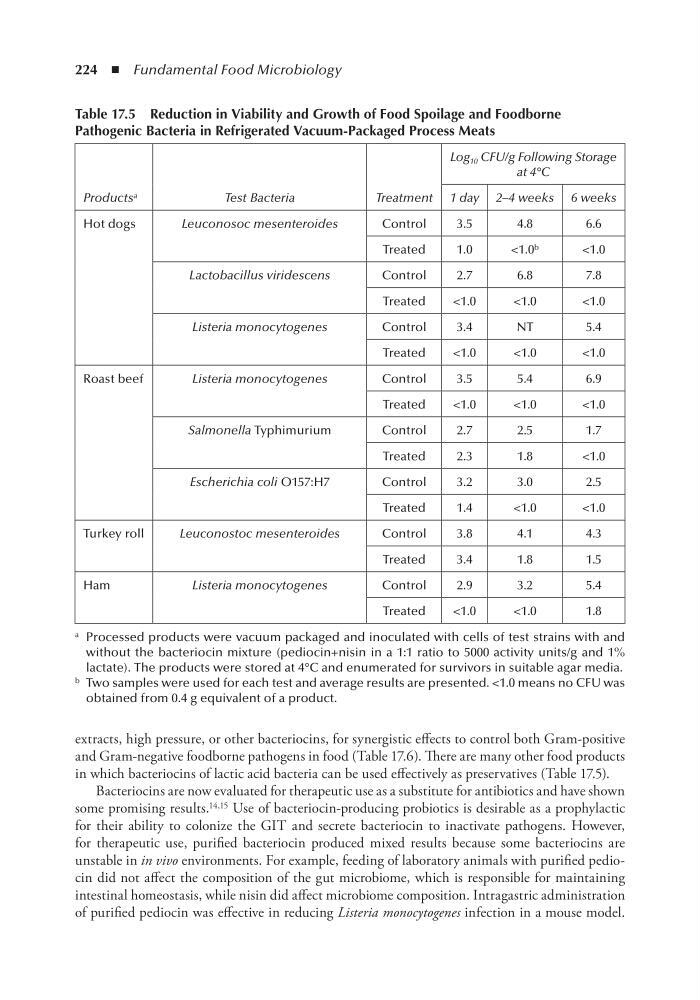
in which bacteriocins of lactic acid bacteria can be used effectively as preservatives (Table 17.5).
Bacteriocins are now evaluated for therapeutic use as a substitute for antibiotics and have shown
some promising results. 14,15 Use of bacteriocin-producing probiotics is desirable as a prophylactic
for their ability to colonize the GIT and secrete bacteriocin to inactivate pathogens. However,
for therapeutic use, purified bacteriocin produced mixed results because some bacteriocins are
unstable in in vivo environments. For example, feeding of laboratory animals with purified pediocin did not affect the composition of the gut microbiome, which is responsible for maintaining
intestinal homeostasis, while nisin did affect microbiome composition. Intragastric administration
of purified pediocin was effective in reducing Listeria monocytogenes infection in a mouse model.
table 17.5 Reduction in Viability and Growth of Food Spoilage and Foodborne
Pathogenic Bacteria in Refrigerated Vacuum-Packaged Process Meats
Products a
Test Bacteria
Treatment
Log 10 CFU/g Following Storage
at 4°C
1 day 2–4 weeks 6 weeks
Hot dogs
Leuconosoc mesenteroides
Control
3.5
4.8
6.6
Treated
1.0
<1.0 b
<1.0
Lactobacillus viridescens
Control
2.7
6.8
7.8
Treated
<1.0
<1.0
<1.0
Listeria monocytogenes
Control
3.4
NT
5.4
Treated
<1.0
<1.0
<1.0
Roast beef
Listeria monocytogenes
Control
3.5
5.4
6.9
Treated
<1.0
<1.0
<1.0
Salmonella Typhimurium
Control
2.7
2.5
1.7
Treated
2.3
1.8
<1.0
Escherichia coli O157:H7
Control
3.2
3.0
2.5
Treated
1.4
<1.0
<1.0
Turkey roll
Leuconostoc mesenteroides
Control
3.8
4.1
4.3
Treated
3.4
1.8
1.5
Ham
Listeria monocytogenes
Control
2.9
3.2
5.4
Treated
<1.0
<1.0
1.8
a Processed products were vacuum packaged and inoculated with cells of test strains with and
without the bacteriocin mixture (pediocin+nisin in a 1:1 ratio to 5000 activity units/g and 1%
lactate). The products were stored at 4°C and enumerated for survivors in suitable agar media.
b Two samples were used for each test and average results are presented. <1.0 means no CFU was
obtained from 0.4 g equivalent of a product.
extracts, high pressure, or other bacteriocins, for synergistic effects to control both Gram-positive
and Gram-negative foodborne pathogens in food (Table 17.6). There are many other food products
in which bacteriocins of lactic acid bacteria can be used effectively as preservatives (Table 17.5).
Bacteriocins are now evaluated for therapeutic use as a substitute for antibiotics and have shown
some promising results. 14,15 Use of bacteriocin-producing probiotics is desirable as a prophylactic
for their ability to colonize the GIT and secrete bacteriocin to inactivate pathogens. However,
for therapeutic use, purified bacteriocin produced mixed results because some bacteriocins are
unstable in in vivo environments. For example, feeding of laboratory animals with purified pediocin did not affect the composition of the gut microbiome, which is responsible for maintaining
intestinal homeostasis, while nisin did affect microbiome composition. Intragastric administration
of purified pediocin was effective in reducing Listeria monocytogenes infection in a mouse model.
table 17.5 Reduction in Viability and Growth of Food Spoilage and Foodborne
Pathogenic Bacteria in Refrigerated Vacuum-Packaged Process Meats
Products a
Test Bacteria
Treatment
Log 10 CFU/g Following Storage
at 4°C
1 day 2–4 weeks 6 weeks
Hot dogs
Leuconosoc mesenteroides
Control
3.5
4.8
6.6
Treated
1.0
<1.0 b
<1.0
Lactobacillus viridescens
Control
2.7
6.8
7.8
Treated
<1.0
<1.0
<1.0
Listeria monocytogenes
Control
3.4
NT
5.4
Treated
<1.0
<1.0
<1.0
Roast beef
Listeria monocytogenes
Control
3.5
5.4
6.9
Treated
<1.0
<1.0
<1.0
Salmonella Typhimurium
Control
2.7
2.5
1.7
Treated
2.3
1.8
<1.0
Escherichia coli O157:H7
Control
3.2
3.0
2.5
Treated
1.4
<1.0
<1.0
Turkey roll
Leuconostoc mesenteroides
Control
3.8
4.1
4.3
Treated
3.4
1.8
1.5
Ham
Listeria monocytogenes
Control
2.9
3.2
5.4
Treated
<1.0
<1.0
1.8
a Processed products were vacuum packaged and inoculated with cells of test strains with and
without the bacteriocin mixture (pediocin+nisin in a 1:1 ratio to 5000 activity units/g and 1%
lactate). The products were stored at 4°C and enumerated for survivors in suitable agar media.
b Two samples were used for each test and average results are presented. <1.0 means no CFU was
obtained from 0.4 g equivalent of a product.