

Intestinal Bacteria and Probiotics ◾ 201
with an invasin protein Internalin A from Lis. monocytogenes to deliver immunostimulatory molecules inside the epithelial cells in the GI tract. A recombinant Lactobacillus lactis expressing
rotavirus spike-protein VP8 induced mucosal IgA and anti-VP8 antibodies and provided 100%
protection against a rotavirus challenge. Expression of Salmonella flagella in probiotics developed
a protective immune response against salmonellosis. Additionally, lactic acid bacteria were used as
a vaccine carrier to prevent Streptococcus pneumoniae, Helicobacter pylori, enterotoxigenic Esc. coli,
Bacillus anthracis, Bordetella pertussis, Borrelia burgdorferi, HIV, Dengue virus, Giardia lamblia,
etc. 12 Also, probiotic strains were engineered to express cytokines and other anti-inflammatory
molecules to help suppress intestinal inflammation and provide cytoprotection.
Some Aspects to Consider
The health benefit theory of fermented foods and beneficial intestinal bacteria is controversial.
Although an association effect, that is, some benefits from their consumption, cannot be denied,
many studies have not been able to prove the benefits without doubts. As suggested previously,
the differences in study methods could be one reason for the differences in results. In designing
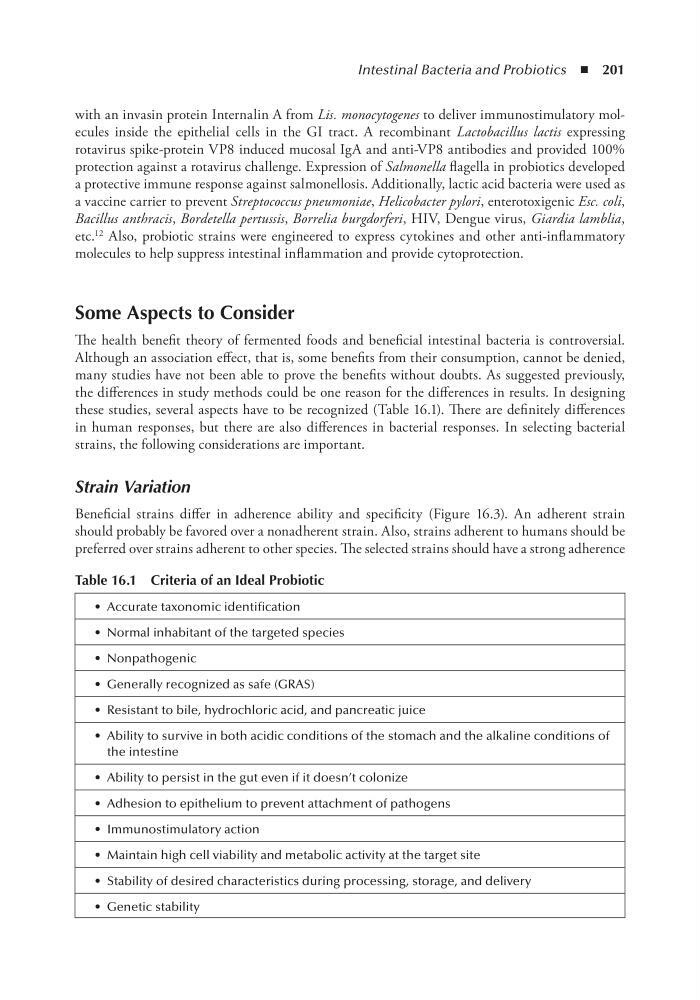
these studies, several aspects have to be recognized (Table 16.1). There are definitely differences
in human responses, but there are also differences in bacterial responses. In selecting bacterial
strains, the following considerations are important.
Strain Variation
Beneficial strains differ in adherence ability and specificity (Figure 16.3). An adherent strain
should probably be favored over a nonadherent strain. Also, strains adherent to humans should be
preferred over strains adherent to other species. The selected strains should have a strong adherence
table 16.1 Criteria of an ideal Probiotic
• Accurate taxonomic identification
• Normal inhabitant of the targeted species
• Nonpathogenic
• Generally recognized as safe (GRAS)
• Resistant to bile, hydrochloric acid, and pancreatic juice
• Ability to survive in both acidic conditions of the stomach and the alkaline conditions of
the intestine
• Ability to persist in the gut even if it doesn’t colonize
• Adhesion to epithelium to prevent attachment of pathogens
• Immunostimulatory action
• Maintain high cell viability and metabolic activity at the target site
• Stability of desired characteristics during processing, storage, and delivery
• Genetic stability
with an invasin protein Internalin A from Lis. monocytogenes to deliver immunostimulatory molecules inside the epithelial cells in the GI tract. A recombinant Lactobacillus lactis expressing
rotavirus spike-protein VP8 induced mucosal IgA and anti-VP8 antibodies and provided 100%
protection against a rotavirus challenge. Expression of Salmonella flagella in probiotics developed
a protective immune response against salmonellosis. Additionally, lactic acid bacteria were used as
a vaccine carrier to prevent Streptococcus pneumoniae, Helicobacter pylori, enterotoxigenic Esc. coli,
Bacillus anthracis, Bordetella pertussis, Borrelia burgdorferi, HIV, Dengue virus, Giardia lamblia,
etc. 12 Also, probiotic strains were engineered to express cytokines and other anti-inflammatory
molecules to help suppress intestinal inflammation and provide cytoprotection.
Some Aspects to Consider
The health benefit theory of fermented foods and beneficial intestinal bacteria is controversial.
Although an association effect, that is, some benefits from their consumption, cannot be denied,
many studies have not been able to prove the benefits without doubts. As suggested previously,
the differences in study methods could be one reason for the differences in results. In designing
these studies, several aspects have to be recognized (Table 16.1). There are definitely differences
in human responses, but there are also differences in bacterial responses. In selecting bacterial
strains, the following considerations are important.
Strain Variation
Beneficial strains differ in adherence ability and specificity (Figure 16.3). An adherent strain
should probably be favored over a nonadherent strain. Also, strains adherent to humans should be
preferred over strains adherent to other species. The selected strains should have a strong adherence
table 16.1 Criteria of an ideal Probiotic
• Accurate taxonomic identification
• Normal inhabitant of the targeted species
• Nonpathogenic
• Generally recognized as safe (GRAS)
• Resistant to bile, hydrochloric acid, and pancreatic juice
• Ability to survive in both acidic conditions of the stomach and the alkaline conditions of
the intestine
• Ability to persist in the gut even if it doesn’t colonize
• Adhesion to epithelium to prevent attachment of pathogens
• Immunostimulatory action
• Maintain high cell viability and metabolic activity at the target site
• Stability of desired characteristics during processing, storage, and delivery
• Genetic stability