

178 ◾ Fundamental Food Microbiology
Slime Formation (Glycan)
β-Galactosidase in some strains of Str. thermophilus polymerizes glucose to produce oligosaccharides and glycan, which may give a viscous texture to yogurt.
Proteolysis
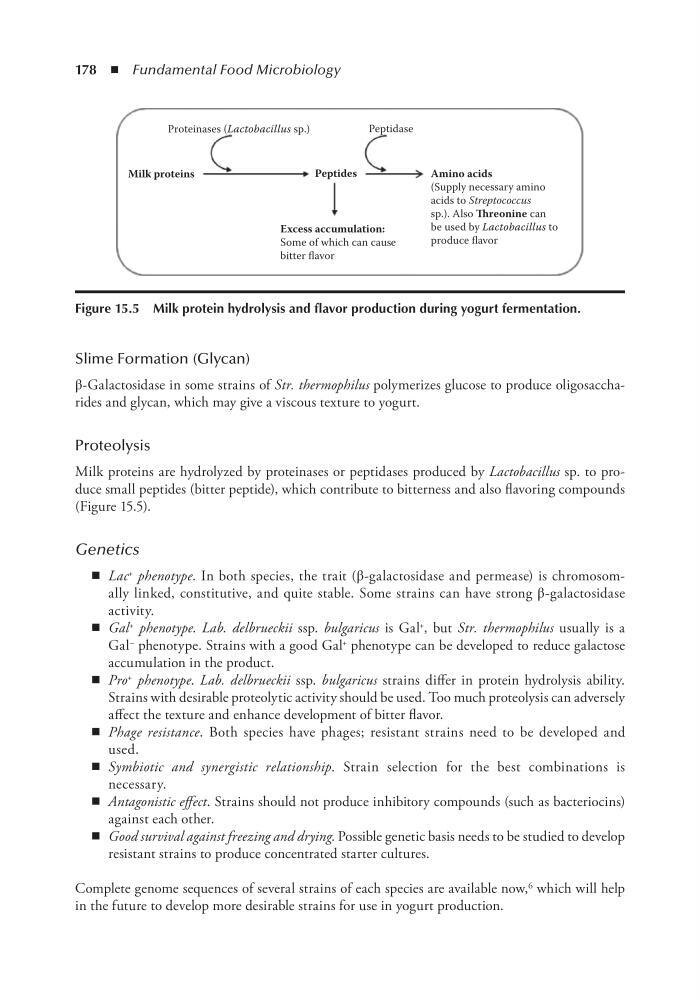
Milk proteins are hydrolyzed by proteinases or peptidases produced by Lactobacillus sp. to produce small peptides (bitter peptide), which contribute to bitterness and also flavoring compounds
(Figure 15.5).
Genetics
◾ Lac + phenotype. In both species, the trait (β-galactosidase and permease) is chromosomally linked, constitutive, and quite stable. Some strains can have strong β-galactosidase
activity.
◾ Gal + phenotype. Lab. delbrueckii ssp. bulgaricus is Gal + , but Str. thermophilus usually is a
Gal – phenotype. Strains with a good Gal + phenotype can be developed to reduce galactose
accumulation in the product.
◾ Pro + phenotype. Lab. delbrueckii ssp. bulgaricus strains differ in protein hydrolysis ability.
Strains with desirable proteolytic activity should be used. Too much proteolysis can adversely
affect the texture and enhance development of bitter flavor.
◾ Phage resistance. Both species have phages; resistant strains need to be developed and
used.
◾ Symbiotic and synergistic relationship. Strain selection for the best combinations is
necessary.
◾ Antagonistic effect. Strains should not produce inhibitory compounds (such as bacteriocins)
against each other.
◾ Good survival against freezing and drying. Possible genetic basis needs to be studied to develop
resistant strains to produce concentrated starter cultures.
Complete genome sequences of several strains of each species are available now, 6 which will help
in the future to develop more desirable strains for use in yogurt production.
Peptidase
Proteinases (Lactobacillus sp.)
Milk proteins
Peptides
Amino acids
(Supply necessary amino
acids to Streptococcus
sp.). Also reonine can
be used by Lactobacillus to
produce flavor
Excess accumulation:
Some of which can cause
bitter flavor
Figure 15.5 Milk protein hydrolysis and flavor production during yogurt fermentation.
Slime Formation (Glycan)
β-Galactosidase in some strains of Str. thermophilus polymerizes glucose to produce oligosaccharides and glycan, which may give a viscous texture to yogurt.
Proteolysis
Milk proteins are hydrolyzed by proteinases or peptidases produced by Lactobacillus sp. to produce small peptides (bitter peptide), which contribute to bitterness and also flavoring compounds
(Figure 15.5).
Genetics
◾ Lac + phenotype. In both species, the trait (β-galactosidase and permease) is chromosomally linked, constitutive, and quite stable. Some strains can have strong β-galactosidase
activity.
◾ Gal + phenotype. Lab. delbrueckii ssp. bulgaricus is Gal + , but Str. thermophilus usually is a
Gal – phenotype. Strains with a good Gal + phenotype can be developed to reduce galactose
accumulation in the product.
◾ Pro + phenotype. Lab. delbrueckii ssp. bulgaricus strains differ in protein hydrolysis ability.
Strains with desirable proteolytic activity should be used. Too much proteolysis can adversely
affect the texture and enhance development of bitter flavor.
◾ Phage resistance. Both species have phages; resistant strains need to be developed and
used.
◾ Symbiotic and synergistic relationship. Strain selection for the best combinations is
necessary.
◾ Antagonistic effect. Strains should not produce inhibitory compounds (such as bacteriocins)
against each other.
◾ Good survival against freezing and drying. Possible genetic basis needs to be studied to develop
resistant strains to produce concentrated starter cultures.
Complete genome sequences of several strains of each species are available now, 6 which will help
in the future to develop more desirable strains for use in yogurt production.
Peptidase
Proteinases (Lactobacillus sp.)
Milk proteins
Peptides
Amino acids
(Supply necessary amino
acids to Streptococcus
sp.). Also reonine can
be used by Lactobacillus to
produce flavor
Excess accumulation:
Some of which can cause
bitter flavor
Figure 15.5 Milk protein hydrolysis and flavor production during yogurt fermentation.