

Microbiology of Fermented Food Production ◾ 177
Flavor Production
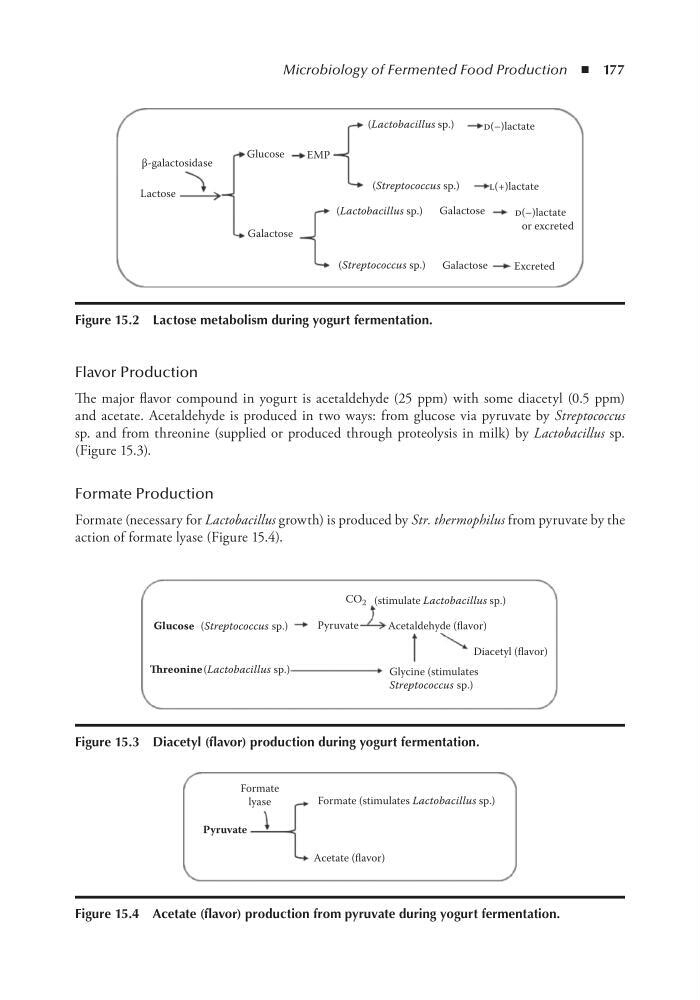
The major flavor compound in yogurt is acetaldehyde (25 ppm) with some diacetyl (0.5 ppm)
and acetate. Acetaldehyde is produced in two ways: from glucose via pyruvate by Streptococcus
sp. and from threonine (supplied or produced through proteolysis in milk) by Lactobacillus sp.
(Figure 15.3).
Formate Production
Formate (necessary for Lactobacillus growth) is produced by Str. thermophilus from pyruvate by the
action of formate lyase (Figure 15.4).
Glucose
EMP
Lactose
β-galactosidase
Galactose
Galactose
Galactose
Excreted
(+)lactate
(–)lactate
(–)lactate
(Streptococcus sp.)
(Streptococcus sp.)
(Lactobacillus sp.)
(Lactobacillus sp.)
or excreted
Figure 15.2 Lactose metabolism during yogurt fermentation.
Glucose
reonine
(Streptococcus sp.)
Glycine (stimulates
Streptococcus sp.)
(Lactobacillus sp.)
Pyruvate
Diacetyl (flavor)
Acetaldehyde (flavor)
CO 2 (stimulate Lactobacillus sp.)
Figure 15.3 Diacetyl (flavor) production during yogurt fermentation.
Pyruvate
Formate
lyase
Formate (stimulates Lactobacillus sp.)
Acetate (flavor)
Figure 15.4 Acetate (flavor) production from pyruvate during yogurt fermentation.
Flavor Production
The major flavor compound in yogurt is acetaldehyde (25 ppm) with some diacetyl (0.5 ppm)
and acetate. Acetaldehyde is produced in two ways: from glucose via pyruvate by Streptococcus
sp. and from threonine (supplied or produced through proteolysis in milk) by Lactobacillus sp.
(Figure 15.3).
Formate Production
Formate (necessary for Lactobacillus growth) is produced by Str. thermophilus from pyruvate by the
action of formate lyase (Figure 15.4).
Glucose
EMP
Lactose
β-galactosidase
Galactose
Galactose
Galactose
Excreted
(+)lactate
(–)lactate
(–)lactate
(Streptococcus sp.)
(Streptococcus sp.)
(Lactobacillus sp.)
(Lactobacillus sp.)
or excreted
Figure 15.2 Lactose metabolism during yogurt fermentation.
Glucose
reonine
(Streptococcus sp.)
Glycine (stimulates
Streptococcus sp.)
(Lactobacillus sp.)
Pyruvate
Diacetyl (flavor)
Acetaldehyde (flavor)
CO 2 (stimulate Lactobacillus sp.)
Figure 15.3 Diacetyl (flavor) production during yogurt fermentation.
Pyruvate
Formate
lyase
Formate (stimulates Lactobacillus sp.)
Acetate (flavor)
Figure 15.4 Acetate (flavor) production from pyruvate during yogurt fermentation.