

Biochemistry of Some Beneficial Traits ◾ 131
systems. 2–4 The same carbohydrate can be transported by the PEP-PTS system in one species and
by the permease system in another species. Similarly, in a species, some carbohydrates are transported by the PEP-PTS system, whereas others are transported by the permease system.
PEP-PTS System for Lactose Transport in Lactococcus lactis
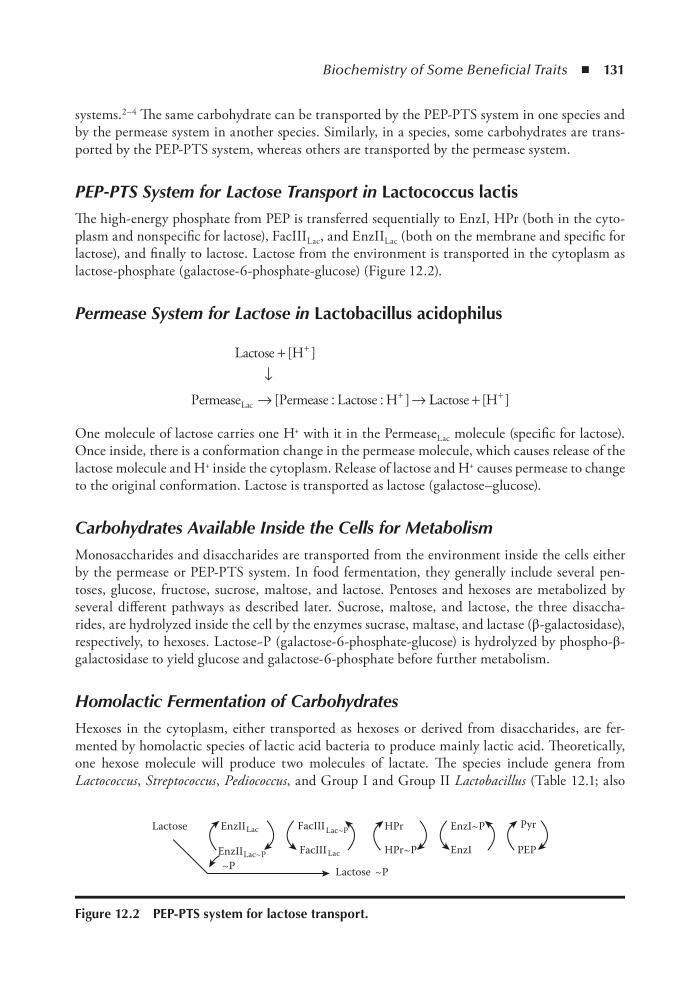
The high-energy phosphate from PEP is transferred sequentially to EnzI, HPr (both in the cytoplasm and nonspecific for lactose), FacIII Lac , and EnzII Lac (both on the membrane and specific for
lactose), and finally to lactose. Lactose from the environment is transported in the cytoplasm as
lactose-phosphate (galactose-6-phosphate-glucose) (Figure 12.2).
Permease System for Lactose in Lactobacillus acidophilus
Lactose H
Permease
Permease Lactose H
+
↓
→
:
:
→
+
+
[ ]
[
]
Lac
L Lactose +
+
[H ]
One molecule of lactose carries one H + with it in the Permease Lac molecule (specific for lactose).
Once inside, there is a conformation change in the permease molecule, which causes release of the
lactose molecule and H + inside the cytoplasm. Release of lactose and H + causes permease to change
to the original conformation. Lactose is transported as lactose (galactose–glucose).
Carbohydrates Available Inside the Cells for Metabolism
Monosaccharides and disaccharides are transported from the environment inside the cells either
by the permease or PEP-PTS system. In food fermentation, they generally include several pentoses, glucose, fructose, sucrose, maltose, and lactose. Pentoses and hexoses are metabolized by
several different pathways as described later. Sucrose, maltose, and lactose, the three disaccharides, are hydrolyzed inside the cell by the enzymes sucrase, maltase, and lactase (β-galactosidase),
respectively, to hexoses. Lactose~P (galactose-6-phosphate-glucose) is hydrolyzed by phospho-βgalactosidase to yield glucose and galactose-6-phosphate before further metabolism.
Homolactic Fermentation of Carbohydrates
Hexoses in the cytoplasm, either transported as hexoses or derived from disaccharides, are fermented by homolactic species of lactic acid bacteria to produce mainly lactic acid. Theoretically,
one hexose molecule will produce two molecules of lactate. The species include genera from
Lactococcus, Streptococcus, Pediococcus, and Group I and Group II Lactobacillus (Table 12.1; also
Lactose
EnzII Lac
FacIII Lac~P
FacIII Lac
EnzII Lac~P
~P
Lactose ~P
HPr
HPr~P
EnzI~P
EnzI
PEP
Pyr
Figure 12.2 PeP-PtS system for lactose transport.
systems. 2–4 The same carbohydrate can be transported by the PEP-PTS system in one species and
by the permease system in another species. Similarly, in a species, some carbohydrates are transported by the PEP-PTS system, whereas others are transported by the permease system.
PEP-PTS System for Lactose Transport in Lactococcus lactis
The high-energy phosphate from PEP is transferred sequentially to EnzI, HPr (both in the cytoplasm and nonspecific for lactose), FacIII Lac , and EnzII Lac (both on the membrane and specific for
lactose), and finally to lactose. Lactose from the environment is transported in the cytoplasm as
lactose-phosphate (galactose-6-phosphate-glucose) (Figure 12.2).
Permease System for Lactose in Lactobacillus acidophilus
Lactose H
Permease
Permease Lactose H
+
↓
→
:
:
→
+
+
[ ]
[
]
Lac
L Lactose +
+
[H ]
One molecule of lactose carries one H + with it in the Permease Lac molecule (specific for lactose).
Once inside, there is a conformation change in the permease molecule, which causes release of the
lactose molecule and H + inside the cytoplasm. Release of lactose and H + causes permease to change
to the original conformation. Lactose is transported as lactose (galactose–glucose).
Carbohydrates Available Inside the Cells for Metabolism
Monosaccharides and disaccharides are transported from the environment inside the cells either
by the permease or PEP-PTS system. In food fermentation, they generally include several pentoses, glucose, fructose, sucrose, maltose, and lactose. Pentoses and hexoses are metabolized by
several different pathways as described later. Sucrose, maltose, and lactose, the three disaccharides, are hydrolyzed inside the cell by the enzymes sucrase, maltase, and lactase (β-galactosidase),
respectively, to hexoses. Lactose~P (galactose-6-phosphate-glucose) is hydrolyzed by phospho-βgalactosidase to yield glucose and galactose-6-phosphate before further metabolism.
Homolactic Fermentation of Carbohydrates
Hexoses in the cytoplasm, either transported as hexoses or derived from disaccharides, are fermented by homolactic species of lactic acid bacteria to produce mainly lactic acid. Theoretically,
one hexose molecule will produce two molecules of lactate. The species include genera from
Lactococcus, Streptococcus, Pediococcus, and Group I and Group II Lactobacillus (Table 12.1; also
Lactose
EnzII Lac
FacIII Lac~P
FacIII Lac
EnzII Lac~P
~P
Lactose ~P
HPr
HPr~P
EnzI~P
EnzI
PEP
Pyr
Figure 12.2 PeP-PtS system for lactose transport.