

130 ◾ Fundamental Food Microbiology
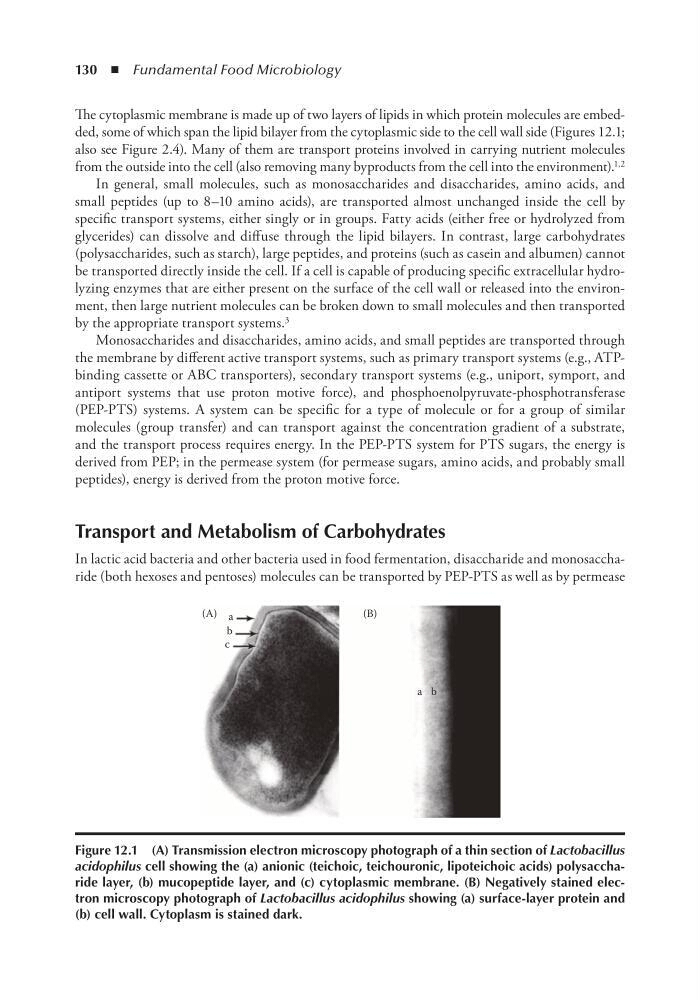
The cytoplasmic membrane is made up of two layers of lipids in which protein molecules are embedded, some of which span the lipid bilayer from the cytoplasmic side to the cell wall side (Figures 12.1;
also see Figure 2.4). Many of them are transport proteins involved in carrying nutrient molecules
from the outside into the cell (also removing many byproducts from the cell into the environment). 1,2
In general, small molecules, such as monosaccharides and disaccharides, amino acids, and
small peptides (up to 8–10 amino acids), are transported almost unchanged inside the cell by
specific transport systems, either singly or in groups. Fatty acids (either free or hydrolyzed from
glycerides) can dissolve and diffuse through the lipid bilayers. In contrast, large carbohydrates
(polysaccharides, such as starch), large peptides, and proteins (such as casein and albumen) cannot
be transported directly inside the cell. If a cell is capable of producing specific extracellular hydrolyzing enzymes that are either present on the surface of the cell wall or released into the environment, then large nutrient molecules can be broken down to small molecules and then transported
by the appropriate transport systems. 3
Monosaccharides and disaccharides, amino acids, and small peptides are transported through
the membrane by different active transport systems, such as primary transport systems (e.g., ATPbinding cassette or ABC transporters), secondary transport systems (e.g., uniport, symport, and
antiport systems that use proton motive force), and phosphoenolpyruvate-phosphotransferase
(PEP-PTS) systems. A system can be specific for a type of molecule or for a group of similar
molecules (group transfer) and can transport against the concentration gradient of a substrate,
and the transport process requires energy. In the PEP-PTS system for PTS sugars, the energy is
derived from PEP; in the permease system (for permease sugars, amino acids, and probably small
peptides), energy is derived from the proton motive force.
transport and Metabolism of Carbohydrates
In lactic acid bacteria and other bacteria used in food fermentation, disaccharide and monosaccharide (both hexoses and pentoses) molecules can be transported by PEP-PTS as well as by permease
(A) a
b
c
(B)
a b
Figure 12.1 (A) transmission electron microscopy photograph of a thin section of Lactobacillus
acidophilus cell showing the (a) anionic (teichoic, teichouronic, lipoteichoic acids) polysaccharide layer, (b) mucopeptide layer, and (c) cytoplasmic membrane. (B) negatively stained electron microscopy photograph of Lactobacillus acidophilus showing (a) surface-layer protein and
(b) cell wall. Cytoplasm is stained dark.
The cytoplasmic membrane is made up of two layers of lipids in which protein molecules are embedded, some of which span the lipid bilayer from the cytoplasmic side to the cell wall side (Figures 12.1;
also see Figure 2.4). Many of them are transport proteins involved in carrying nutrient molecules
from the outside into the cell (also removing many byproducts from the cell into the environment). 1,2
In general, small molecules, such as monosaccharides and disaccharides, amino acids, and
small peptides (up to 8–10 amino acids), are transported almost unchanged inside the cell by
specific transport systems, either singly or in groups. Fatty acids (either free or hydrolyzed from
glycerides) can dissolve and diffuse through the lipid bilayers. In contrast, large carbohydrates
(polysaccharides, such as starch), large peptides, and proteins (such as casein and albumen) cannot
be transported directly inside the cell. If a cell is capable of producing specific extracellular hydrolyzing enzymes that are either present on the surface of the cell wall or released into the environment, then large nutrient molecules can be broken down to small molecules and then transported
by the appropriate transport systems. 3
Monosaccharides and disaccharides, amino acids, and small peptides are transported through
the membrane by different active transport systems, such as primary transport systems (e.g., ATPbinding cassette or ABC transporters), secondary transport systems (e.g., uniport, symport, and
antiport systems that use proton motive force), and phosphoenolpyruvate-phosphotransferase
(PEP-PTS) systems. A system can be specific for a type of molecule or for a group of similar
molecules (group transfer) and can transport against the concentration gradient of a substrate,
and the transport process requires energy. In the PEP-PTS system for PTS sugars, the energy is
derived from PEP; in the permease system (for permease sugars, amino acids, and probably small
peptides), energy is derived from the proton motive force.
transport and Metabolism of Carbohydrates
In lactic acid bacteria and other bacteria used in food fermentation, disaccharide and monosaccharide (both hexoses and pentoses) molecules can be transported by PEP-PTS as well as by permease
(A) a
b
c
(B)
a b
Figure 12.1 (A) transmission electron microscopy photograph of a thin section of Lactobacillus
acidophilus cell showing the (a) anionic (teichoic, teichouronic, lipoteichoic acids) polysaccharide layer, (b) mucopeptide layer, and (c) cytoplasmic membrane. (B) negatively stained electron microscopy photograph of Lactobacillus acidophilus showing (a) surface-layer protein and
(b) cell wall. Cytoplasm is stained dark.