

94 ◾ Fundamental Food Microbiology
Sporulation
The transition from a normal vegetative cell cycle to sporulation in spore-forming bacteria is
triggered by the changes in the environmental parameters in which the cells are growing as well
as a high cell number existing in the environment. The environmental factors include reduction
in nutrient availability (particularly carbon, nitrogen, and phosphorous sources) and changes in
the optimum growth temperature, A W , and pH. 5 Transition from cell division cycle to sporulation is genetically controlled, involving many genes. A cell initiates sporulation only at the end of
completion of DNA replication. A triggering compound may be involved at that time for a cell to
decide to either go through normal cell division or to initiate steps for sporulation. The triggering
compound is probably synthesized when nutrition depletion and other unfavorable conditions
occur. Adenosine bistriphosphate (Abt) could be one of the triggering compounds as it is synthesized by spore formers under carbon or phosphorous depletion.
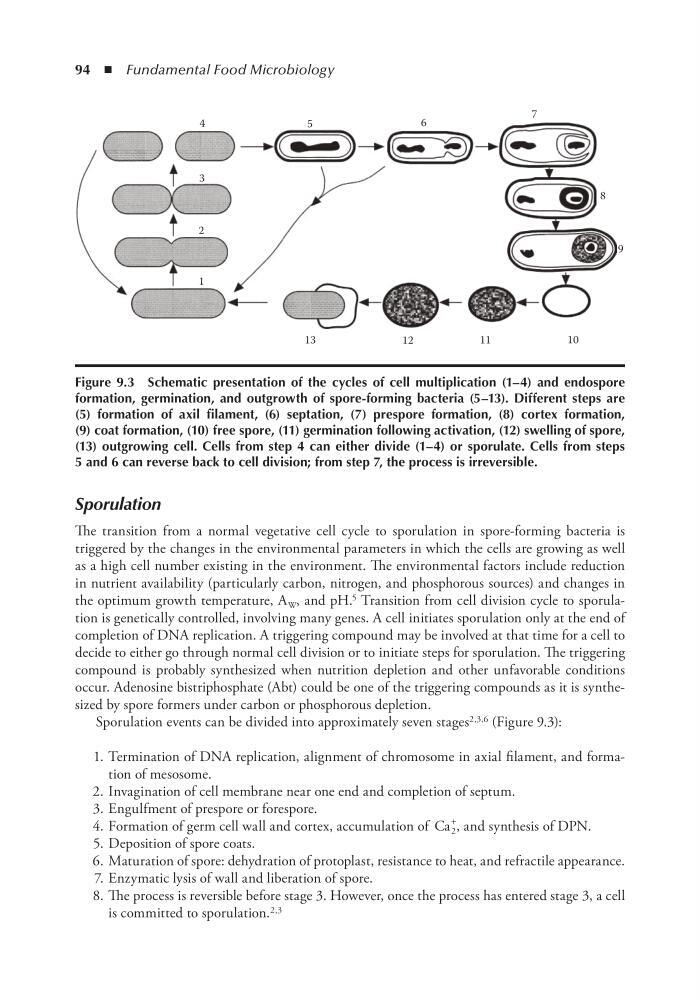
Sporulation events can be divided into approximately seven stages 2,3,6 (Figure 9.3):
1. Termination of DNA replication, alignment of chromosome in axial filament, and formation of mesosome.
2. Invagination of cell membrane near one end and completion of septum.
3. Engulfment of prespore or forespore.
4. Formation of germ cell wall and cortex, accumulation of Ca 2
+
, and synthesis of DPN.
5. Deposition of spore coats.
6. Maturation of spore: dehydration of protoplast, resistance to heat, and refractile appearance.
7. Enzymatic lysis of wall and liberation of spore.
8. The process is reversible before stage 3. However, once the process has entered stage 3, a cell
is committed to sporulation. 2,3
4
5
6
7
8
9
10
11
12
13
1
2
3
Figure 9.3 Schematic presentation of the cycles of cell multiplication (1–4) and endospore
formation, germination, and outgrowth of spore-forming bacteria (5–13). Different steps are
(5) formation of axil filament, (6) septation, (7) prespore formation, (8) cortex formation,
(9) coat formation, (10) free spore, (11) germination following activation, (12) swelling of spore,
(13) outgrowing cell. Cells from step 4 can either divide (1–4) or sporulate. Cells from steps
5 and 6 can reverse back to cell division; from step 7, the process is irreversible.
Sporulation
The transition from a normal vegetative cell cycle to sporulation in spore-forming bacteria is
triggered by the changes in the environmental parameters in which the cells are growing as well
as a high cell number existing in the environment. The environmental factors include reduction
in nutrient availability (particularly carbon, nitrogen, and phosphorous sources) and changes in
the optimum growth temperature, A W , and pH. 5 Transition from cell division cycle to sporulation is genetically controlled, involving many genes. A cell initiates sporulation only at the end of
completion of DNA replication. A triggering compound may be involved at that time for a cell to
decide to either go through normal cell division or to initiate steps for sporulation. The triggering
compound is probably synthesized when nutrition depletion and other unfavorable conditions
occur. Adenosine bistriphosphate (Abt) could be one of the triggering compounds as it is synthesized by spore formers under carbon or phosphorous depletion.
Sporulation events can be divided into approximately seven stages 2,3,6 (Figure 9.3):
1. Termination of DNA replication, alignment of chromosome in axial filament, and formation of mesosome.
2. Invagination of cell membrane near one end and completion of septum.
3. Engulfment of prespore or forespore.
4. Formation of germ cell wall and cortex, accumulation of Ca 2
+
, and synthesis of DPN.
5. Deposition of spore coats.
6. Maturation of spore: dehydration of protoplast, resistance to heat, and refractile appearance.
7. Enzymatic lysis of wall and liberation of spore.
8. The process is reversible before stage 3. However, once the process has entered stage 3, a cell
is committed to sporulation. 2,3
4
5
6
7
8
9
10
11
12
13
1
2
3
Figure 9.3 Schematic presentation of the cycles of cell multiplication (1–4) and endospore
formation, germination, and outgrowth of spore-forming bacteria (5–13). Different steps are
(5) formation of axil filament, (6) septation, (7) prespore formation, (8) cortex formation,
(9) coat formation, (10) free spore, (11) germination following activation, (12) swelling of spore,
(13) outgrowing cell. Cells from step 4 can either divide (1–4) or sporulate. Cells from steps
5 and 6 can reverse back to cell division; from step 7, the process is irreversible.