

Microbial Sporulation and Germination ◾ 93
Gram-negative Desulfotomaculum species. Among these, Bacillus, Alicyclobacillus, Clostridium,
and Desulfotomaculum are of considerable interest in food because they include species implicated
in food spoilage and foodborne diseases. 2–4 Several Bacillus and Clostridium species are used to
produce enzymes important in food bioprocessing.
In contrast to mold and yeast spores, bacterial cells produce endospores (inside a cell and one
spore per cell). During sporulation and until a spore emerges following cell lysis, a spore can be
located terminally, centrally, or off-center, causing bulging of the cell. Under a phase-contrast
microscope, spores appear as refractile spheroid or oval structures. The surface of a spore is
negatively charged and hydrophobic. Spores, as compared with vegetative cells, are much more
resistant to physical and chemical antimicrobial treatments, many of which are employed in
the processing and preservation of food. This is because the specific structure of bacterial spores
is quite different from that of the vegetative cells from which they are formed. From inside
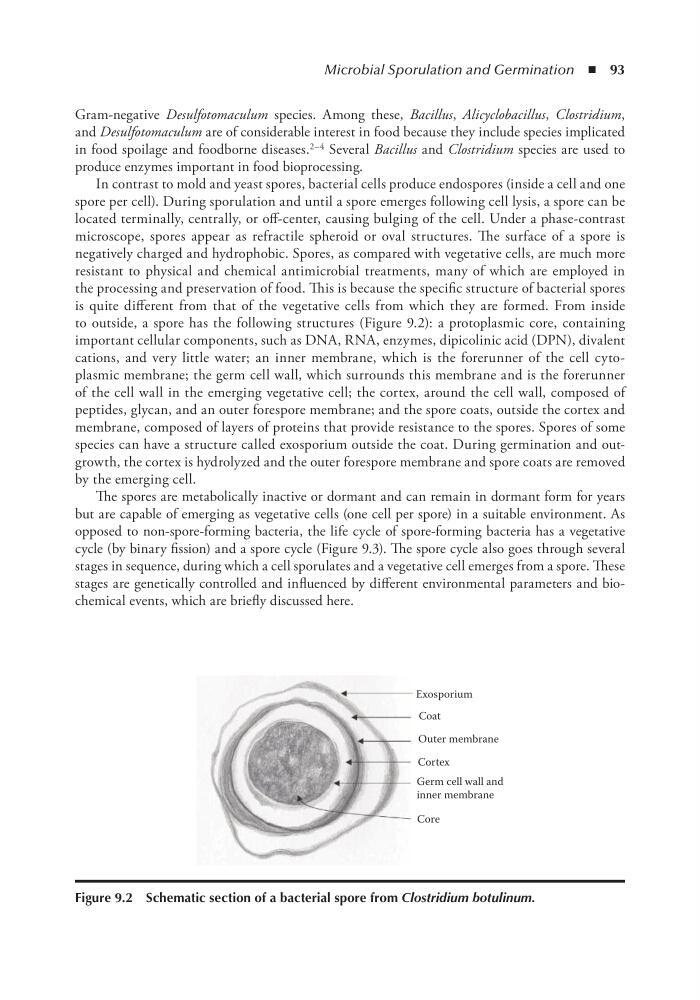
to outside, a spore has the following structures (Figure 9.2): a protoplasmic core, containing
important cellular components, such as DNA, RNA, enzymes, dipicolinic acid (DPN), divalent
cations, and very little water; an inner membrane, which is the forerunner of the cell cytoplasmic membrane; the germ cell wall, which surrounds this membrane and is the forerunner
of the cell wall in the emerging vegetative cell; the cortex, around the cell wall, composed of
peptides, glycan, and an outer forespore membrane; and the spore coats, outside the cortex and
membrane, composed of layers of proteins that provide resistance to the spores. Spores of some
species can have a structure called exosporium outside the coat. During germination and outgrowth, the cortex is hydrolyzed and the outer forespore membrane and spore coats are removed
by the emerging cell.
The spores are metabolically inactive or dormant and can remain in dormant form for years
but are capable of emerging as vegetative cells (one cell per spore) in a suitable environment. As
opposed to non-spore-forming bacteria, the life cycle of spore-forming bacteria has a vegetative
cycle (by binary fission) and a spore cycle (Figure 9.3). The spore cycle also goes through several
stages in sequence, during which a cell sporulates and a vegetative cell emerges from a spore. These
stages are genetically controlled and influenced by different environmental parameters and biochemical events, which are briefly discussed here.
Exosporium
Coat
Outer membrane
Cortex
Germ cell wall and
inner membrane
Core
Figure 9.2 Schematic section of a bacterial spore from Clostridium botulinum.
Gram-negative Desulfotomaculum species. Among these, Bacillus, Alicyclobacillus, Clostridium,
and Desulfotomaculum are of considerable interest in food because they include species implicated
in food spoilage and foodborne diseases. 2–4 Several Bacillus and Clostridium species are used to
produce enzymes important in food bioprocessing.
In contrast to mold and yeast spores, bacterial cells produce endospores (inside a cell and one
spore per cell). During sporulation and until a spore emerges following cell lysis, a spore can be
located terminally, centrally, or off-center, causing bulging of the cell. Under a phase-contrast
microscope, spores appear as refractile spheroid or oval structures. The surface of a spore is
negatively charged and hydrophobic. Spores, as compared with vegetative cells, are much more
resistant to physical and chemical antimicrobial treatments, many of which are employed in
the processing and preservation of food. This is because the specific structure of bacterial spores
is quite different from that of the vegetative cells from which they are formed. From inside
to outside, a spore has the following structures (Figure 9.2): a protoplasmic core, containing
important cellular components, such as DNA, RNA, enzymes, dipicolinic acid (DPN), divalent
cations, and very little water; an inner membrane, which is the forerunner of the cell cytoplasmic membrane; the germ cell wall, which surrounds this membrane and is the forerunner
of the cell wall in the emerging vegetative cell; the cortex, around the cell wall, composed of
peptides, glycan, and an outer forespore membrane; and the spore coats, outside the cortex and
membrane, composed of layers of proteins that provide resistance to the spores. Spores of some
species can have a structure called exosporium outside the coat. During germination and outgrowth, the cortex is hydrolyzed and the outer forespore membrane and spore coats are removed
by the emerging cell.
The spores are metabolically inactive or dormant and can remain in dormant form for years
but are capable of emerging as vegetative cells (one cell per spore) in a suitable environment. As
opposed to non-spore-forming bacteria, the life cycle of spore-forming bacteria has a vegetative
cycle (by binary fission) and a spore cycle (Figure 9.3). The spore cycle also goes through several
stages in sequence, during which a cell sporulates and a vegetative cell emerges from a spore. These
stages are genetically controlled and influenced by different environmental parameters and biochemical events, which are briefly discussed here.
Exosporium
Coat
Outer membrane
Cortex
Germ cell wall and
inner membrane
Core
Figure 9.2 Schematic section of a bacterial spore from Clostridium botulinum.